

Government Incentives for Conducting Energy Audits PowerPoint PPT Presentation
Title: Government Incentives for Conducting Energy Audits
1
Government Incentives for Conducting Energy Audits
Energy audits are essential for identifying
opportunities to improve energy efficiency and
reduce costs in both residential and commercial
buildings. Governments around the world recognize
the importance of these audits in promoting
sustainability and reducing energy consumption.
This document explores the various incentives
that governments may offer to encourage
individuals and businesses to conduct energy
audits.
Types of Government Incentives
- Financial Incentives
- Many governments provide financial incentives to
encourage energy audits. These can include - Grants and Rebates Some local or state
governments offer grants or rebates to cover a
portion of the costs associated with conducting
an energy audit. This can significantly reduce
the financial burden on homeowners and
businesses. - Tax Credits Certain jurisdictions provide tax
credits for the costs incurred during an energy
audit. This can incentivize property owners to
invest in energy efficiency improvements. - Low-Interest Loans Some programs offer
low-interest loans specifically for energy audits
and subsequent energy efficiency upgrades. This
makes it easier for property owners to finance
the upfront costs.
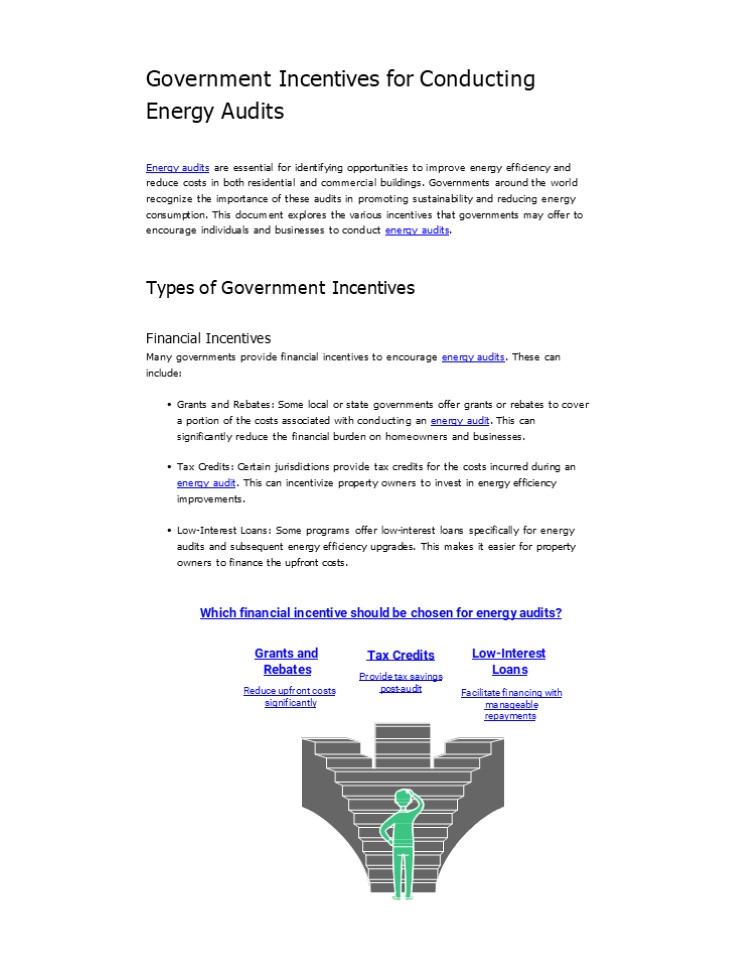
Which financial incentive should be chosen for
energy audits?
Low-Interest Loans Facilitate financing with
manageable repayments
Grants and Rebates Reduce upfront costs
significantly
Tax Credits Provide tax savings post-audit
2
- Technical Assistance
- In addition to financial support, governments may
offer technical assistance to help property
owners navigate the energy audit process. This
can include - Free or Subsidized Audits Some programs provide
free or subsidized energy audits conducted by
certified professionals. This ensures that
property owners have access to expert advice
without incurring high costs. - Training Programs Governments may sponsor
training programs for energy auditors, ensuring
that there is a skilled workforce available to
conduct audits effectively. - Regulatory Incentives
- Governments may also implement regulatory
measures that encourage energy audits - Building Codes Some regions have adopted
building codes that require energy audits for new
constructions or major renovations. This ensures
that energy efficiency is considered from the
outset. - Energy Efficiency Standards Governments may set
energy efficiency standards that require regular
audits for certain types of buildings,
particularly commercial properties. - Regulatory Cycle for Energy Audits
- Implement Building Codes
Improve Energy Efficiency
Set Efficiency Standards
Conduct Energy Audits Conclusion Government
incentives for conducting energy audits play a
crucial role in promoting energy efficiency and
sustainability. By providing financial support,
technical assistance, and regulatory measures,
governments can encourage property owners to
invest in energy audits, leading to reduced
energy consumption and lower utility costs. It is
essential for individuals and businesses to
explore the available incentives in their area to
take full advantage of these opportunities.
Recommended

