

China Straw paintings PowerPoint PPT Presentation
Title: China Straw paintings
1
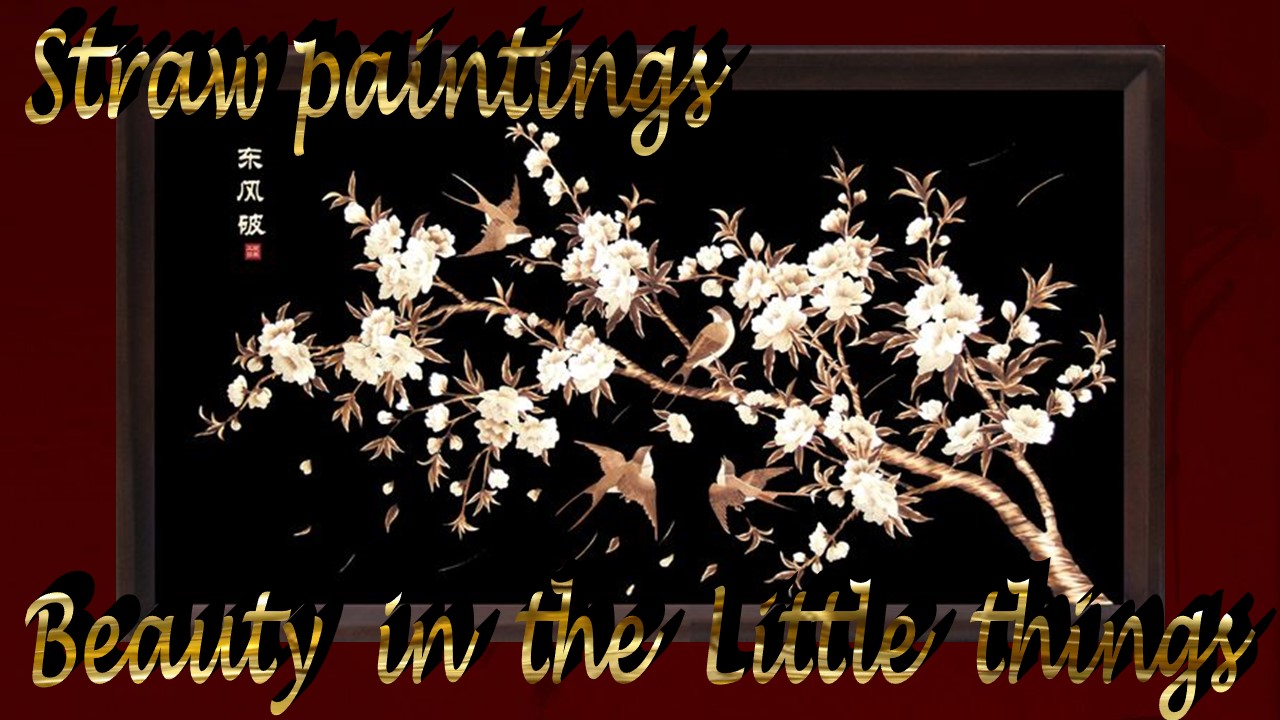
Straw paintings
Beauty in the Little things
2
Thoughtfully
3
(No Transcript)
4
(No Transcript)
5
(No Transcript)
6
(No Transcript)
7
Straw paintings are craft objects made by shaping
straw into patterns and representational
images. By modeling and playing with straw,
people, especially women, started weaving straw
into artistic objects. As time passed, they
acquired more skill in working with straw and a
century ago, created a very specific art, the art
of weaving straw into pictures by using and
combining the natural colours and shades of oats,
barley, rye, wheat, and other grasses. These
"paintings" have become a speciality of China,
Mexico, and Subotica in Serbia and its vicinity
8
(No Transcript)
9
Straw patchwork is a well-known Chinese art and
boasts a history of over 2000 years, as evidenced
by ancient relics. It traces its roots to folk
art, originating as handicrafts used by local
governments to pay tributes to emperors during
the Sui Dynasty. This artwork constitutes the
essence of Chinese folk art, and has a
distinctive national characteristic
10
(No Transcript)
11
Straw patchwork owes its popularity to its bright
vibrant colors which does not fade and its
simple, lifelike designs. The artifact is a
combination of primitive simplicity and elegance
of exquisite craftsmanship. Furthermore, it is
able to retain its original texture and color for
up to thousands of years without aging or fading
12
This ancient art disappeared for awhile but was
soon revived in the 1970s, when these ancient
straw patchwork relics were discovered. The
straw patchwork, with its excellent detailing
showcasing the works of talented Chinese artists,
are highly enjoyed and appreciated by both the
Chinese and Westerners.
13
The straw patchwork is used to both decorate and
beautify homes and offices, and is also often
given as gifts.
14
The peony the king of the flowers
15
Then what is wheat straw? Wheat straw has long
been regarded as a sacred object in Chinese
beliefs. It is said that Liu Xiu, the Dong Han
Dynasty emperor, was hunted by his enemies before
he ascended the throne. He had no choice but to
hide in wheat straw, which immediately changed
into wood to protect him.
16
Since patchwork wheat straw has been considered
a symbol of good fortune. So, the Chinese people
made wheat straw patchwork a unique art form
devoted to the royal court
17
(No Transcript)
18
(No Transcript)
19
Lady of Guo Country Goes Sightseeing in Spring by
Liu, has been collected by the Great Hall of the
People
20
Mrs. Chang - Ask God (Tian Wen), 70x120cm
21
Mrs. Chang - Light and song on the moon (85x115cm)
22
Mrs. Chang - Wooden snow (70x90cm)
23
Mrs. Chang Awakening (70x90cm)
Mrs. Chang - Birds and flowers (68x58cm)
24
Mrs. Chang The thousand- hand Bodhisattva
Mrs. Chang - Buddha (80x60cm)
25
Mrs. Chang Blue rose (90x130cm)
26
Mrs. Chang The blue bird in June(70x90cm)
27
Mrs. Chang - Time Light
28
Mrs. Chang - The Watcher in the wheat (85cm x
115cm)
29
Modem pieces are produced by combining modern
production techniques with the traditional
techniques
Mrs. Chang Moon on String, 79x90cm
30
Mrs. Chang - Fairies playing music
31
Modern art techniques are applied in the
manufacturing process, for example, evaporation,
dissection and ironing. But it is filled with a
rich Chinese countryside flavor
Mrs. Chang Li Hua in spring, 70x90cm
32
Mrs. Chang Morning Sun (70x90cm)
33
Mrs. Chang - God taking, 96x166cm
34
Mrs. Chang - Snow in South Wind (70x90cm)
35
The final products portray Chinese flowers,
birds, worms, landscapes, buildings, people and
fashions.
Mrs. Chang the thorn birds, abstract, 70x90cm
36
The quality of the workman ship combined
with outstanding artistry further contributes
to the work's lasting value
Mrs. Chang Lily (70x90cm)
37
Mrs. Chang Tian Yu, 100x150cm
38
Mrs. Chang Nirvana
39
Text and pictures Internet All copyrights belong
to their respective owners Presentation Sanda
Foisoreanu
2015
Sound Teresa Teng - Deng Lijun Tian
mi mi
Recommended

