

AI-in-Healthcare-Revolutionizing-Medicine PowerPoint PPT Presentation
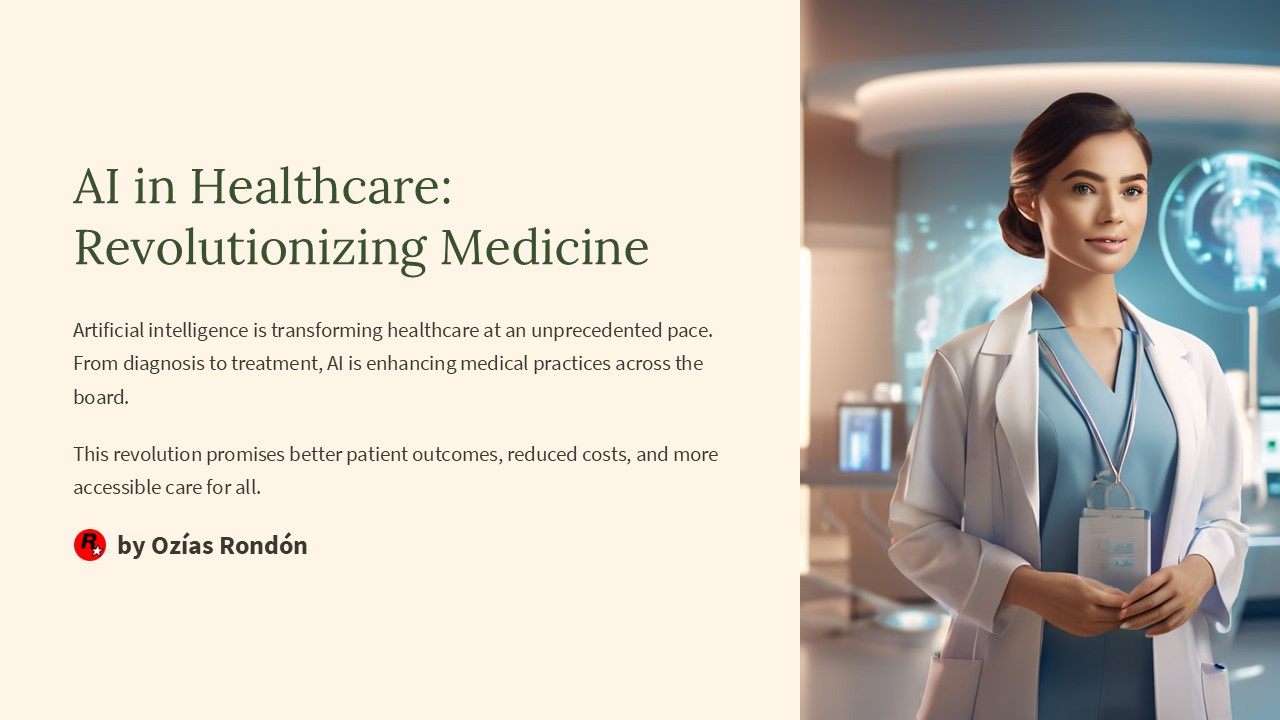
Title: AI-in-Healthcare-Revolutionizing-Medicine
1
AI in Healthcare Revolutionizing Medicine
Artificial intelligence is transforming
healthcare at an unprecedented pace. From
diagnosis to treatment, AI is enhancing medical
practices across the board.
This revolution promises better patient outcomes,
reduced costs, and more accessible care for all.
by Ozías Rondón
2
Introduction to AI in Healthcare
What is Medical AI?
Historical Development
AI in healthcare uses algorithms and software to
analyze complex medical data. It mimics human
cognition in analyzing complicated medical
information.
The journey began in the 1970s with expert
systems. Modern AI applications emerged in the
2010s with deep learning breakthroughs.
3
The Current State of AI in Healthcare
45B
28
6.6B
Market Size
Annual Growth
Investment
Expected global AI healthcare market by 2026.
Compound annual growth rate from 2022-2026.
Venture capital funding in 2021 alone.
4
AI-Powered Diagnostics
Radiology Revolution
Pathology Precision
Early Detection
AI systems predict health issues before symptoms
appear. They analyze risk factors and biomarkers
with remarkable precision.
AI algorithms detect subtle abnormalities in
X-rays, MRIs, and CT scans. They spot patterns
invisible to the human eye.
Digital pathology with AI analyzes tissue samples
with 99 accuracy. It reduces diagnostic time
from days to minutes.
5
AI in Drug Discovery and Development
Target Identification
1
AI analyzes biological data to identify promising
drug targets. It predicts protein structures and
interactions.
Compound Screening
2
Algorithms evaluate millions of chemical
compounds in days. Traditional methods would take
years.
Clinical Trial Optimization
3
AI predicts trial outcomes and identifies ideal
patient matches. It reduces failure rates and
accelerates approvals.
Manufacturing Distribution
4
Smart systems optimize production and supply
chains. They ensure medicines reach patients
efficiently.
6
Personalized Medicine and AI
Individualized Treatment
1
Precise therapy for each patient
Genetic Analysis
2
DNA mapping and interpretation
Patient Data Integration
3
Medical history and lifestyle factors
Population Health Data
4
Patterns across similar patients
AI analyzes thousands of variables to create
truly personalized treatment plans. The days of
one-size-fits-all medicine are ending.
7
AI-Assisted Surgery and Robotics
Pre-surgical Planning
Robotic Assistance
Real-time Guidance
Post-op Analysis
AI creates detailed 3D models from patient scans.
It simulates procedures and predicts
complications.
Surgical robots provide superhuman precision and
stability. They eliminate hand tremors and
enhance control.
AI provides surgeons with augmented reality
overlays. It highlights critical structures and
optimal paths.
Systems review surgical recordings to improve
techniques. They offer insights for continuous
improvement.
8
Virtual Health Assistants and Chatbots
Senior Care
Busy Professionals
Family Health
AI companions offer medication reminders and
symptom monitoring. They reduce isolation while
maintaining independence.
Quick triage and health advice between meetings.
Accessible healthcare that fits into hectic
schedules.
Symptom checking for concerned parents. Guidance
on when professional care is needed.
9
AI in Electronic Health Records (EHR)
Intelligent Documentation
AI transcribes doctor-patient conversations
automatically. It creates accurate notes without
distracting from care.
Predictive Analytics
Algorithms identify patients at risk for
readmission. They spot subtle warning signs for
proactive intervention.
Workflow Optimization
Smart systems prioritize tasks and alerts. They
reduce administrative burden by 40 on average.
Research Insights
De-identified data reveals population health
trends. It accelerates medical research and
evidence-based practices.
10
Wearable Devices and AI
Early Warning Systems
Continuous Monitoring
AI detects subtle changes preceding health
events. It can predict heart attacks hours before
symptoms appear.
Smartwatches and patches track vital signs 24/7.
They create comprehensive health profiles over
time.
1
2
Behavioral Insights
Treatment Adherence
Activity patterns reveal physical and mental
health status. Sleep quality, movement, and
social interactions tell a story.
Smart pill bottles and ingestible sensors track
medication use. They improve compliance with
treatment plans.
3
4
11
AI in Mental Health Care
Mood Analysis
AI analyzes text, voice, and facial expressions
to track mood states. It detects depression and
anxiety with 89 accuracy.
Crisis Intervention
Chatbots provide immediate support during mental
health crises. They connect users with human
resources when needed.
Therapy Enhancement
AI monitors progress and suggests personalized
strategies. It helps therapists optimize
treatment approaches.
Social Connection
Companion bots reduce isolation for vulnerable
populations. They provide consistent emotional
support and engagement.
12
Challenges in AI Healthcare Implementation
Trust Adoption
Integration Issues
Clinicians and patients may resist AI
recommendations. Building trust requires
transparency and proven results.
Regulatory Compliance
Legacy systems resist modern AI solutions.
Hospitals average 16 different electronic systems
that don't communicate.
Data Privacy Security
AI systems face strict approval processes. They
must prove safety and efficacy beyond traditional
software.
Medical data requires extraordinary protection.
Breaches can have devastating personal
consequences.
13
Overcoming AI Bias in Healthcare
Unbiased AI requires diverse data and development
teams. Healthcare algorithms must work equally
well for all populations.
Regular auditing and continuous improvement keep
systems fair. Transparency in how decisions are
made builds trust.
14
The Future of AI in Healthcare
Ambient Intelligence
1
Smart hospitals that anticipate needs
Digital Twins
2
Virtual replicas of patients
Nanorobotics
3
Microscopic treatment delivery
Brain-Computer Interfaces
4
Direct neural connections
The convergence of AI with 5G, quantum computing,
and IoT will create healthcare capabilities once
thought impossible. We're entering an era of
predictive, preventative medicine.
15
Economic Impact of AI in Healthcare
AI is projected to save the healthcare industry
over 150 billion annually by 2026. These savings
will help make advanced care more accessible.
New careers in healthcare AI will replace many
jobs that become automated. The transition
requires thoughtful planning.
16
Patient Empowerment through AI
Knowledge Access
Self-Monitoring
1
Medical information simplified
Health tracking with insights
2
4
Shared Decision-Making
Ongoing Support
3
Informed choices with doctors
Continuous guidance and education
AI transforms patients from passive recipients to
active partners in care. Knowledge and tools once
reserved for professionals are now accessible to
all.
17
Global Health and AI
Region
Challenge
AI Solution
Rural Africa
Doctor shortage
Smartphone diagnostics
South Asia
Disease outbreaks
Predictive monitoring
Remote Islands
Limited specialists
Telehealth with AI triage
Urban Slums
Poor sanitization
Pathogen detection systems
AI can democratize healthcare access globally.
Simple AI tools running on basic smartphones
bring expert-level care to underserved regions.
18
Preparing for an AI-Driven Healthcare Future
Education Reform
Infrastructure Updates
Policy Development
Medical curricula now include AI fundamentals.
Students learn to collaborate with intelligent
systems.
Hospitals are upgrading networks and systems.
Cloud computing and secure data pipelines support
AI tools.
New frameworks balance innovation with safety.
Regulations adapt to the unique challenges of
learning systems.
19
Case Studies AI Success Stories in Healthcare
Breast Cancer Detection
Diabetic Retinopathy
Stroke Treatment
1
2
3
Google Health's AI reduces false negatives by
9.4. A UK study showed it outperformed
radiologists.
IDx-DR system diagnoses eye disease with 87
sensitivity. FDA-approved for use without
specialist oversight.
Viz.ai's algorithm reduced treatment time by 66
minutes. This critical time-saving increases
survival rates significantly.
20
Call to Action Embrace AI for Better Health
For Healthcare Providers
For Patients
Explore AI tools that complement your expertise.
Start small with focused applications that solve
specific problems.
Ask about AI-powered options for your care.
Consider verified health apps that can monitor
and support your well-being.
For Everyone
Try Puravive, which uses AI-optimized natural
ingredients. This supplement supports metabolic
health and brown fat production.
The AI healthcare revolution is happening now.
Those who embrace it will enjoy better health
outcomes and more personalized care.
Recommended

