

111 PowerPoint PPT Presentation
Title: 111
1
Press Brake Training Boost
Efficiency and Safety
- I. Introduction
- Overview of Press Brake Training
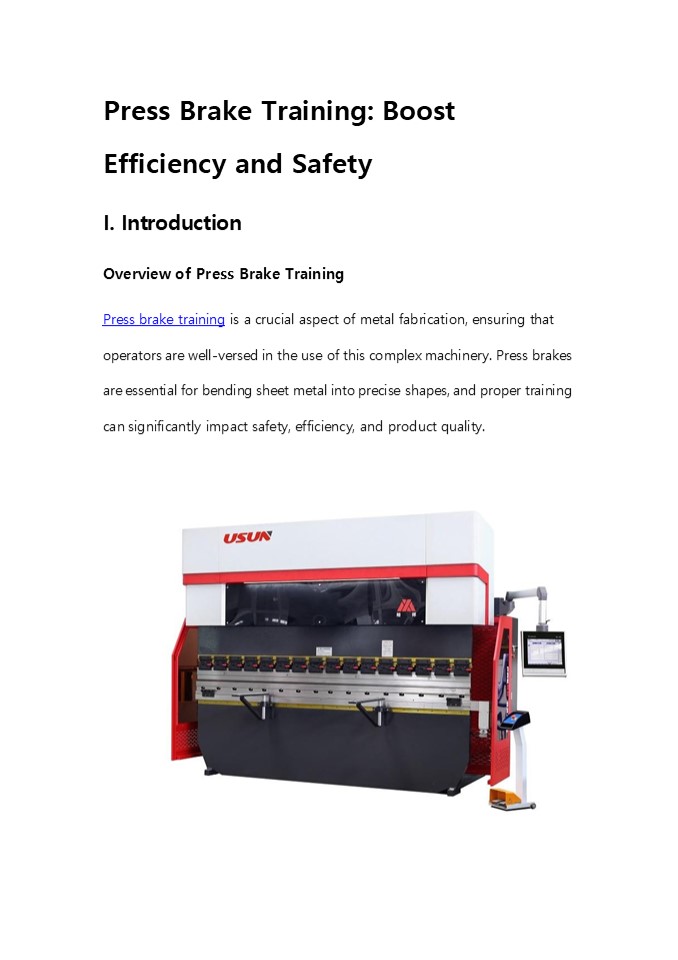
- Press brake training is a crucial aspect of metal
fabrication, ensuring that operators are
well-versed in the use of this complex machinery.
Press brakes are essential for bending sheet
metal into precise shapes, and proper training
can significantly impact safety, efficiency, and
product quality.
2
- Importance of Press Brake Training in Metal
Fabrication - Training on press brakes is vital because these
machines are integral to many metal fabrication
processes. A well-trained operator can maximize
the machine's capabilities, leading to higher
productivity and better-quality products. The
training typically covers various aspects,
including machine setup, material handling,
bending techniques, and maintenance procedures. - Impact on Safety, Efficiency, and Product Quality
- Safety Proper training ensures that operators
understand the potential hazards associated with
press brake operations. They learn to follow
safety protocols, - such as the correct use of personal protective
equipment (PPE), understanding emergency stop
functions, and recognizing pinch points. This
knowledge helps in preventing accidents and
injuries in the workplace. - Efficiency Skilled operators can set up and
adjust the press brake more quickly and
accurately, reducing downtime and material waste.
They can troubleshoot - common issues, maintain consistent production
speeds, and ensure that each bend is made
correctly on the first attempt, thereby enhancing
overall operational efficiency. - Product Quality Accurate press brake operation
is critical for achieving precise bends and
maintaining tight tolerances. Training helps
operators understand the - importance of factors like bend radius, material
thickness, and springback. This
3
knowledge ensures that the final products meet
the required specifications and quality
standards. Consequences of Improper
Operation Improper operation of a press brake
can lead to several negative outcomes
Safety Hazards Inadequate training can result in
serious accidents, including crush injuries and
amputations. Operators who are not familiar with
the machine's safety features are more likely to
make mistakes that could harm themselves or
others. Reduced Efficiency Without proper
training, operators may struggle with machine
setup and adjustments, leading to increased
downtime and reduced productivity. Inefficiencies
can also arise from frequent mistakes and the
need for rework. Poor Product Quality Incorrect
bending techniques can cause defects such as
incorrect angles, inconsistent bends, and
material cracking. These defects not only lead to
product rejections and increased scrap rates but
can also damage the company's reputation for
quality.
II. Getting Started with Press Brake
Training Prerequisites for Training Mechanical
Knowledge, Math, and Measuring Skills
4
Before embarking on press brake training, it's
essential to have a solid foundation in
mechanical knowledge. This includes understanding
basic principles of mechanics, materials, and the
function of various machine components.
Familiarity with common tools and their
applications is also crucial. Math skills are
equally important. Trainees should be comfortable
with basic arithmetic, algebra, and geometry, as
these are frequently used in calculating bend
allowances, angles, and other critical
dimensions. Measuring skills are imperative for
ensuring precision in metal forming. Trainees
must be adept with measuring instruments such as
calipers, micrometers, and tape measures to
verify dimensions and tolerances
accurately. Safety Awareness and Basic Computer
Skills Safety is paramount in any manufacturing
environment. Trainees should have a strong
awareness of workplace safety protocols,
including the proper use of personal protective
equipment (PPE), understanding hazard symbols,
and knowledge of emergency procedures.
Familiarity with safety standards and
regulations, such as OSHA guidelines, is highly
beneficial. Basic computer skills are
increasingly important in modern press brake
operations. Trainees should be comfortable using
computers to interact with CNC (Computer
Numerical Control) systems, access digital
manuals, and
5
utilize software for programming and
troubleshooting. Proficiency in using basic
office software and understanding file management
will also aid in handling digital documentation
and reports. Standard Training Curriculum Press
Brake Basics, Operation Skills, Programming, and
Control Systems The training curriculum begins
with an introduction to press brake basics. This
includes understanding the machine's components,
functions, and the types of operations it can
perform. Trainees learn about different types of
press brakes, such as hydraulic, mechanical, and
servo-electric, and their respective advantages
and applications. Operation skills training
covers the setup and execution of various bending
operations. This includes selecting and
installing appropriate tooling, setting up the
machine parameters, and performing test bends to
ensure accuracy. Trainees practice making
adjustments to achieve desired bend angles and
radii. Programming and control systems training
is critical for modern press brake operations.
Trainees learn to use CNC systems to create and
modify bending programs. This involves
understanding G-code, inputting bend sequences,
and optimizing programs for efficiency and
precision. Familiarity with control panel
interfaces and software navigation is emphasized.
6
Quality Control, Safety Operations, Maintenance,
and Troubleshooting Quality control training
focuses on ensuring that the final products meet
specified dimensions and tolerances. Trainees
learn to inspect and measure parts accurately,
identify defects, and implement corrective
actions. Understanding quality standards and
documentation practices is also covered. Safety
operations training reinforces the importance of
adhering to safety protocols. This includes safe
machine operation practices, proper handling of
materials, and emergency shutdown procedures.
Trainees are taught to recognize potential
hazards and take proactive measures to mitigate
risks. Maintenance and troubleshooting are vital
for the longevity and reliability of press
brakes. Trainees learn routine maintenance tasks
such as lubrication, inspection, and part
replacement. They also gain skills in diagnosing
common issues, such as alignment problems,
hydraulic leaks, and electrical faults, and
performing necessary repairs. Practical
Internships for Hands-On Experience Hands-on
experience is crucial for mastering press brake
operations. Practical internships provide
trainees with real-world exposure to press brake
environments. During these internships, trainees
apply their theoretical
7
knowledge to actual production scenarios, working
under the supervision of experienced operators
and technicians. Internships typically involve a
rotation through different departments, allowing
trainees to experience various aspects of press
brake operations. They participate in setup,
programming, operation, and maintenance tasks,
gaining a comprehensive understanding of the
workflow and challenges encountered in a
manufacturing setting. By the end of the training
program, trainees should be well-equipped with
the knowledge and skills needed to operate press
brakes safely and efficiently, ensuring
high-quality production and adherence to industry
standards.
III. Choosing the Right Press Brake Training
Program
Selecting an appropriate press brake training
program is crucial for enhancing the skills and
efficiency of operators. The right program can
significantly impact productivity, safety, and
the quality of metal forming operations. This
section will explore key factors to consider when
choosing a training program and the benefits of
manufacturer-led training. Factors to Consider
8
When evaluating press brake training programs,
several critical factors should be taken into
account to ensure the training meets the specific
needs of your operators and organization. Course
Content, Duration, and Format 1. Course Content
- Fundamentals Ensure the program covers basic
principles of press brake - operation, including machine setup, tooling, and
maintenance. - Advanced Techniques Look for courses that delve
into complex bending operations, precision
forming, and troubleshooting. - Safety Protocols Comprehensive training on
safety procedures to prevent accidents and
injuries.
2. Duration
- Short-term vs. Long-term Determine if the course
length aligns with - your operational needs. Short-term courses are
ideal for quick skill upgrades, while long-term
programs provide in-depth knowledge. - Flexible Scheduling Programs that offer flexible
scheduling can better accommodate the varying
availability of your workforce.
3. Format (Online vs. In-person)
9
- Online Training Offers convenience and
flexibility, allowing operators to - learn at their own pace. Ideal for theoretical
knowledge and basic skills. - In-person Training Provides hands-on
experience, essential for mastering practical
skills and real-world applications. Consider
hybrid models that combine both formats for
comprehensive training.
Training Provider's Reputation and Expertise 1.
Reputation
- Industry Recognition Choose providers with a
strong reputation in the - metal forming and manufacturing industry.
- Testimonials and Reviews Look for feedback from
past participants to gauge the effectiveness and
quality of the training.
2. Expertise
- Instructor Credentials Ensure instructors have
extensive experience and - technical expertise in press brake operations.
- Up-to-date Curriculum Training programs should
reflect the latest advancements and best
practices in the industry.
Cost and Location of Training Programs 1. Cost
10
- Budget Considerations Balance the cost of the
program with the - potential benefits and return on investment.
Higher upfront costs may be justified by improved
efficiency and reduced downtime. - Funding Options Explore if there are any grants,
subsidies, or employer-sponsored training
programs available.
2. Location
- Proximity Consider the location of in-person
training programs to - minimize travel expenses and downtime.
- On-site Training Some providers offer on-site
training, bringing the expertise directly to your
facility, which can be more convenient and
tailored to your specific equipment and
processes. - Training Provided by Manufacturers
- Manufacturer-led training programs offer several
unique advantages that can enhance the learning
experience and effectiveness of the training. - Advantages of Manufacturer-led Training Programs
- In-depth Product Knowledge
- Manufacturers have comprehensive knowledge of
their equipment, enabling them to provide
detailed and accurate training on
machine-specific features and capabilities.
11
- Customized Training
- Programs can be tailored to the specific models
and configurations of press brakes used in your
facility, ensuring that the training is highly
relevant and immediately applicable.
3. Access to Latest Updates
- Manufacturers often have the latest information
on technological - advancements, software updates, and best
practices, ensuring that your operators are
trained on the most current methods and tools.
4. Technical Support
- Direct training from manufacturers usually
includes ongoing technical - support and resources, providing operators with a
reliable point of contact for troubleshooting and
further assistance.
- Hands-on Experience
- Manufacturer-led programs typically offer
extensive hands-on training, allowing operators
to gain practical experience under the guidance
of experts who are intimately familiar with the
equipment. - IV. Safety Protocols and Maintenance
- Safety Measures
12
Importance of Safety Protocols and Personal
Protective Equipment In the realm of metal
processing and manufacturing, adherence to safety
protocols and the use of personal protective
equipment (PPE) are paramount. These measures are
designed to mitigate the risk of accidents and
injuries, ensuring a safe working environment for
all personnel. Safety protocols typically include
guidelines for operating machinery, handling
materials, and performing specific tasks. They
are grounded in industry standards and regulatory
requirements, such as those set by the
Occupational Safety and Health Administration
(OSHA) or international equivalents. Personal
protective equipment, such as helmets, gloves,
safety glasses, and ear protection, serves as the
first line of defense against potential hazards.
For instance, safety glasses protect against
flying debris during cutting or grinding
operations, while gloves safeguard hands from
sharp edges and hot surfaces. Proper training in
the use of PPE and regular audits to ensure
compliance are essential components of a
comprehensive safety strategy. Emergency
Procedures and Safety Controls Effective
emergency procedures and safety controls are
critical in preventing minor incidents from
escalating into major accidents. Emergency
procedures should be well-documented and easily
accessible, covering scenarios such as fires,
chemical spills, and equipment malfunctions.
Regular drills and training
13
sessions help ensure that all personnel are
familiar with these procedures and can act
swiftly in an emergency. Safety controls,
including emergency stop buttons, machine guards,
and lockout/tagout (LOTO) systems, play a crucial
role in safeguarding workers. Emergency stop
buttons must be strategically placed and clearly
marked, allowing for immediate shutdown of
machinery in case of an emergency. Machine guards
protect operators from moving parts, while LOTO
systems ensure that machines are properly shut
down and cannot be restarted during maintenance
or repair work. Implementing these controls and
regularly inspecting them for functionality are
vital to maintaining a safe working
environment. Maintenance Practices Daily and
Periodic Maintenance Tasks Regular maintenance is
essential to ensure the longevity and optimal
performance of machinery and equipment in metal
processing and manufacturing. Daily maintenance
tasks typically include checking and refilling
lubrication systems, inspecting machine
components for wear and tear, and cleaning work
areas to prevent accumulation of debris that
could cause malfunctions. Operators should also
verify that all safety features, such as guards
and emergency stop buttons, are in proper working
order.
14
Periodic maintenance, conducted weekly, monthly,
or annually, involves more comprehensive
inspections and servicing. This may include
replacing worn-out parts, calibrating machines to
maintain precision, and conducting detailed
inspections of critical components such as
bearings, belts, and hydraulic systems. Following
a structured maintenance schedule helps prevent
unexpected breakdowns and extends the lifespan of
equipment. Importance of Inspecting and
Maintaining Tooling and Components Inspecting and
maintaining tooling and components is crucial for
ensuring the quality and efficiency of
manufacturing processes. Tooling, such as cutting
tools, dies, and molds, must be regularly
inspected for signs of wear, chipping, or damage.
Using worn or damaged tooling can result
in poor-quality products, increased scrap rates,
and potential damage to machinery. Maintaining
components such as bearings, gears, and hydraulic
systems is equally important. Regular inspections
can identify issues such as misalignment,
insufficient lubrication, or excessive wear,
which can lead to machine failure if not
addressed promptly. Implementing a proactive
maintenance approach, where potential issues are
identified and resolved before they result in
downtime, is essential for maintaining
operational efficiency and reducing maintenance
costs.
15
V. Conclusion
In conclusion, the importance of press brake
training in the metal fabrication industry cannot
be overstated, as it is vital for ensuring
precision, efficiency, and safety in operations.
Proper training equips operators with the skills
needed to enhance precision and quality by
understanding the nuances of press brake
operations, interpreting technical drawings, and
reducing errors. Additionally, comprehensive
safety training minimizes the risks associated
with operating powerful machinery, while
improving operational efficiency by enabling
operators to set up and adjust press brakes
quickly. The reduction in errors and rework
further contributes to cost savings, decreasing
material wastage and machine maintenance. As
technology evolves, ongoing training is essential
for operators to adapt to advanced tools like CNC
press brakes, ensuring the workforce remains
proficient. When choosing and implementing
effective training programs, several key factors
must be considered. Programs should be customized
to fit the organizations specific needs, taught
by experienced instructors, and include a
comprehensive curriculum that covers all critical
aspects, from machine setup to troubleshooting.
Continuous learning through refresher courses
helps operators stay updated, while assessments
and feedback ensure training objectives are met.
Overall, investing in robust press brake training
is a strategic decision that leads to increased
productivity, safety, and quality,
16
ensuring that the workforce remains skilled and
prepared to meet the industry's evolving demands.
Recommended

