

Budgeting-Like-a-Pro-Take-Control-of-Your-Finances PowerPoint PPT Presentation
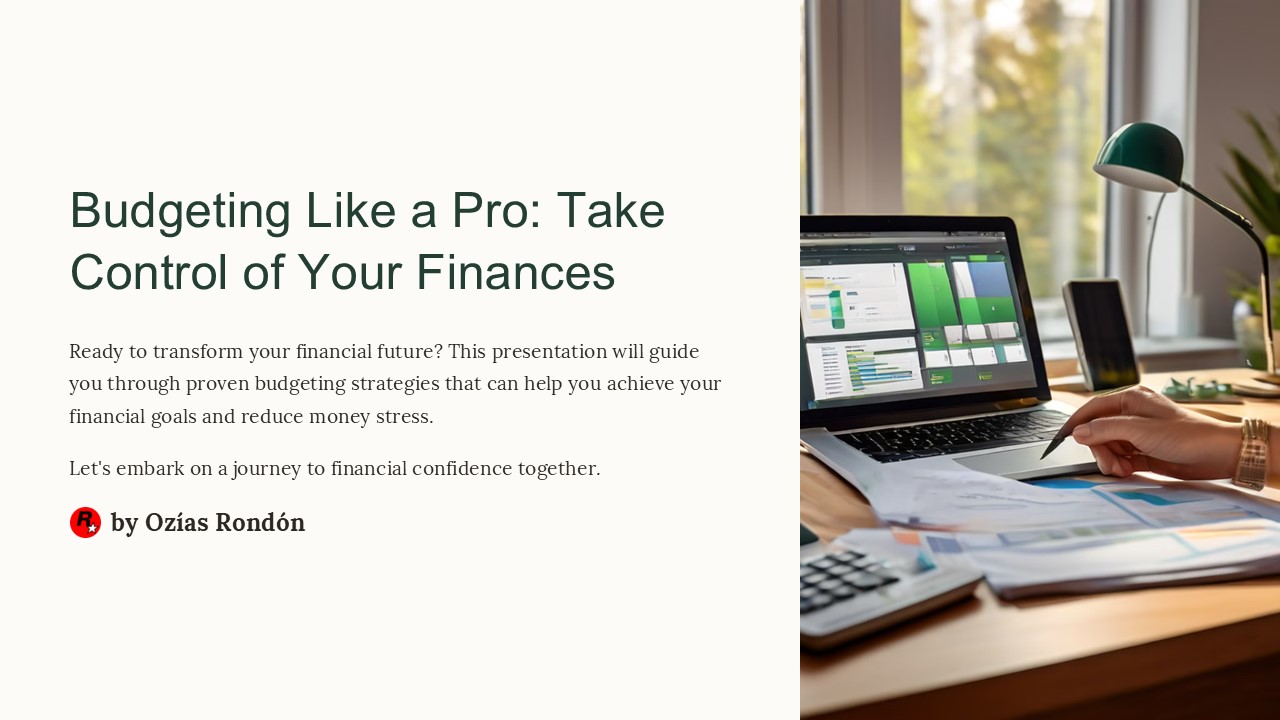
Title: Budgeting-Like-a-Pro-Take-Control-of-Your-Finances
1
Budgeting Like a Pro Take Control of Your
Finances
Ready to transform your financial future? This
presentation will guide you through proven
budgeting strategies that can help you achieve
your financial goals and reduce money stress.
Let's embark on a journey to financial confidence
together.
by Ozías Rondón
2
Why Budget? The Power of Financial Planning
Achieve Financial Goals
Reduce Money Stress
Knowing where your money goes eliminates
financial anxiety. You'll sleep better at night.
Budgeting creates a roadmap for reaching your
dreams. It turns vague wishes into concrete plans.
Gain Spending Control
Take charge of your finances instead of wondering
where your money disappeared to.
3
Common Budgeting Myths Debunked
"Budgeting is too restrictive"
"I don't make enough to budget"
Reality A good budget gives you freedom. It's a
spending plan that prioritizes what matters most
to you.
Reality Budgeting is even more crucial when
resources are limited. Every dollar needs clear
direction.
"I can track everything in my head"
Reality Studies show mental tracking leads to
overspending. Our brains aren't built for precise
financial memory.
4
The 50/30/20 Rule A Simple Budgeting Framework
30 for Wants
Lifestyle choices that enhance your life
- Dining out
50 for Needs
- Entertainment
Essential expenses you can't live without
- Travel
- Hobbies
- Housing and utilities
20 for Savings
- Groceries
Future financial security
- Transportation
- Healthcare
- Emergency fund
- Retirement
- Debt repayment
- Investments
5
Step 1 Calculate Your Monthly Income
Identify All Income Sources
List your salary, freelance work, side hustles,
rental income, and any other money coming in.
Focus on Take-Home Pay
Budget with after-tax amounts. This is what you
actually have available to spend.
Account for Irregular Income
Calculate averages for variable income. Create a
baseline for planning.
6
Step 2 Track Your Expenses
Fixed Expenses
Unchanging monthly costs like rent, car payments,
insurance premiums, and subscription services.
Variable Expenses
Fluctuating costs like groceries, dining out,
entertainment, and utilities that change monthly.
Periodic Expenses
Quarterly or annual costs like property taxes,
car maintenance, and holiday gifts.
7
Step 3 Set Financial Goals
Short-term Goals (0-1 year)
Build 1,000 emergency fund
Medium-term Goals (1-5 years)
Save for down payment or dream vacation
Long-term Goals (5 years)
Fund retirement or children's education
Write specific, measurable goals with deadlines.
"Save 20,000 for a home down payment by December
2025" is better than "save for a house."
8
Step 4 Create Your Budget Categories
Savings Investments
Financial security and growth
Quality of Life
Entertainment, hobbies, travel
Essential Expenses
Housing, utilities, food, transportation
Organize spending into clear categories that
match your priorities. Customize categories to
fit your unique lifestyle and goals.
9
Step 5 Allocate Funds to Each Category
Category
Amount
of Income
Housing
1,500
30
Food
600
12
Transportation
400
8
Savings
1,000
20
Entertainment
500
10
Other
1,000
20
Assign specific dollar amounts to each category.
Ensure the total equals your take-home pay. Be
realistic about your true spending habits.
10
Step 6 Choose Your Budgeting Method
Envelope System
Zero-Based Budgeting
Pay-Yourself-First
Cash-based method where you fill physical or
digital envelopes with allocated money for each
category.
Every dollar gets a job. Income minus expenses
equals zero.
Automatically save/invest first, then live on
what's left.
- Maximum control
- Simplest method
- Highly visual
- Highly intentional
- Automates saving
- Prevents overspending
- Works for variable income
- Minimal tracking needed
- Great for tactile learners
11
Step 7 Implement Your Budget
Start Fresh Monthly
Begin implementing your budget at the start of
the month. Update numbers based on your actual
income.
Set Up Tools
Choose digital apps or paper tracking systems.
Consistency matters more than the specific tool.
Automate Payments
Schedule bill payments and savings transfers.
Automation removes willpower from the equation.
Track Daily Spending
Record expenses as they happen. Small purchases
add up quickly and can derail your budget.
12
Step 8 Monitor and Adjust Regularly
Review Weekly
Analyze Monthly
Check your spending against your plan. Catch
issues before they become problems.
Compare actual spending to your budget. Look for
patterns and opportunities.
Adjust As Needed
Celebrate Wins
Reallocate funds between categories. Your budget
should evolve as your life changes.
Acknowledge progress and successes. Small
victories build financial confidence.
13
Dealing with Unexpected Expenses
Build Emergency Fund
Adjust Other Categories
Avoid Emergency Debt
Aim for 3-6 months of essential expenses. Start
with 1,000 and build from there.
Temporarily reduce "wants" spending. Redirect
funds to cover the unexpected expense.
Credit cards should be last resort. High interest
makes problems worse in the long run.
Plan for Irregular Expenses
Create sinking funds for predictable irregular
costs like car repairs or medical bills.
14
Strategies for Cutting Expenses
30
Housing Costs
Potential savings from downsizing or finding a
roommate
40
Food Budget
Average reduction from meal planning and cooking
at home
1,348
Annual Subscription Waste
What average American spends on unused
subscriptions
5
Bill Negotiation
Typical savings from calling service providers
and negotiating rates
15
Increasing Your Income
Boosting income often has more potential than
cutting expenses. Invest time in developing
skills that can increase your earning power.
16
Avoiding Common Budgeting Pitfalls
Overly Restrictive Budgets
1
Allow flexibility and fun money. Extreme
restriction leads to budget rebellion and binge
spending.
Forgetting Irregular Expenses
2
Account for annual costs like insurance premiums,
holidays, and maintenance needs.
Misaligned Values
3
Ensure your budget reflects your true priorities.
Your spending should match what matters most to
you.
Ignoring Partner Input
4
Create budgets together if finances are shared.
Both parties need buy-in for success.
17
Tools for Successful Budgeting
Budgeting Apps
Spreadsheet Templates
Automated Savings Tools
Digital tools like Mint, YNAB, and EveryDollar
that sync with bank accounts to automatically
categorize transactions.
Customizable Excel or Google Sheets templates
that give you complete control over your budget
format.
Apps like Qapital and Acorns that make saving
effortless through automation and round-ups.
18
The Psychology of Budgeting
Childhood Money Messages
Emotional State
Social Comparison
Financial Knowledge
Willpower
Successful budgeting is more psychological than
mathematical. Understand your money triggers and
beliefs to create lasting financial change.
19
Recap Key Steps to Budget Like a Pro
Track Income Expenses
Set Clear Goals
Choose a Method
Monitor Adjust
Give your money purpose and direction.
Find a budgeting system that works for you.
Regularly review and refine your budget.
Know your numbers before making a plan.
Remember The best budget is one you'll actually
follow. Start simple and build consistency before
adding complexity.
20
Take Your Finances to the Next Level!
Join Millionaire Partner System
Exclusive Member Benefits
Start Today!
- Step-by-step video courses
Visit millionairepartnership.com/webclass-d24
Transform your financial life with expert
guidance. Our comprehensive system takes you
beyond basic budgeting.
- Powerful wealth-building strategies
Your financial freedom journey awaits!
- Community of success-minded peers
Recommended

