

Data Annotation Tools Guide: Which One Fits Your Needs? PowerPoint PPT Presentation
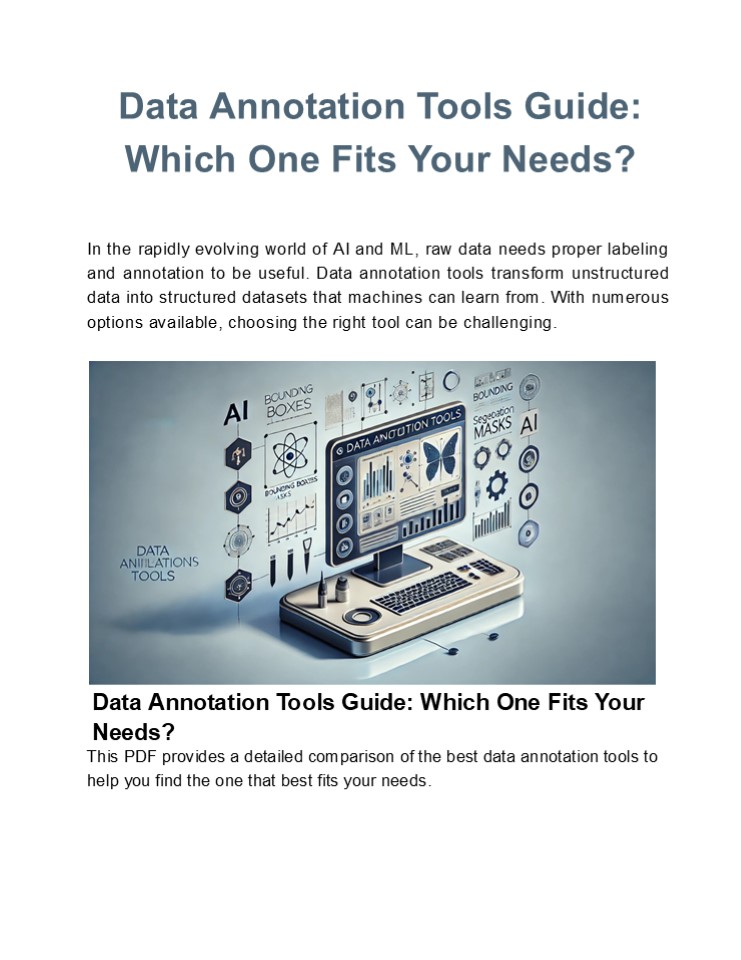
Title: Data Annotation Tools Guide: Which One Fits Your Needs?
1
Data Annotation Tools Guide Which One Fits Your
Needs?
In the rapidly evolving world of AI and ML, raw
data needs proper labeling and annotation to be
useful. Data annotation tools transform
unstructured data into structured datasets that
machines can learn from. With numerous options
available, choosing the right tool can be
challenging.
Data Annotation Tools Guide Which One Fits Your
Needs?
This PDF provides a detailed comparison of the
best data annotation tools to help you find the
one that best fits your needs.
2
Understanding Data Annotation and Its
Importance Data annotation involves tagging
data to make it interpretable by machines. This
process is crucial in training ML models, as it
helps them recognize patterns, make predictions,
and improve accuracy over time. Whether its
annotating images, videos, text, or audio,
choosing the right data annotation tool can
greatly influence the success of your AI
projects.
Key Features to Look for in Data Annotation Tools
Before diving into comparison, it's essential to
understand the data annotation tool features
that matter most
1. User-Friendly Interface A tool should be
user-friendly, allowing even those without
technical expertise to navigate it easily. 2.
Scalability It should accommodate the growing
needs of your project as it evolves. 3.
Automation Capabilities Features like
auto-labeling can save time and reduce manual
efforts. 4. Collaboration Features Support for
teamwork, allowing multiple users to work on a
project simultaneously. 5. Integration with ML
Platforms Seamless integration with popular ML
platforms ensures a smooth workflow. 6. Support
for Multiple Data Types The ability to annotate
various data types, such as images, videos,
text, and audio.
Top Data Annotation Tools Comparison Here, we
compare some of the best data annotation tools
available today, evaluating them based on the
features mentioned above.
3
1. Labelbox
Features Labelbox is a versatile tool offering a
user-friendly interface, automation capabilities,
and robust collaboration features. It supports
various data types and integrates well with
popular ML platforms like TensorFlow and PyTorch.
Pros User-friendly interface, scalable
solutions, and robust community support. Cons
Higher cost, which may be prohibitive for smaller
teams. Best For Large teams working on complex
AI projects.
?
?
? ?
2. SuperAnnotate
Features Renowned for its robust automation
features, SuperAnnotate facilitates annotation
for images, videos, and text. It also provides
extensive collaboration features, making it ideal
for team projects. Pros High-quality
annotations, excellent collaboration features,
and strong customer support. Cons Limited
integrations compared to competitors.
?
?
? ?
Best
For
Projects
requiring
high-quality
annotations
and team
collaboration.
3. V7
Features V7 offers a blend of automation and
manual annotation tools, with strong support for
image and video data. It also integrates
seamlessly with ML platforms. Pros Robust
automation, flexible workflow, and good
integration options. Cons Higher learning curve
for new users. Best For Experienced users
working on image and video data labeling.
?
? ? ?
4
4. Hive Data
Features Hive Data provides a comprehensive
platform for large-scale data annotation
projects, particularly in the areas of image and
video labeling. It offers strong AI-powered
automation features and excellent scalability.
?
Pros
Scalable
solutions,
powerful AI tools, and industry-specific
?
applications. Cons It may not be suitable for
small projects due to its complexity. Best For
Large enterprises with extensive data annotation
needs.
? ?
Factors to consider for Data Annotation
Software and Data Labeling Tools
1. Data Annotation Software Reviews
?
Objective Feedback Reviews provide insights into
the user experience, highlighting the strengths
and weaknesses of various data annotation tools.
Comparative Analysis Reading reviews allows you
to evaluate tools in terms of usability,
features, customer support, and cost. User
Recommendations Reviews often include real-world
use cases, helping you determine if a tool meets
your specific needs.
?
?
2. Data Labeling Tools For Machine Learning
?
Critical for Model Training Data labeling tools
are essential for preparing accurate datasets
that train machine learning models effectively.
Automation and Precision These tools often
incorporate automation to speed up labeling
processes while ensuring high precision. Variety
of Data Types They support labeling for various
data types, including images, text, and video,
making them versatile for different ML
applications.
?
?
5
3. Data Annotation Tools For AI Projects
?
Key to Success High-quality data annotation is
fundamental for the success of AI projects, as it
directly impacts the accuracy of AI models.
Scalability These tools must handle large
volumes of data efficiently, enabling AI projects
to scale without compromising quality.
Customizable Features Many tools offer
customization options to cater to the specific
requirements of different AI projects.
?
?
Data Annotation Service Providers A Reliable
Alternative
Outsourcing to data annotation service providers
like EnFuse Solutions India is a practical
choice for businesses lacking the resources to
handle data annotation in-house. EnFuse
Solutions offers tailored data labeling solutions
with expert teams and advanced tools, ensuring
high-quality annotations and letting your team
focus on core activities. Conclusion
Selecting the right data annotation tool is
crucial for your AI projects success. Whether
you need scalability, cost-effectiveness, or
advanced features like AI-assisted annotation,
this data labeling tools comparison guide should
help you make an informed decision. For
customized solutions, EnFuse Solutions India
offers expert services combining advanced
technology with human insight, ensuring accurate
and efficient data labeling. Explore your options
and choose the tool that will elevate your AI
projects to new heights. Read more
The Future Of Gaming Is Here How Game
Developers Leverage
Annotation Tools To Create Richer Gaming
Experiences
Recommended

