

Complete Guide to Ball Clay Uses And Properties PowerPoint PPT Presentation
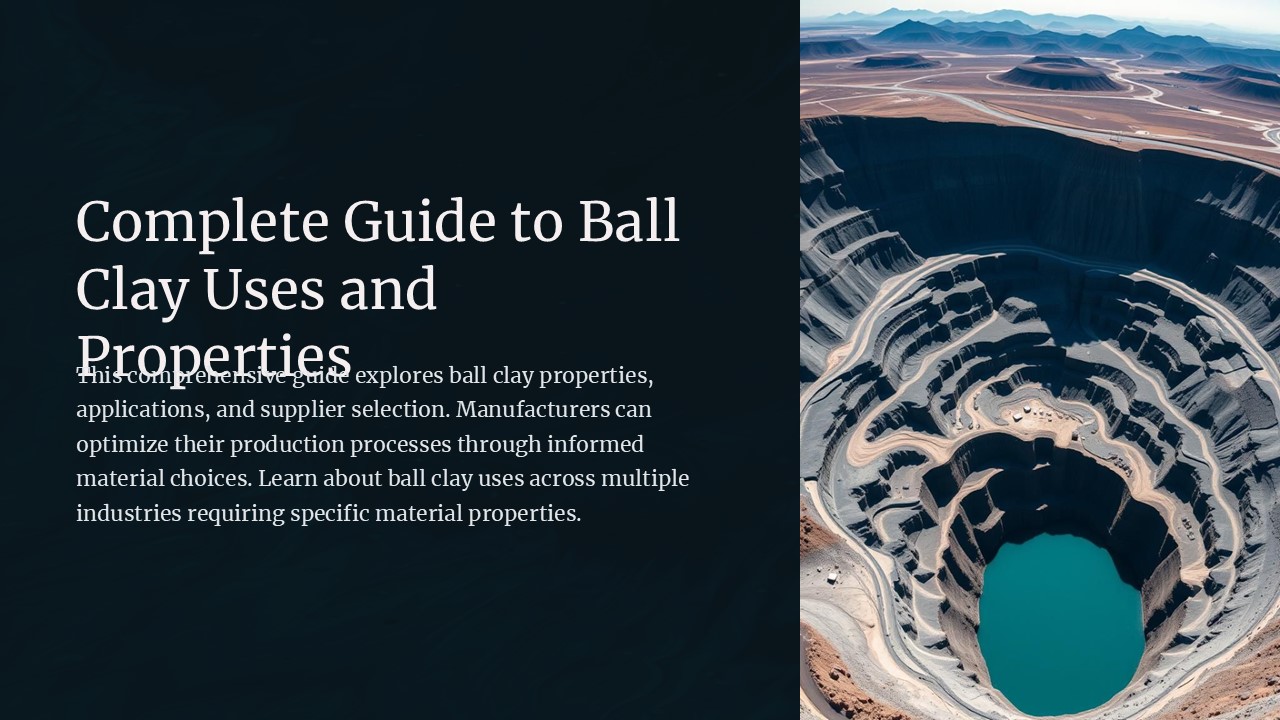
Title: Complete Guide to Ball Clay Uses And Properties
1
Complete Guide to Ball Clay Uses and Properties
This comprehensive guide explores ball clay
properties, applications, and supplier selection.
Manufacturers can optimize their production
processes through informed material choices.
Learn about ball clay uses across multiple
industries requiring specific material properties.
2
Understanding Ball Clay Properties
Physical Characteristics
Chemical Properties
Firing Properties
- High plasticity when mixed with water.
- Varying amounts of silica and alumina.
- Heat treatment changes the molecular structure.
- Exceptional binding strength.
- Impurities create distinctive coloring.
- Color changes indicate firing stages.
- Raw deposits contain organic matter.
- Silicon dioxide is 60 of the composition.
- Shrinkage depends on moisture content.
Manufacturing industries require high-quality raw
materials. Ball clay properties are essential for
producing ceramic and construction products.
3
Processing Ball Clay for Optimal Use
Mechanical Processing
Breaks down large particles into uniform sizes
for consistent application.
Screening
Separates different particle size distributions
to meet specific requirements.
Moisture Control
Maintains consistent product quality by
regulating moisture levels during processing.
Refine raw clay materials using specialized
equipment in manufacturing facilities. Advanced
milling ensures precise particle size reduction.
4
Ball Clay vs. Kaolin
Ball Clay
Kaolin
- Higher plasticity.
- Lower plasticity.
- Off-white to cream after firing.
- Pure white after firing.
- Finer particle size.
- Coarser particle size.
- Higher organic content.
- Lower organic content.
Material composition creates distinct differences
in manufacturing applications. Processing
requirements differ significantly between these
two essential ceramic materials.
5
Essential Ball Clay Uses
Ceramics
Construction
Enhances plasticity and workability for shaping
and molding.
Improves binding strength and structural
integrity in building materials.
Refractories
Increases thermal shock resistance in
high-temperature applications.
The versatile nature of ball clay makes it
valuable across numerous industrial applications.
Manufacturing sectors worldwide depend on this
material.
6
Optimizing Ceramic Production with Ball Clay
Mixing
1
Combine ball clay with other ingredients.
Molding
2
Shape the mixture into desired forms.
Firing
3
Harden the molded objects at high temperatures.
Glazing
4
Apply surface coatings for enhanced aesthetics
and protection.
Ball clay enhances plasticity and workability,
making it ideal for shaping ceramics. Controlled
firing temperatures ensure product quality and
durability.
7
Selecting Ball Clay Suppliers
Consistent Quality
Timely Delivery
Competitive Pricing
Ensures reliable performance.
Minimizes production delays.
Optimizes costs.
Supplier selection impacts production efficiency,
product quality, and overall costs. Consider
these factors when selecting ball clay suppliers.
8
Key Takeaways Next Steps
Strategic Material Choice
Supplier Evaluation
Quality, delivery, and cost are critical.
Ball clay selection impacts manufacturing
outcomes.
Continuous Improvement
Optimize processes for better results.
Understand ball clay properties, applications,
and supplier selection. Optimize your production
processes through informed material choices.
9
contact us harsh_at_thesharadgroup.com 91 8469219999
https//thesharadgroup.com/
Recommended

