

Secondary Macronutrients: Essential for Balanced Crop Nutrition PowerPoint PPT Presentation
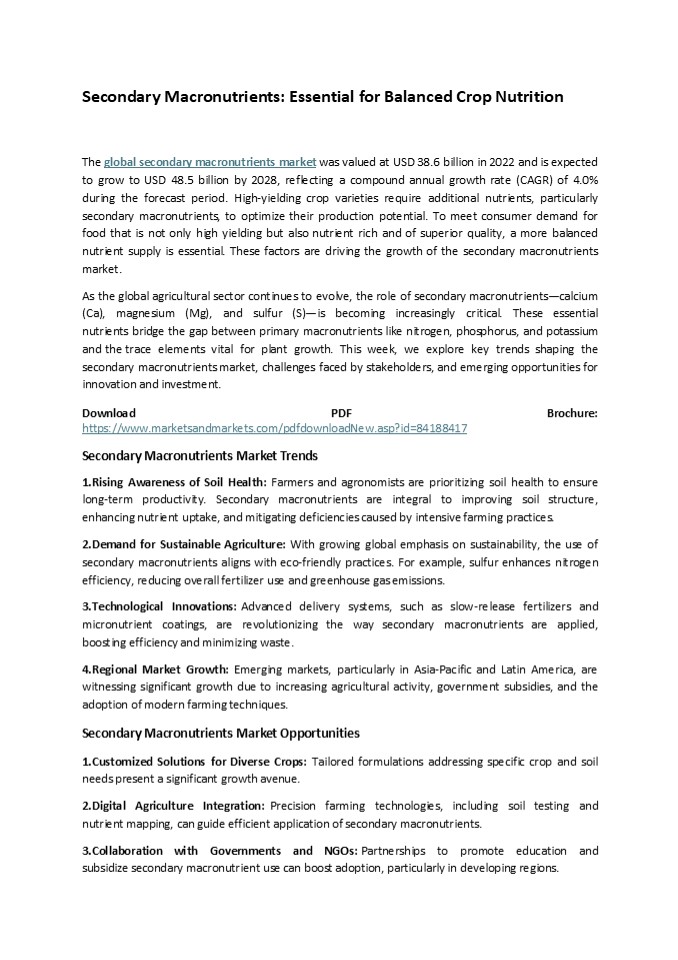
Title: Secondary Macronutrients: Essential for Balanced Crop Nutrition
1
Secondary Macronutrients Essential for Balanced
Crop Nutrition
- The global secondary macronutrients market was
valued at USD 38.6 billion in 2022 and is
expected to grow to USD 48.5 billion by 2028,
reflecting a compound annual growth rate (CAGR)
of 4.0 during the forecast period. High-yielding
crop varieties require additional nutrients,
particularly secondary macronutrients, to
optimize their production potential. To meet
consumer demand for food that is not only high
yielding but also nutrient rich and of superior
quality, a more balanced nutrient supply is
essential. These factors are driving the growth
of the secondary macronutrients market. - As the global agricultural sector continues to
evolve, the role of secondary macronutrientscalci
um (Ca), magnesium (Mg), and sulfur (S)is
becoming increasingly critical. These
essential nutrients bridge the gap between
primary macronutrients like nitrogen, phosphorus,
and potassium and the trace elements vital for
plant growth. This week, we explore key
trends shaping the secondary macronutrients
market, challenges faced by stakeholders, and
emerging opportunities for innovation and
investment. - Download PDF Brochure https//www.marketsandmarke
ts.com/pdfdownloadNew.asp?id84188417 - Secondary Macronutrients Market Trends
- Rising Awareness of Soil Health Farmers and
agronomists are prioritizing soil health to
ensure long-term productivity. Secondary
macronutrients are integral to improving
soil structure, enhancing nutrient uptake, and
mitigating deficiencies caused by intensive
farming practices. - Demand for Sustainable Agriculture With growing
global emphasis on sustainability, the use of
secondary macronutrients aligns with eco-friendly
practices. For example, sulfur enhances nitrogen
efficiency, reducing overall fertilizer use and
greenhouse gas emissions. - Technological Innovations Advanced delivery
systems, such as slow-release fertilizers
and micronutrient coatings, are
revolutionizing the way secondary
macronutrients are applied, boosting efficiency
and minimizing waste. - Regional Market Growth Emerging markets,
particularly in Asia-Pacific and Latin America,
are witnessing significant growth due to
increasing agricultural activity, government
subsidies, and the adoption of modern farming
techniques. - Secondary Macronutrients Market Opportunities
- Customized Solutions for Diverse Crops Tailored
formulations addressing specific crop and soil
needs present a significant growth avenue. - Digital Agriculture Integration Precision
farming technologies, including soil testing
and nutrient mapping, can guide efficient
application of secondary macronutrients. - Collaboration with Governments and NGOs
Partnerships to promote education and
subsidize secondary macronutrient use can boost
adoption, particularly in developing regions.
2
Make an Inquiry https//www.marketsandmarkets.com
/Enquiry_Before_BuyingNew.asp?id84188417 Calcium
A Key Nutrient for Market Growth Calcium is
anticipated to hold the largest market
share among nutrients during the study
period. Adequate calcium intake plays a crucial
role in promoting healthy root system
development, successful fruit set, and the
production of high-quality fruits. Additionally,
it enhances photosynthesis efficiency and
nitrogen utilization. By increasing root mass,
calcium fosters faster and healthier plant
growth, particularly in the spring. It also
supports crop uniformity, a critical factor for
row crops and forage growers. Calciums role
in improving soil structure leads to
aerated, healthy soils, a fundamental
requirement for optimal plant growth. However,
as calcium is immobile within plants, a
consistent supply is essential, driving the
expansion of this segment in the secondary
macronutrients market. Fruits Vegetables The
Fastest-Growing Crop Segment The fruits and
vegetables segment are projected to grow at the
highest compound annual growth rate (CAGR) during
the research period. Rising health consciousness
across age groups has spurred demand for fresh
produce, particularly in developed countries
like the United States, Canada, the United
Kingdom, and Germany. With the increasing
adoption of vegan diets, fruits and
vegetables have become a primary source of
essential vitamins and minerals. To meet
this growing demand, the production of these
crops is expected to rise significantly.
However, deficiencies in secondary
macronutrients, such as calcium, can
negatively impact both the quality and
quantity of yield. For example, calcium
deficiency can lead to small, thickened leaves,
reduced vigor, thinning foliage, and diminished
fruit production, underscoring the importance of
proper nutrient management. Request Sample
Pages https//www.marketsandmarkets.com/requestsa
mpleNew.asp?id84188417 South America is
estimated to be the fastest-growing region during
the study period. South America is the
fastest-growing region in the secondary
macronutrient market. South America has a large
agricultural sector, which is a significant
contributor to the regions economy. The use of
secondary macronutrient fertilizers can help
farmers improve crop yields and
profitability. The availability of secondary
macronutrient fertilizers is increasing in the
South America region, making it easier and more
cost-effective for farmers to use these
fertilizers. Many South American countries
export agricultural products to other countries,
and the use of secondary macronutrient
fertilizers can help ensure that these products
meet the quality standards required by export
markets. and hence it is projected to foster at a
higher rate in the secondary macronutrients
market. Top Secondary Macronutrients
Companies Key players in this market include
Nutrien Ltd. (Canada), Yara (Norway), The Mosaic
Company (US), Israel Chemicals Limited (Israel),
KS Aktiengesellschaft (Germany), Nufarm
(Australia), SPIC (India), Koch Industries, INC.
(US), Coromandel International (India), Deepak
Fertilisers and Petrochemicals Corporation Ltd.
(India), Haifa Negev Technologies LTD (Israel),
Kugler Company (USA), IFFCO (India), Western
Nutrient Corporation (US), and Arise Agro Limited
(India).
Recommended

