

What should students consider before choosing an assignment writing service? PowerPoint PPT Presentation
Title: What should students consider before choosing an assignment writing service?
1
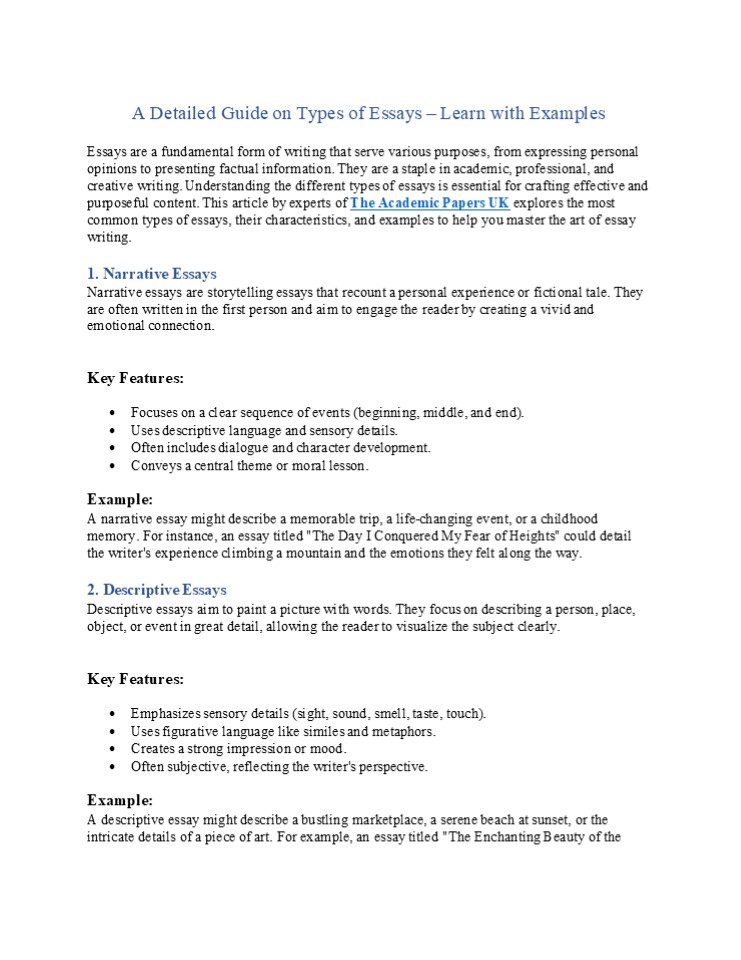
- A Detailed Guide on Types of Essays Learn with
Examples - Essays are a fundamental form of writing that
serve various purposes, from expressing personal
opinions to presenting factual information. They
are a staple in academic, professional, and
creative writing. Understanding the different
types of essays is essential for crafting
effective and purposeful content. This article by
experts of The Academic Papers UK explores the
most common types of essays, their
characteristics, and examples to help you master
the art of essay writing. - Narrative Essays
- Narrative essays are storytelling essays that
recount a personal experience or fictional tale.
They are often written in the first person and
aim to engage the reader by creating a vivid and
emotional connection. - Key Features
- Focuses on a clear sequence of events (beginning,
middle, and end). - Uses descriptive language and sensory details.
- Often includes dialogue and character
development. - Conveys a central theme or moral lesson.
- Example
- A narrative essay might describe a memorable
trip, a life-changing event, or a childhood
memory. For instance, an essay titled "The Day I
Conquered My Fear of Heights" could detail the
writer's experience climbing a mountain and the
emotions they felt along the way. - Descriptive Essays
- Descriptive essays aim to paint a picture with
words. They focus on describing a person, place,
object, or event in great detail, allowing the
reader to visualize the subject clearly. - Key Features
- Emphasizes sensory details (sight, sound, smell,
taste, touch).
2
- Northern Lights" could vividly describe the
colors, movements, and emotions evoked by the
natural phenomenon. - Expository Essays
- Expository essays are factual and informative.
They aim to explain, clarify, or define a topic
without expressing the writer's personal
opinions. These essays are common in academic
settings. - Key Features
- Presents clear, concise, and logical information.
- Uses evidence, examples, and statistics to
support claims. - Follows a structured format (introduction, body
paragraphs, conclusion). - Maintains an objective tone.
- Example
- An expository essay might explain how a volcano
erupts, the causes of climate change, or the
process of photosynthesis. For instance, an essay
titled "The Impact of Social Media on Modern
Communication" could provide a balanced analysis
of the topic without personal bias. - Persuasive Essays
- Persuasive essays aim to convince the reader to
adopt a particular viewpoint or take a specific
action. They rely on logical arguments, emotional
appeals, and credible evidence to persuade the
audience. - Key Features
- Presents a clear thesis statement.
- Uses logical reasoning and evidence to support
claims. - Addresses counterarguments and refutes them.
3
- Focuses on a debatable issue.
- Presents a clear thesis and supporting evidence.
- Uses factual data, statistics, and expert
opinions. - Acknowledges opposing views and refutes them.
- Example
- An argumentative essay might debate the ethics of
animal testing, the pros and cons of artificial
intelligence, or the effectiveness of
standardized testing. For instance, an essay
titled "The Case for Universal Basic Income"
could present economic and social arguments in
favor of the policy. - Compare and Contrast Essays
- Compare and contrast essays analyze the
similarities and differences between two or more
subjects. They help readers understand the
relationships between ideas, concepts, or
objects. - Key Features
- Organizes content by subject or point-by-point.
- Highlights similarities and differences.
- Uses transitional words like "similarly,"
"however," and "in contrast." - Concludes with a summary of the comparison.
- Example
- A compare and contrast essay might examine the
differences between high school and college life,
the similarities between two historical figures,
or the pros and cons of living in a city versus a
rural area. For example, an essay titled "Public
Schools vs. Private Schools A Comparative
Analysis" could explore factors like cost,
curriculum, and student outcomes. - Cause and Effect Essays
- Cause and effect essays explore the reasons
behind an event (the cause) and its consequences
(the effect). They help readers understand the
relationship between actions and outcomes.
4
- Reflective Essays
- Reflective essays focus on the writer's personal
experiences, thoughts, and feelings. They
encourage introspection and self-analysis, often
leading to personal growth or insight. - Key Features
- Written in the first person.
- Explores personal experiences and emotions.
- Connects experiences to broader themes or
lessons. - Encourages critical thinking and self-awareness.
- Example
- A reflective essay might discuss what the writer
learned from a challenging situation, how a book
or movie influenced their perspective, or how
they have grown over time. For example, an essay
titled "What I Learned from Volunteering at a
Homeless Shelter" could reflect on the writer's
experiences and the impact on their worldview. - Analytical Essays
- Analytical essays break down a complex topic into
smaller parts to examine and interpret it. They
require critical thinking and a deep
understanding of the subject. - Key Features
- Focuses on analyzing a text, event, or
phenomenon. - Uses evidence to support interpretations.
- Maintains an objective tone.
- Concludes with a synthesis of the analysis.
- Example
- An analytical essay might analyze a literary
work, a historical event, or a scientific theory.
For instance, an essay titled "The Symbolism in
The Great Gatsby" could explore the use of
symbols like the green light and the eyes of Dr.
T.J. Eckleburg.
5
Example A definition essay might define concepts
like "love," "success," or "freedom." For
example, an essay titled "What Does It Mean to Be
Brave?" could explore the various ways bravery is
demonstrated in everyday life. Conclusion Essays
are a versatile and powerful form of writing that
can inform, persuade, entertain, and inspire. By
understanding the different types of essays and
their unique characteristics, you can choose the
appropriate style for your purpose and audience.
Whether you're crafting a narrative, analyzing a
text, or arguing a point, mastering these essay
types will enhance your writing skills and enable
you to communicate effectively. So, the next time
you sit down to write, consider the type of essay
that best suits your goals and let your words
shine! You can consider hiring an essay writing
service if at any point you face confusion while
writing your essay.
Recommended

