

Exploring The Historical Significance Of Sakleshpur PowerPoint PPT Presentation
Title: Exploring The Historical Significance Of Sakleshpur
1
Exploring The Historical Significance Of
Sakleshpur
Situated in the scenic Western Ghats of
Karnataka, Sakleshpur transcends its identity as
a delightful hill station it is a region imbued
with a profound historical and cultural legacy.
From ancient temples that resonate with the
echoes of bygone eras to the stunning vistas that
grace its hills and valleys, Sakleshpur presents
a captivating story of its heritage. This blog
post invites you to embark on a journey to
discover the history of Sakleshpur and delve into
its rich cultural fabric. An insight into the
history of Sakleshpur The origins of Sakleshpur
can be traced back to ancient times, particularly
to the Hoysala dynasty, which flourished from the
10th to the 14th centuries. The Hoysalas governed
a substantial part of Karnataka and significantly
influenced the region's architecture,
religion, and cultural practices. Much of
the architectural legacy visible today is a
result of their support for art and temple
construction. The town's name is derived from the
deity Sakaleshwara, a manifestation of Lord
Shiva, and the Sakaleshwara Temple, established
in 1180 AD, serves as a testament to this rich
historical background. Over the years, the temple
has evolved into a vital pilgrimage destination
and a symbol of Sakleshpur's cultural
identity. The heritage temples of Sakleshpur
2
Sakaleshwara Temple As previously highlighted,
the Sakaleshwara Temple stands as the crown jewel
of Sakleshpur. This historic temple is
celebrated for its exquisite Hoysala
architecture, which features delicate
soapstone craftsmanship, elaborate sculptures,
and intricately carved friezes. The temple
showcases remarkable representations of various
Hindu deities and acts as a focal point for local
celebrations, particularly during Shivaratri,
when numerous devotees gather to receive
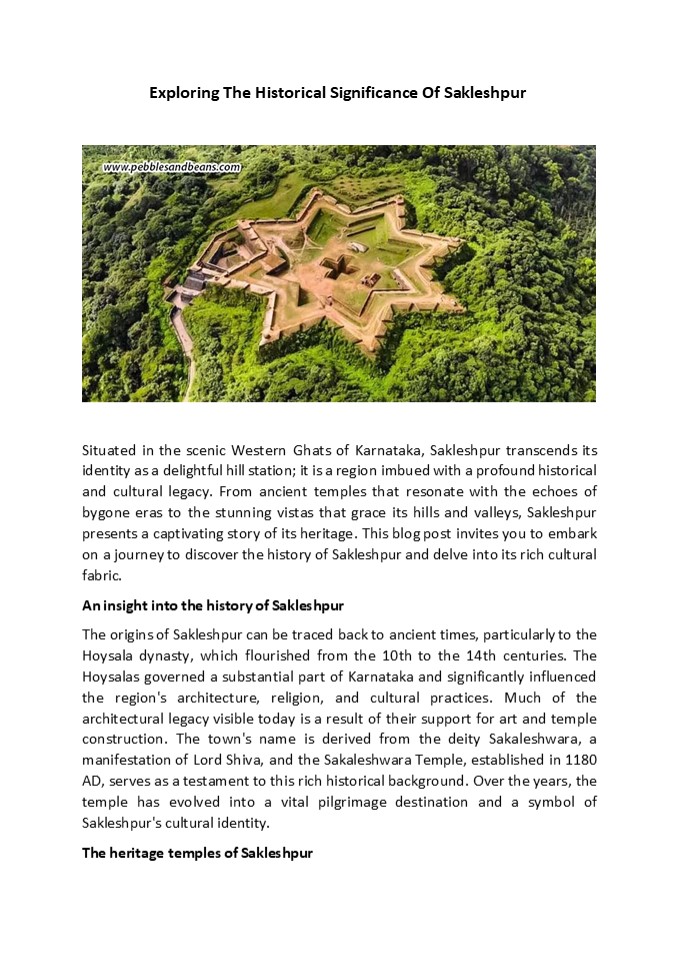
blessings. Manjarabad Fort In addition to its
sacred temples, Sakleshpur is also home to the
Manjarabad Fort, constructed by Tippu Sultan in
the late 18th century. Situated atop a hill, the
fort commands a strategic view of the surrounding
terrain, serving as a crucial military stronghold
during the Anglo-Mysore Wars. Its distinctive
star- shaped layout is enhanced by walls
featuring cannon placements and remnants of
structures that once accommodated soldiers.
Today, visitors can trek the steep ascent to the
fort, where they are rewarded with breathtaking
vistas of the verdant hills, coffee
plantations, and meandering rivers below.
History enthusiasts can delve into the fort's
crumbling edifices and artifacts that narrate
stories of valour, strategy, and historical
conflicts. Gadaikallu Another significant yet
often overlooked site in Sakleshpur is
Gadaikallu, a rock formation of historical
importance. It is believed that this location
served various purposes for ancient communities,
including offerings to deities and possibly as a
marker of ancient trade routes. Besides its
historical significance, the rock formations
provide stunning views during sunrise and sunset,
making it a tranquil spot for contemplation and
photography. The cultural heritage of
Sakleshpur Sakleshpur boasts a vibrant and
resilient cultural heritage that reflects the
challenges and victories of its inhabitants. The
region hosts a variety of festivals that
celebrate its cultural richness. Notably, Gudi
Padwa, which signifies the New Year for the local
Konkanis, is observed with great enthusiasm.
During this time, homes are embellished with
rangolis and festive decorations, while the
delightful scents of traditional dishes permeate
the surroundings.
3
Another significant cultural event is Kambala, an
exhilarating annual buffalo race where local
farmers display their esteemed buffaloes. These
races occur in the paddy fields, creating an
electrifying ambiance filled with cheers, music,
and traditional dance performances. The
folk-dance traditions of Sakleshpur, including
Kolata and Ballari, highlight the region's
artistic heritage. These performances are often
linked to seasonal transitions or agricultural
activities, illustrating the deep-rooted
connection between the community and their
farming lifestyle. Coffee plantations and
nature's abundance The undulating hills of
Sakleshpur are renowned for their coffee
plantations, which play a vital role in the local
economy and cultural heritage. The picturesque
landscape, adorned with coffee plants, presents a
stunning sight, particularly during the blooming
of coffee flowers or the harvest season. Numerous
plantation owners have opened their doors to
visitors, providing opportunities to witness
coffee cultivation up close, partake in tastings,
and appreciate the cultural importance of coffee
in the area. These estates are often accompanied
by traditional residences that reflect colonial
architectural styles, reminiscent of a past era.
A visit to these plantations not only offers a
glimpse into the coffee production process but
also fosters connections with the local community
and their customs. Sakleshpur is surrounded by
the Western Ghats, a UNESCO World Heritage Site
celebrated for its exceptional biodiversity. The
region's verdant landscapes and wildlife have
been essential for the sustenance of its
residents throughout history. The Ghats have
served as a historical trade route linking
coastal towns to the plateau, promoting cultural
exchanges and interactions. The rich variety of
flora and fauna in the area has established it as
a centre for eco-tourism, drawing nature
enthusiasts, trekkers, and bird watchers. Peaks
such as Kumara Parvatha, one of the tallest in
the region, offer challenging trekking
opportunities that allow hikers to immerse
themselves in the natural splendour of the
Western Ghats. These activities are vital for
preserving the historical significance of
Sakleshpur as a confluence of nature and
culture. Historical routes The renowned "Coffee
Trail" in Sakleshpur is not just a passage
through fragrant plantations it also embodies a
rich historical narrative. These trails narrate
the evolution of trade and cultural exchanges,
showcasing the blending of influences
4
from various communities along the way.
Historically, these routes were essential for
transporting coffee to ports for export,
solidifying Sakleshpur's significance in the
global coffee market. In contemporary times,
Sakleshpur is undergoing a transformation through
eco-tourism, focusing on sustainable practices
that honour its historical heritage and cultural
identity. Local artisans are rejuvenating
traditional crafts, creating economic
opportunities while preserving time-honoured
skills. Sakleshpur serves not only as a travel
destination but also as a vibrant testament to
Karnataka's rich history, featuring ancient
temples, colonial architecture, and stunning
landscapes. It beckons historians, nature
enthusiasts, and culture aficionados to engage
with its ongoing narrative, intricately woven
with time and identity. And, for those seeking a
peaceful retreat during their exploration, The
Pebbles Beans Resort stands out as an
exceptional choice, harmonizing comfort with
nature. Nestled among lush coffee plantations in
the Western Ghats, this is one of the
Sakleshpur resorts known to offer luxurious
accommodations that reflect the region's cultural
legacy. Guests can savour local cuisine, partake
in guided tours of historical sites, and enjoy a
range of activities such as trekking and coffee
plantation walks, making it an ideal base to
fully experience the beauty and history of
Sakleshpur. So, pack your bags and immerse
yourself in the historical richness that
Sakleshpur has to offer! Resource Read more
Recommended

