

Gaskets For High-Temperature And High-Pressure Applications PowerPoint PPT Presentation
Title: Gaskets For High-Temperature And High-Pressure Applications
1
Gaskets For High-Temperature And High-Pressure
Applications
- Gaskets play a vital role in industrial systems
by providing leak-proof seals in pipelines,
boilers, and processing equipment. However, they
face considerable stress under extreme
conditions, such as elevated temperatures and
pressures, which can lead to failures that result
in expensive downtime, safety risks, and
operational inefficiencies. It is essential to
choose the appropriate gasket material and design
to ensure reliability in these challenging
environments. This blog addresses the
difficulties associated with high- temperature
and high-pressure applications and offers
guidance on the selection, installation, and
maintenance of gaskets under extreme conditions. - Challenges of high-temperature applications
- Material degradation due to heat
- Elevated temperatures can compromise gasket
materials, diminishing their sealing capabilities
over time. Gaskets made from rubber and fiber
tend to harden and crack with extended exposure
to heat, while elastomers may soften and lose
their original shape. The process of thermal
oxidation further accelerates material
deterioration, ultimately reducing the lifespan
of the gasket. - Thermal expansion and contraction
- Gaskets undergo expansion and contraction in
response to temperature changes, which can induce
material stress and lead to leaks. Continuous
thermal cycling can result in seal fatigue, and
high temperatures may cause the gasket to relax,
thereby decreasing compression and sealing
efficiency over time. - Exposure to high-temperature chemicals
- In industrial processes involving steam, hot
gases, or corrosive fluids at elevated
temperatures, gaskets can be weakened, leading to
a loss of strength, degradation, or even
dissolution over time.
2
- Challenges of high-pressure applications
- Gasket blowout risks
- High-pressure systems apply significant force on
gaskets, which can lead to rupture or
displacement if the gasket does not possess
adequate strength. Key factors contributing to
this issue include insufficient bolt load, where
uneven or inadequate tightening results in gaps
in the seal, and material failure, where gaskets
not designed for high pressure may compress
excessively or extrude. - Compression set and creep
- Prolonged exposure to pressure can cause gasket
materials to lose their elasticity, hindering
their ability to return to their original shape
after compression. This leads to a deterioration
of seal integrity, as gaskets become permanently
deformed, thereby increasing the likelihood of
leaks as fluids or gases escape due to the
gaskets inability to regain its initial form.
Best gasket materials for high-temperature and
high- pressure applications Metal gaskets
Metal gaskets represent the most robust option
for extreme temperature and pressure conditions.
Ring-Type Joint (RTJ) gaskets, constructed from
stainless steel or Inconel, form a metal-to-metal
seal suitable for high- pressure applications.
Metal-jacketed gaskets consist of a soft filler
core encased in a metal outer layer, providing
exceptional resistance to temperature and
pressure. Corrugated metal gaskets offer a
combination of flexibility and strength, making
them effective for applications involving thermal
cycling. Graphite gaskets Flexible graphite
gaskets can endure temperatures exceeding 500C
while retaining excellent sealing capabilities.
Unlike rubber or fibre gaskets, graphite remains
resilient under heat, avoiding hardening or
cracking. Furthermore, its robust chemical
resistance makes it an ideal choice for sealing
steam, hot oils, and aggressive
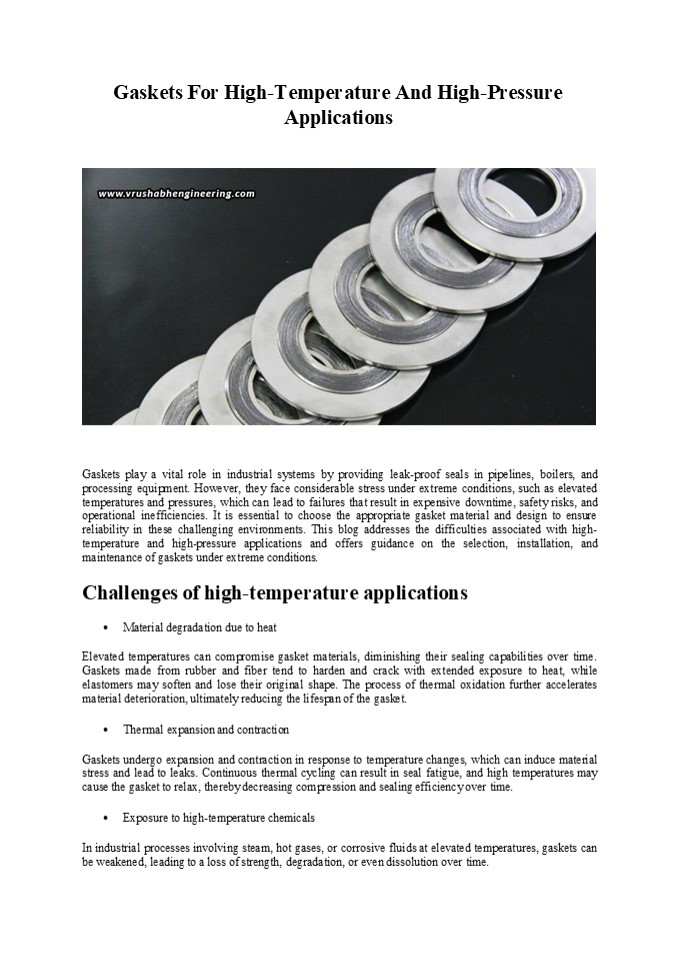
chemicals. Spiral-wound gaskets Spiral-wound
gaskets are constructed with alternating layers
of metal and filler material, resulting in a
strong and adaptable seal. They can withstand
pressures up to 250 bar (3625 psi) and
effectively manage thermal expansion,
accommodating minor flange movements during
heating and cooling cycles. PTFE gaskets PTFE
(Teflon) gaskets provide outstanding performance
at high temperatures while resisting chemical
degradation. With a temperature tolerance of up
to 260C (500F), they remain stable under heat.
Their low creep characteristics minimize
significant compression set, ensuring a
dependable seal under high-pressure conditions.
Industry applications for high-temperature and
high- pressure gaskets
3
- Oil and gas industry RTJ gaskets are utilized in
high-pressure pipelines and drilling activities,
whereas graphite and metal-jacketed gaskets
effectively prevent leaks in high-temperature
processing facilities. - Power plants and steam systems Graphite and
spiral-wound gaskets are crucial for sealing
boilers and connecting turbines, while metal
gaskets endure the extreme heat present in steam
systems. - Chemical processing plants PTFE gaskets are
employed for the transport of corrosive chemicals
at elevated temperatures, while metal-jacketed
gaskets safeguard against pressure fluctuations
in reactors and heat exchangers. - Aerospace and automotive engineering
Metal-reinforced gaskets are designed to seal
high- pressure fuel and exhaust systems, while
spiral-wound gaskets offer durability for engine
components subjected to severe heat and pressure. - Selecting the right gasket for high-temperature
and high-pressure applications is critical for
maintaining system reliability, safety, and
efficiency. For example, metal, graphite, and
spiral-wound gaskets deliver optimal performance
in extreme conditions, providing resistance to
heat, pressure, and thermal cycling. For
professional guidance on high-performance
gaskets, reach out to Vrushabh Engineering today.
Our selection of specialized gaskets guarantees
effective sealing solutions for applications
involving extreme temperatures and high
pressures, making us the most versatile
industrial gaskets manufacturer in India.
Resource Read more
Recommended

