

Relationship between Data Governance and AI Governance-Tejasvi Addagada PowerPoint PPT Presentation
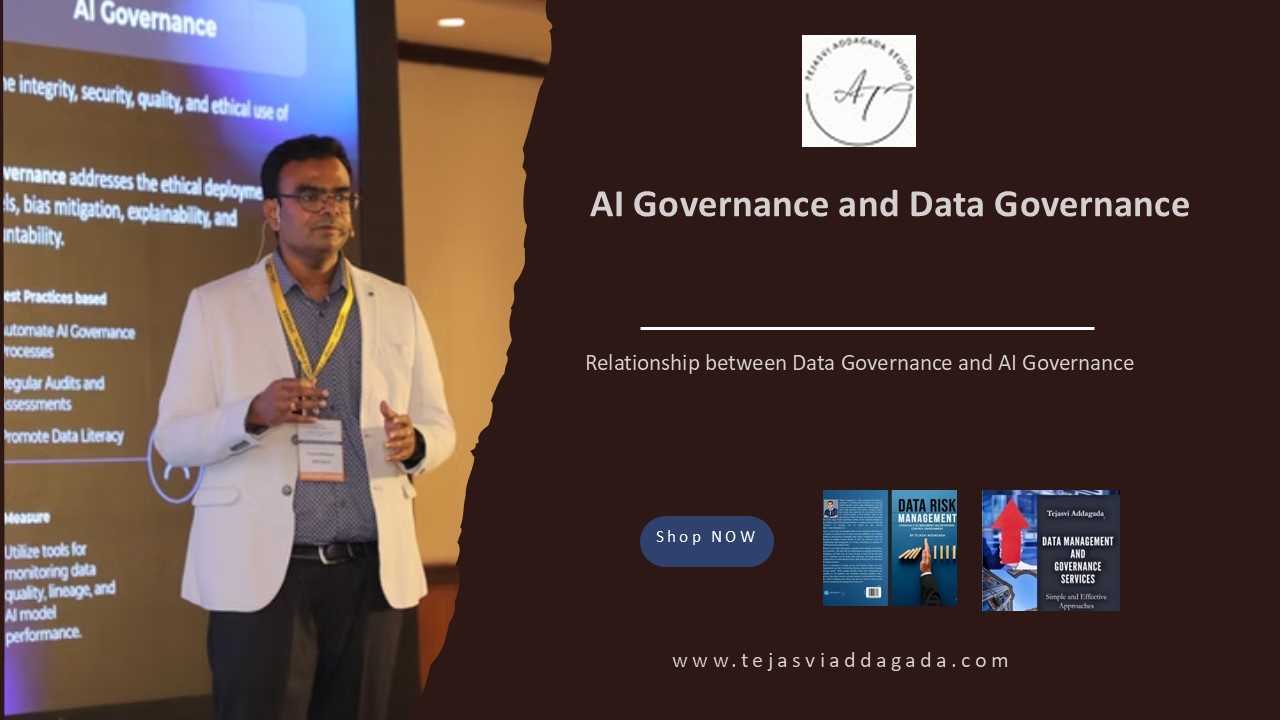
Title: Relationship between Data Governance and AI Governance-Tejasvi Addagada
1
AI Governance and Data Governance
Relationship between Data Governance and AI
Governance
www.tejasviaddagada.com
2
Relationship between Data Governance and AI
Governance
In todays data-driven world, data quality
generative AI plays a vital role in shaping both
AI and data governance strategies. Businesses
need structured approaches to ensure their data
is accurate, secure, and ethically used. Data
Governance Strategy and AI Governance are
interconnected, as AI models rely on high-quality
data to function effectively. By integrating a
strong Data Governance Framework, organizations
can establish policies that support responsible
AI development.
Data Governance Strategy
A Data Governance Strategy ensures that data
assets are properly managed, secured, and used
responsibly. It establishes guidelines for data
collection, processing, and sharing, ensuring
compliance with regulatory requirements. Key
aspects include
www.tejasviaddagada.com
3
- Defining Data Ownership Establishing roles and
responsibilities for data management. - Ensuring Data Quality Maintaining accurate,
consistent, and reliable data. - Regulatory Compliance Adhering to laws like
GDPR, HIPAA, and CCPA. - Data Security Measures Implementing access
controls and encryption techniques.
Data Governance Supports AI Governance
A well-structured Data Governance Framework lays
the foundation for AI Governance by ensuring that
AI models use high-quality, unbiased, and
compliant data. Without proper governance,
AI-driven decisions can be flawed, leading to
inaccurate results and ethical concerns.
- Reliable AI Outputs Ensuring that AI models
generate trustworthy insights. - Bias Mitigation Preventing discriminatory
outcomes in AI decisions. - Data Ethics Ensuring AI adheres to legal and
ethical standards.
www.tejasviaddagada.com
4
AI Governance Builds Upon Data Governance
AI Governance focuses on overseeing AI systems
development, deployment, and monitoring. It
builds upon Data Governance Strategy by
addressing the ethical, regulatory, and
operational risks associated with AI. Core
components include
- AI Model Transparency Making AI decision-making
processes explainable. - Risk Management Identifying potential AI-related
risks and mitigating them. - Regulatory Compliance Ensuring AI systems comply
with legal frameworks.
AI Can Enhance Data Governance
AI can improve data governance by automating
processes and enhancing decision-making. Data
quality generative AI helps
- Automate Data Cleaning Identifying and
rectifying errors in large datasets. - Improve Data Classification Categorizing data
for better management. - Enhance Security Detecting anomalies and
potential breaches.
www.tejasviaddagada.com
5
Data Governance Framework
A Data Governance Framework consists of policies,
tools, and processes designed to manage data
effectively. It includes
- Data Policies and Standards Establishing
guidelines for data usage. - Data Stewardship Programs Assigning roles for
data management. - Technology Integration Using AI and automation
for data governance.
Data Governance Tools
Various tools help organizations implement data
governance effectively
- Master Data Management (MDM) Centralizing data
from multiple sources. - Metadata Management Ensuring proper data
categorization. - Data Lineage Tracking Monitoring data movement
and transformations.
www.tejasviaddagada.com
6
Data Management Services
Data management services support organizations in
handling their data assets efficiently. These
services include
- Data Storage Solutions Ensuring secure and
scalable storage. - Data Integration Services Connecting disparate
data sources. - Cloud Data Management Managing data across cloud
environments.
While AI Governance Focuses
While AI Governance is centered around regulating
AI models, it cannot function without strong Data
Governance Strategy. AI models require
high-quality data to deliver reliable results.
Data Governance ensures data quality, security,
and compliance, providing a solid foundation for
AI applications.
www.tejasviaddagada.com
7
Data Governance Goals, Focus, and Example
Data management services support organizations in
handling their data assets efficiently. These
services include
Goals
- Maintain high data quality.
- Ensure regulatory compliance.
- Enhance data security.
Focus
Data policies, security, and compliance.
Example
A financial institution using a Data Governance
Framework to protect customer information and
ensure compliance with financial regulations.
www.tejasviaddagada.com
8
AI Governance Goals, Focus, and Example
Goals
- Monitor AI decision-making.
- Reduce biases in AI models.
- Ensure ethical AI use.
Focus
AI model transparency, risk management, and
ethics.
Example
A healthcare provider implementing AI Governance
to ensure AI driven diagnoses are fair and
accurate.
www.tejasviaddagada.com
9
How They Work Together?
A well-integrated approach to AI and Data
Governance enhances data security, ethical AI
usage, and regulatory compliance. When these
strategies align, businesses can
- Improve Decision-Making High-quality data leads
to better AI-driven insights. - Enhance Security AI strengthens data governance
by detecting anomalies. - Ensure Compliance Both governance frameworks
work together to meet regulatory standards.
Conclusion
The relationship between Data Governance Strategy
and AI Governance is essential for maintaining
data quality generative AI standards. By
implementing a strong Data Governance Framework,
businesses can ensure that their AI models
operate securely, ethically, and effectively.
Leveraging data management services and AI-driven
tools further enhances data integrity and
compliance, leading to better business outcomes.
www.tejasviaddagada.com
10
FAQ
1. What is AI Governance?
4. What are some common Data Governance tools?
AI Governance is the framework for overseeing AI
systems, ensuring ethical use, transparency, and
compliance.
Master Data Management (MDM), metadata
management, and data lineage tracking are popular
tools used for governance.
2. Why is Data Governance essential for AI?
Data Governance ensures AI models use
high-quality, unbiased, and regulatory-compliant
data, leading to better decision-making.
5. How can businesses implement Data Governance
effectively?
Organizations should establish policies, invest
in governance tools, and integrate AI for
automation and efficiency.
3. How does AI improve Data Governance?
AI enhances data governance by automating data
cleaning, classification, and anomaly detection.
www.tejasviaddagada.com
11
By combining AI Governance with a robust Data
Governance Strategy, businesses can ensure
responsible AI usage, high data integrity, and
compliance with evolving regulations.
www.tejasviaddagada.com
12
Contact Us
Website www.tejasviaddagada.com
Address Airoli Knowledge Park Road, Dighe, Green
World, vitawa, Airoli, Thane, Maharashtra 400708,
India
Email Tejasvi_at_tejasviaddagada.com
13
(No Transcript)
Recommended

