

Top Challenges in Healthcare Software Development & How to Overcome Them PowerPoint PPT Presentation
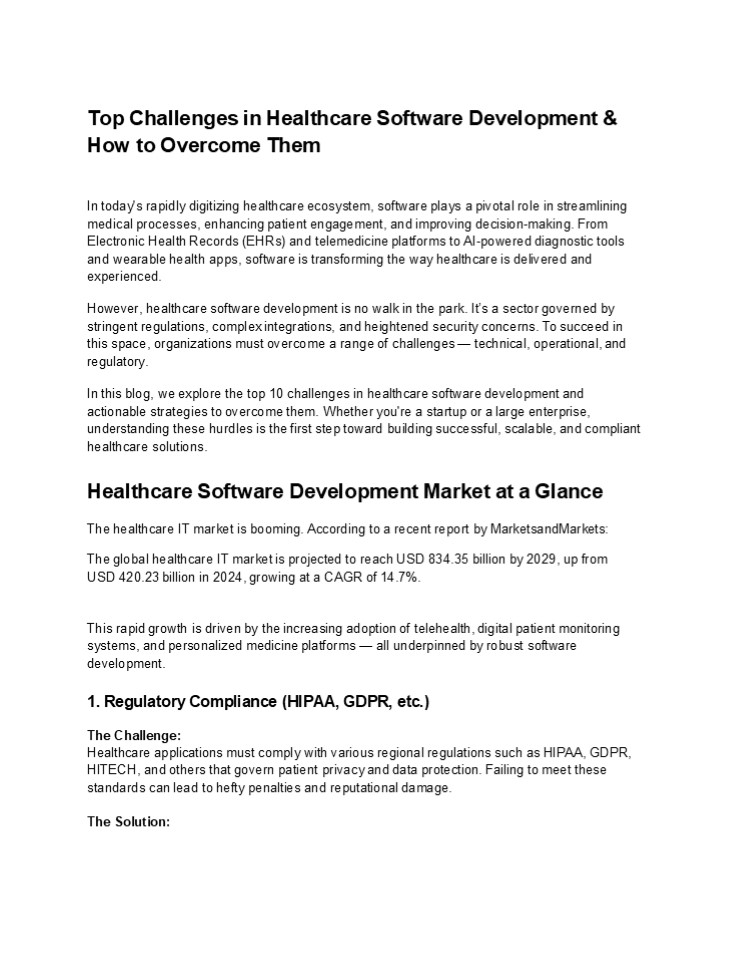
Title: Top Challenges in Healthcare Software Development & How to Overcome Them
1
Top Challenges in Healthcare Software Development
How to Overcome Them
In today's rapidly digitizing healthcare
ecosystem, software plays a pivotal role in
streamlining medical processes, enhancing patient
engagement, and improving decision-making. From
Electronic Health Records (EHRs) and telemedicine
platforms to AI-powered diagnostic tools and
wearable health apps, software is transforming
the way healthcare is delivered and
experienced. However, healthcare software
development is no walk in the park. Its a sector
governed by stringent regulations, complex
integrations, and heightened security concerns.
To succeed in this space, organizations must
overcome a range of challenges technical,
operational, and regulatory. In this blog, we
explore the top 10 challenges in healthcare
software development and actionable strategies to
overcome them. Whether you're a startup or a
large enterprise, understanding these hurdles is
the first step toward building successful,
scalable, and compliant healthcare
solutions. Healthcare Software Development
Market at a Glance The healthcare IT market is
booming. According to a recent report by
MarketsandMarkets The global healthcare IT
market is projected to reach USD 834.35 billion
by 2029, up from USD 420.23 billion in 2024,
growing at a CAGR of 14.7. This rapid growth
is driven by the increasing adoption of
telehealth, digital patient monitoring systems,
and personalized medicine platforms all
underpinned by robust software development. 1.
Regulatory Compliance (HIPAA, GDPR, etc.) The
Challenge Healthcare applications must comply
with various regional regulations such as HIPAA,
GDPR, HITECH, and others that govern patient
privacy and data protection. Failing to meet
these standards can lead to hefty penalties and
reputational damage. The Solution
2
- Hire a healthcare software development company
experienced in regulatory frameworks. - Conduct frequent compliance audits.
- Ensure that all data transmission and storage
mechanisms are encrypted and access-controlled. - Data Security Privacy
- The Challenge
- Patient data is extremely sensitive and a prime
target for cyberattacks. Healthcare software must
be bulletproof against breaches, phishing
attacks, and ransomware. - The Solution
- Implement end-to-end encryption.
- Use two-factor/multi-factor authentication.
- Conduct regular security testing and
vulnerability assessments.
3
- The Challenge
- Healthcare software is used by a wide range of
usersdoctors, nurses, administrative staff, and
patientswith different tech proficiencies. - The Solution
- Conduct in-depth user research.
- Design simple, intuitive interfaces tailored for
each user group. - Provide onboarding tools like video guides,
tooltips, and in-app support. - Scalability for Growing Needs
- The Challenge
- As patient data grows and features expand, the
software must scale without performance issues or
downtime. - The Solution
- Use cloud-native technologies and microservices
architecture.
4
- Ensuring Performance Reliability
- The Challenge
- In healthcare, even a minute of downtime or a
system lag can be life-threatening. Software must
perform consistently in high-load environments. - The Solution
- Implement performance monitoring tools.
- Use load balancing and failover systems.
- Test under simulated high-load conditions to
identify performance bottlenecks. - Managing Development Costs
- The Challenge
- Building healthcare software can be costly,
especially with compliance, integration, and
security needs factored in. - The Solution
- Opt for software development consulting services
to define clear project scopes and avoid scope
creep.
5
- Ensure your architecture is flexible enough to
incorporate new tech over time. - Lack of Domain Expertise
- The Challenge
- Healthcare software developers must understand
both medical workflows and technical architecture
a rare combination. - The Solution
- Work with developers or vendors who have prior
experience in healthcare projects. - Provide medical domain training to your tech
team. - Collaborate with medical professionals during the
design and development phases. - Role of Software Development Consulting Services
in Healthcare - Hiring a specialized software development
consulting services provider can significantly
de-risk your healthcare project. These
consultants help you
Why Partner with a Healthcare Software
Development Company? Partnering with an
experienced healthcare software development
company ensures
6
- Faster time to market
- Compliance with global healthcare regulations
- Secure, scalable infrastructure
- Better patient and provider experiences
- Full-cycle custom software development services
tailored to your unique needs - Such companies not only help develop your product
but also assist in support, maintenance, and
continuous improvement making them strategic
allies in your healthcare digital transformation
journey. - Final Thoughts
- Healthcare software development is undoubtedly
challenging but the rewards are equally
significant. By addressing key challenges such as
compliance, security, scalability, and
integration with the right strategy, you can
build impactful solutions that revolutionize
healthcare delivery. - Engage the right partners, invest in future-ready
technology, and prioritize user needs. With the
right healthcare IT solutions and development
expertise, youre not just building software
youre helping shape the future of healthcare.
Recommended

