

A Complete Guide to Credentialing for Healthcare Providers PowerPoint PPT Presentation
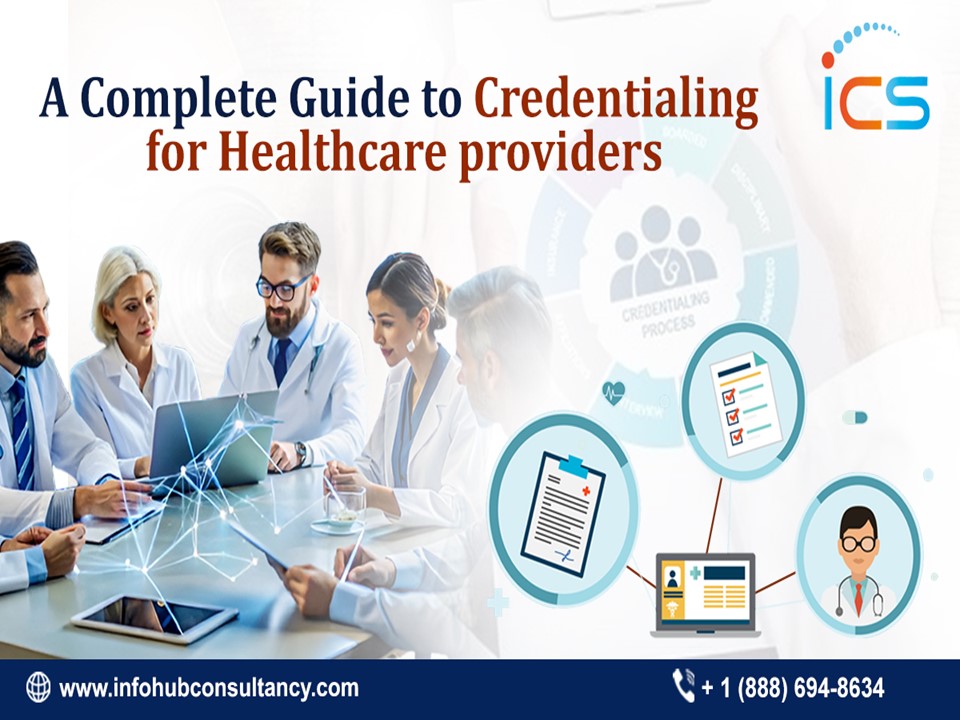
Title: A Complete Guide to Credentialing for Healthcare Providers
1
(No Transcript)
2
A Complete Guide to Credentialing for Healthcare
Providers
Credentialing operates as an essential
cornerstone within the healthcare industry as it
only authorizes skilled healthcare professionals
to offer patient care. In an increasingly complex
healthcare environment, the importance of
credentialing cannot be overstated. The National
Association of Medical Staff Services (NAMSS)
indicates that provider onboarding delays due to
credentialing issues affect more than 90 of
healthcare providers. Hospitals allocate over 2
billion per year to handle credentialing-related
administrative tasks based on research conducted
by the Council for Affordable Quality Healthcare
(CAQH). Despite its importance, hospitals
encounter multiple challenges with their
credentialing procedure as they deal with
prolonged processing times, inconsistent
procedures, and regulatory compliance issues.
This blog provides a comprehensive guide
to credentialing services for healthcare
providers. Read detailed blog
https//infohubconsultancy.com/blog/a-complete-gui
de-to-credentialing-for-healthcare-providers/
inquiry_at_infohubconsultancy.com
3
A Complete Guide to Credentialing for Healthcare
Providers
What is Healthcare Provider Credentialing? Hospita
l administrators perform systematic checks to
verify their health care professionals
qualifications which ensures healthcare standards
are met for delivering proper patient care. The
credentialing assessment requires to examine a
providers education, licensure, certifications,
work history, training, and malpractice
records. The credentialing system defends patient
health, enhances the quality of care, and shields
hospitals financially and legally. The assessment
serves as a prerequisite for insurance plan
enrollment and reimbursement eligibility.
inquiry_at_infohubconsultancy.com
4
A Complete Guide to Credentialing for Healthcare
Providers
Credentialing vs. Privileging vs.
Enrollment Although providers frequently
interchange these terms, they represent distinct
yet interrelated elements of provider
verification and onboarding Credentialing This
involves verifying the qualifications and
background of a healthcare providereducation,
licensure, board certifications, and
more. Privileging The process of authorizing a
provider to perform specific procedures or
deliver certain services within a healthcare
facility based on verified qualifications. Enrollm
ent It refers to a providers registration with
insurance companies, allowing them to receive
reimbursements for covered services. Healthcare
administrators need to understand these
distinctions because non-completion of these
steps will cause in delays, denied claims, or
regulatory violations.
inquiry_at_infohubconsultancy.com
5
A Complete Guide to Credentialing for Healthcare
Providers
Step-by-Step Credentialing Process The following
is the process to be followed for credentialling
of the healthcare providers 1. Pre-Application
Preparation A providers credentialing process
starts after they collect the necessary documents
for demonstrating their qualifications and
relevant experience. Hospitals or healthcare
facilities require degrees from accredited
medical schools, certificates from residency or
fellowship programs, active state licenses, board
certifications, and up-to-date malpractice
insurance coverage. The preparation stage enables
smooth progress during application and
verification steps which decreases the risk of
incomplete submissions or rejections.
inquiry_at_infohubconsultancy.com
6
A Complete Guide to Credentialing for Healthcare
Providers
2. Application Submission Healthcare providers
must complete the required documentation after
which they submit their formal application to
organizations, credentialing committees, or
third-party credentialing services. This
application must contain basic personal and
professional information while showing evidence
of past disciplinary actions, employment gaps,
malpractice history, and any legal issues. The
applicant must maintain accuracy and honesty
because discrepancies might result in
disqualification or delays. A detailed and
accurate application creates the foundation that
enables smooth credentialing operations and
future privileging.
inquiry_at_infohubconsultancy.com
7
A Complete Guide to Credentialing for Healthcare
Providers
3. Primary Source Verification (PSV) Primary
Source Verification is the most crucial part of
the credentialing process. This step makes
contact directly with the institutions and
agencies responsible for providing these
credentials. The medical school receives requests
for graduation verification, the state medical
board is contacted to confirm provider licensure
and certification boards check that active
relevant board certifications exist. The
credential legitimacy check defends healthcare
system integrity by verifying all documented
information remains authentic without any
falsification or misrepresentation.
inquiry_at_infohubconsultancy.com
8
A Complete Guide to Credentialing for Healthcare
Providers
4. Background Check After PSV, the organization
conducts a detailed background check to identify
red flags. The investigation includes checks of
criminal records from local, state, and federal
levels, malpractice claims or settlements
reviews, and inquiries of previous disciplinary
actions made by licensing and regulatory bodies.
The review process may extend to substance abuse
history assessment and drug testing for certain
organizations. This step safeguards organizations
and their patients through verification that
providers maintain safe and reliable medical
histories.
inquiry_at_infohubconsultancy.com
9
A Complete Guide to Credentialing for Healthcare
Providers
5. Credentialing Committee Review The
credentialing committee which typically includes
medical staff members and administrators
investigates verified data and background check
outcomes. Their main responsibility involves
checking if the provider matches quality patient
care standards set by the facility. The
credentialing committee evaluates clinical
competencies, ethical behavior, and the overall
suitability for performing the assigned duties.
Through this formal review process, the
decision-making stays unbiased while creating a
standardized record of credentialing decisions.
inquiry_at_infohubconsultancy.com
10
A Complete Guide to Credentialing for Healthcare
Providers
6. Approval and Privileging The provider moves
onto clinical privilege authorization after the
credentialing committee decides to approve them.
The healthcare facility uses these privileges to
determine the clinical boundaries of work
practice for providers, defining their procedure
capabilities, treatment limits by patient
categories, and practice conditions. The
credentialing process creates unique requirements
through the utilization of provider education,
training, specialty, and experience. The
privileging process permits healthcare providers
to conduct treatments only within their approved
skill sets which protects patient care quality
and minimizes potential liabilities.
inquiry_at_infohubconsultancy.com
11
A Complete Guide to Credentialing for Healthcare
Providers
7. Recredentialing and Continuous Monitoring A
credentialing system operates through multiple
stages that extend over a sustained period.
Organizations enforce re-credentialing processes
that repeat every 23 years as per their internal
policies and state authorities. During
re-credentialing, providers need to update their
information, verify ongoing professional
development, and evaluate clinical outcomes and
conduct. Certain healthcare organizations employ
automated tools to flag license expirations,
malpractice suits, or other risk factors in real
time. The monitoring system protects continuous
patient safety and compliance throughout service
delivery.
inquiry_at_infohubconsultancy.com
12
A Complete Guide to Credentialing for Healthcare
Providers
Why Effective Credentialing is Crucial Effective
credentialing serves multiple hospitals and
patient-centered goals Patient Safety Verifies
that only qualified professionals treat patients,
reducing the risk of medical errors and
malpractice. Regulatory Compliance Ensures
alignment with federal, state, and accreditation
body requirements (e.g., The Joint
Commission). Operational Efficiency Prevents
costly onboarding delays and lost
revenue. Reimbursement Integrity Proper
enrollment and credentialing enable timely
insurance reimbursements.
inquiry_at_infohubconsultancy.com
13
A Complete Guide to Credentialing for Healthcare
Providers
Key Challenges in Credentialing Despite its
importance, credentialing often poses serious
challenges for hospitals, such as 1. Processing
DelaysCredentialing can take 60 to 180 days,
particularly when information is missing or
verification is delayed. 2. Incomplete or
Inaccurate InformationErrors in submitted
documents or applications lead to rework and
extended turnaround times. 3. Complex Regulatory
LandscapeCredentialing rules vary across states
and specialties, making compliance challenging to
maintain without expert oversight. 4. Manual and
Outdated SystemsRelying on spreadsheets or
paper-based processes can lead to data loss,
inconsistencies, and reduced auditability.
inquiry_at_infohubconsultancy.com
14
A Complete Guide to Credentialing for Healthcare
Providers
Best Practices for Streamlining Credentialing To
mitigate delays and errors, organizations can
adopt these strategies 1. Use Credentialing
Management SoftwareModern tools can
automate Document tracking PSV
follow-ups Reminders for re-credentialing Real-tim
e reporting 2. Regular Training for
Credentialing StaffInvest in training to ensure
staff stay up-to-date with regulations,
technology tools, and industry changes. 3. Mai
ntain Updated Digital RecordsCloud-based storage
and credentialing platforms allow for easy
updates and accessibility from anywhere. 4. Ou
tsource to Credentialing ExpertsOutsourcing to
an offshore medical billing company in India,
such as InfoHub Consultancy Services, can speed
up the process, ensure compliance, and reduce
administrative burden.
inquiry_at_infohubconsultancy.com
15
A Complete Guide to Credentialing for Healthcare
Providers
Conclusion Credentialing operates beyond
regulatory requirements to serve as a primary
defense for keeping care quality and patient
safety secure during treatment delivery. The
process can be long and complicated but hospitals
can minimize delays and risks through program
automation with standardized practices
complemented by expert supervision. Nowadays,
modern digital technologies offer an opportunity
to implement AI technologies for creating an
efficient value-centered credentialing process.
Therefore, healthcare leaders need to make
credentialing their top priority in order to stay
compliant and create an organizational atmosphere
based on excellence, trust, and accountability.
inquiry_at_infohubconsultancy.com
16
A Complete Guide to Credentialing for Healthcare
Providers
FAQs 1. Does credentialing apply to non-physician
providers like NPs or PAs?Yes, all licensed
healthcare providers must undergo
credentialing. 2. Can a provider be credentialed
in multiple states?Yes, but credentialing must
be done separately in each state of practice. 3.
Is credentialing the same as provider
enrollment?No, credentialing verifies
qualifications, while enrollment links providers
to payers. 4. What happens if a providers
credentials expire?The provider may be suspended
from billing or practicing until renewed.
inquiry_at_infohubconsultancy.com
17
A Complete Guide to Credentialing for Healthcare
Providers
5. Do solo practitioners need credentialing?Yes,
solo providers must be credentialed with payers
to receive reimbursement. 6. Can credentialing
delays affect patient care?Delays can prevent
providers from seeing insured patients or billing
for care. 7. Who performs provider credentialing
in a healthcare facility?It is usually handled
by credentialing coordinators or third-party
credentialing companies.
inquiry_at_infohubconsultancy.com
18
We at Info Hub Consultancy Services (ICS), a
leading medical billing company in India offer
medical billing solutions to healthcare
organizations, physicians, medical institutions,
and groups. Our revenue management cycle helps
in reducing operational expenses and increasing
the overall revenue. Info Hub Consultancy
Services (ICS) was founded in 2010 and is now
one of the leading service providers of highly
motivated, certified coders, and billers in the
US medical billing industry.
inquiry_at_infohubconsultancy.com
19
Info Hub Consultancy (ICS) Services Pvt. Ltd. Sf
No 558/2, Udayampalyam Rd, Nava India,
Coimbatore, Tamil Nadu 641028 Tel 1 (888)
694-8634 Email - inquiry_at_infohubconsultancy.com
inquiry_at_infohubconsultancy.com
Recommended

