

Overcoming Challenges In Retrofitting With Heat Pumps PowerPoint PPT Presentation
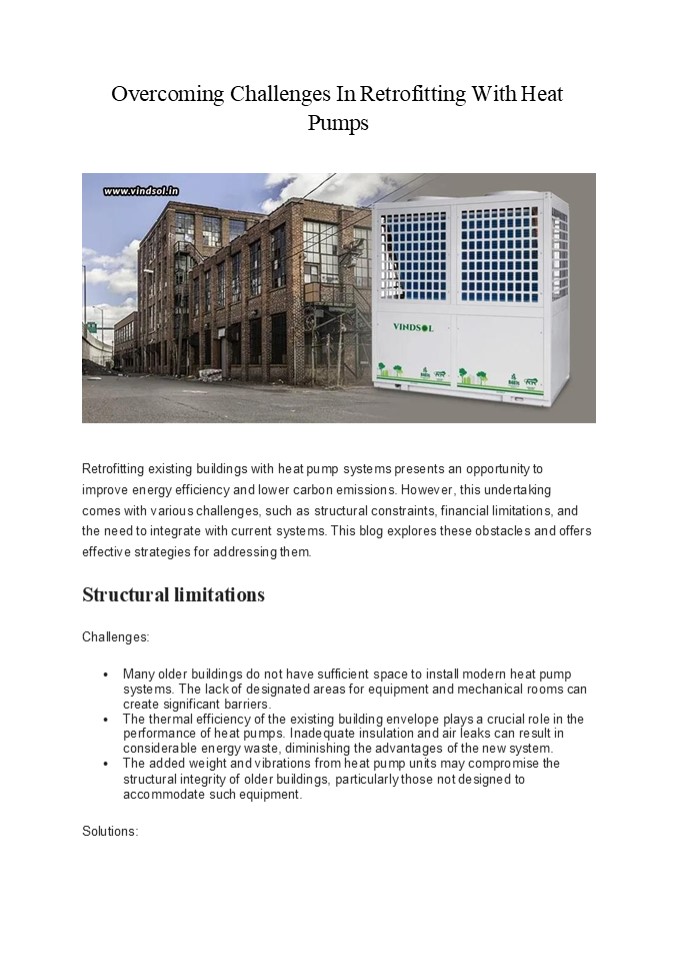
Title: Overcoming Challenges In Retrofitting With Heat Pumps
1
Overcoming Challenges In Retrofitting With Heat
Pumps
Retrofitting existing buildings with heat pump
systems presents an opportunity to improve energy
efficiency and lower carbon emissions. However,
this undertaking comes with various challenges,
such as structural constraints, financial
limitations, and the need to integrate with
current systems. This blog explores these
obstacles and offers effective strategies for
addressing them.
Structural limitations
- Challenges
- Many older buildings do not have sufficient space
to install modern heat pump systems. The lack of
designated areas for equipment and mechanical
rooms can create significant barriers. - The thermal efficiency of the existing building
envelope plays a crucial role in the performance
of heat pumps. Inadequate insulation and air
leaks can result in considerable energy waste,
diminishing the advantages of the new system. - The added weight and vibrations from heat pump
units may compromise the - structural integrity of older buildings,
particularly those not designed to accommodate
such equipment. - Solutions
2
- Perform a comprehensive evaluation of the
available space to pinpoint potential
installation sites. Utilizing innovative options,
such as compact or modular heat pump units, can
help fit them into limited areas. Working with
skilled engineers and architects can lead to
inventive placements that require minimal
structural changes. - Focus on enhancing the buildings insulation and
sealing any air leaks prior to - heat pump installation. Improving the thermal
envelope will ensure the heat pump functions
efficiently, maintaining consistent indoor
comfort and lowering energy expenses. - Consult with structural engineers to assess the
buildings ability to support the - new system. Reinforcements or adjustments may be
needed to guarantee safety and durability.
Choosing lightweight and vibration-dampening
equipment can also help alleviate potential
structural concerns.
Budget constraints
- Challenges
- The initial expenses related to the purchase and
installation of heat pump systems can be
significant, creating a challenge for numerous
property owners. - Retrofitting projects might face unforeseen costs
due to hidden problems such as asbestos,
outdated wiring, or structural deficiencies that
are uncovered during the installation process. - Solutions
- Investigate financial incentives, grants, and
subsidies provided by governmental bodies and
organizations that encourage energy-efficient
improvements. Conducting a life-cycle cost
analysis can demonstrate long-term savings on
energy expenses, which may help justify the
initial investment. Financing options, including
loans or leasing agreements, can also ease the
immediate financial strain. - Set aside a contingency budget to manage
unexpected costs. Carry out thorough - pre-installation assessments to identify and
prepare for potential challenges, thereby
minimizing the risk of budget overruns.
Integration with existing systems
- Challenges
- The integration of heat pumps with current
heating, ventilation, and air conditioning (HVAC)
systems can be intricate, particularly if the
existing infrastructure is outdated or
incompatible. - Heat pumps necessitate sufficient electrical
capacity, which older buildings may - not possess, potentially leading to overloads or
the requirement for electrical system upgrades. - It is essential to ensure that new heat pump
systems can effectively communicate with existing
building management systems (BMS) for optimal
functionality.
3
- Solutions
- Conduct a comprehensive assessment of the current
HVAC components to evaluate compatibility. In
certain situations, partial upgrades or hybrid
systems that combine heat pumps with traditional
boilers may be effective solutions. Utilizing
advanced control systems can enhance integration
and operational efficiency. - Evaluate the buildings electrical infrastructure
to confirm it can accommodate the additional
load. Upgrading the electrical system may be
essential to safely meet the heat pumps
requirements. Implementing energy management
systems can optimize electricity consumption and
prevent overload situations. - Consider using compatible control interfaces or
upgrading the Building Management System (BMS) to
support the new equipment. Providing training for
staff on how to operate the integrated system can
improve efficiency and enhance their ability to
address any issues that may occur.
Regulatory and compliance challenges
- Challenges
- Navigating the regulatory environment, which
includes acquiring necessary permits and adhering
to building codes, can be both intricate and
time-intensive. - Buildings of historical importance may face
limitations on modifications, making the
installation of contemporary heat pump systems
more challenging. - Solutions
- Engage with local authorities early in the
planning phase to gain insight into specific
requirements and expedite the approval process.
Employing professionals who are well-versed in
local regulations can help streamline compliance
and mitigate potential legal complications. - Collaborate closely with preservation
organizations and regulatory agencies to - create solutions that honour the buildings
historical significance while integrating
energy-efficient technologies. It may be
necessary to design custom systems that harmonize
with the architectural style.
Operational considerations
- Challenges
- It is crucial for maintenance staff to be
well-acquainted with the new heat pump system to
ensure its effective performance and durability. - Occupants may need to adapt to different
operational features, such as extended - run times or altered temperature settings, when
transitioning to a new heating and cooling
system. - Solutions
4
- Offer thorough training for in-house maintenance
teams or set up service agreements with
specialized technicians. Implementing regular
maintenance schedules will help prevent issues
and sustain efficiency. - Inform building occupants about the advantages
and operational differences of - the new system. Addressing their concerns and
providing clear guidance can ease the transition
and improve overall satisfaction. - Upgrading existing buildings with heat pumps
offers a practical solution for enhancing energy
efficiency and minimizing environmental effects.
Although there are notable challenges, including
structural restrictions, financial limitations,
and the complexities of system integration, these
can be navigated successfully with thorough
planning, collaboration with skilled
professionals, and utilizing available resources.
Collaborating with reputable companies like
Vindsol for commercial heat pump in - Bangalore guarantees expert assistance and
cutting-edge technology designed for - successful retrofitting. By tackling these
challenges head-on, property owners can
effectively adopt heat pump technology, resulting
in lasting economic and environmental advantages. - Resource Read more
Recommended

