

Discover the Anti-Aging Benefits of Exosome Therapy PowerPoint PPT Presentation
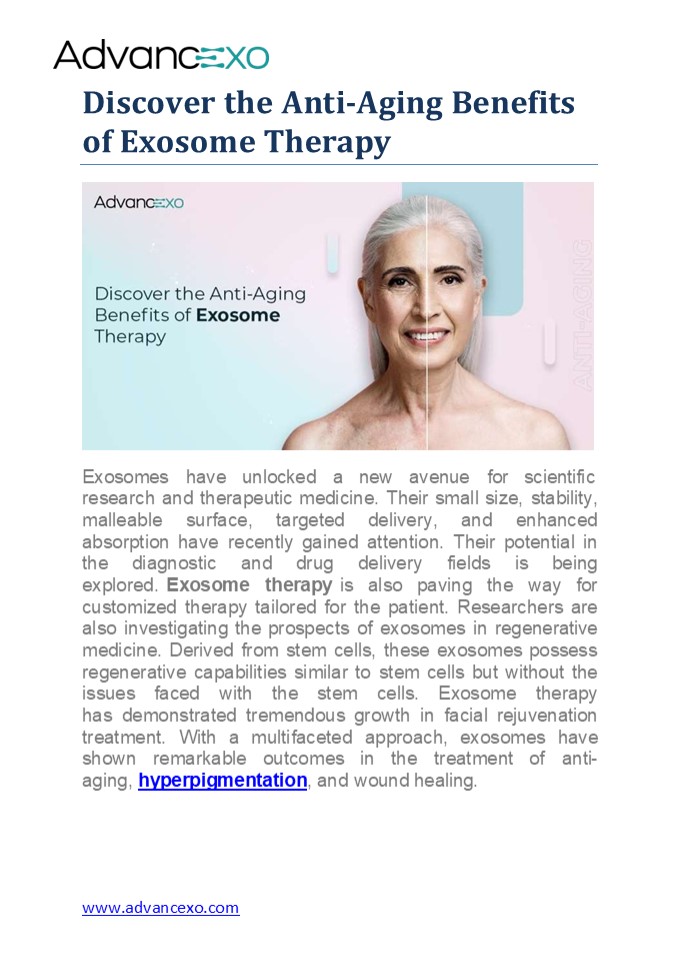
Title: Discover the Anti-Aging Benefits of Exosome Therapy
1
Discover the Anti-Aging Benefits of Exosome
Therapy
Exosomes have
unlocked a new avenue for scientific
research and therapeutic medicine. Their small
size, stability, malleable surface, targeted
delivery, and enhanced absorption have
recently gained attention. Their potential in the
diagnostic and drug delivery fields
is being explored. Exosome therapy is also
paving the way for customized therapy tailored
for the patient. Researchers are also
investigating the prospects of exosomes in
regenerative medicine. Derived from stem cells,
these exosomes possess regenerative capabilities
similar to stem cells but without the issues
faced with the stem cells. Exosome therapy
has demonstrated tremendous growth in facial
rejuvenation treatment. With a multifaceted
approach, exosomes have shown remarkable
outcomes in the treatment of anti- aging,
hyperpigmentation, and wound healing.
www.advancexo.com
2
Mechanism behind Aging Aging can occur due to
genetic and environmental factors, largely
categorizing it as intrinsic and extrinsic aging.
Intrinsic aging is a natural phenomenon
programmed into the genetic structure of a
person. Extrinsic aging results from exposure to
pollution, UV rays, heat, etc., that initiates
cellular processes contributing to the early
aging. Together these factors induce
physiological changes such as wrinkles, creasing,
dry skin, sagging skin, reduced elasticity,
and hyperpigmentation. Thus, the aging
process significantly deteriorates the
appearance of a person. Numerous research
studies have delineated mechanisms behind this
process. Cellular senescence
Age-related accumulation of chromosomal damage and
and
telomere shortening induce cellular senescence
apoptosis, decreasing the turnover of skin
cells. UV ray exposure increases the oxidative
stress in these cells by inhibiting antioxidants
and augmenting the occurrence of reactive
oxygen species (ROS). These ROS damages DNA,
proteins, and lipids, which deteriorate the cell
membrane, leading to the dysfunction, senescence,
or apoptosis of cells. The effect manifests in
the form of age spots and wrinkles. Degradation
of Extracellular Matrix Fibroblasts in the
dermis layer produce extracellular matrix (ECM).
But these cells markedly decrease with the aging
process, thereby reducing the ECM synthesis.
Moreover, UV radiation on its own and through ROS
upregulates matrix metalloproteinases that
degrade ECM components, further degenerating
collagen and elastin fibers of ECM. Also, the
keratin fibers located in the epidermis layer
stiffen with age and lose the capacity of
movement of water across them. The reduced
density of ECM components combined with their
degradation adversely affects the firmness and
elasticity of the skin.
www.advancexo.com
3
Angiogenesis Along with programmed cellular
damage, aging also reduces the thickness of the
papillary layer of dermis manifested as sagging
of the skin. The age-related impaired
angiogenesis also decreases the vascular
density in the skin, thus alleviating the
blood supply required for cell growth and
development. Lipid content of the skin also
diminishes owing to the aging process. Moreover,
amino acids of the protein also undergo change,
interfering with their water-binding
capacity. On the other hand, UV ray
exposure induces chronic inflammation through
inflammatory cells and cytokines that further
enhance ROS production and upregulate matrix
metalloproteinases. Benefits of Exosome Therapy
for Anti- Aging Exosomes are extracellular
vesicles secreted by cells to mediate
cell-cell signaling in a paracrine manner.
Originally thought to be a cellular waste, the
heterogeneous nature of exosomes proved there is
more to them. Their content and characteristics
depend upon the cells they originated from and
drove in-depth research that uncovered their
therapeutic potential. Their extraction from stem
cells has provided an acellular alternative to
stem cells. Unlike conventional treatments,
exosomes act on all the degenerative processes
and induce natural regenerative healing of the
tissue, giving
them an upper hand in the field of facial
rejuvenation and anti-aging therapy. Effect on
cellular damage
Cells like keratinocytes and fibroblasts are
present in the epidermis and dermis layers of
skin, respectively. The epidermis forms the
outer layer of the skin and fibroblasts
synthesize the extracellular matrix, thus
maintaining the structure and function of
the skin. Several studies have proven
enhanced proliferation and migration of
keratinocytes
www.advancexo.com
4
with the application of exosomes derived from
mesenchymal stem cells. A research study by Wei
Chen et al. demonstrated that these exosomes can
also mitigate senescence in dermal fibroblasts by
inhibiting the expression of senescence-related
proteins. Additionally, the exosomes also
promoted fibroblast migration. By enhancing the
proliferation of cells and reducing their
senescence, exosomes can heal the adverse impact
of the aging process. Effect on
ECM Extracellular matrix (ECM) is composed of
laminin, collagen, dermatan sulfate, perlocan,
elastin, etc. Collagen and elastin are a few of
the key components that provide mechanical
strength, support, stability, firmness, and
elasticity to skin. The team of Kwang-Won Seo
and Kyung-Sun Kang conducted a study
demonstrating that exosomes extracted from the
umbilical cord mesenchymal stem cells prevented
skin from the oxidative stress and promoted wound
healing. In addition, these exosomes
significantly decreased matrix metalloproteinases,
increased collagen synthesis, as well as reduced
cell apoptosis and senescence. A randomized study
by Luiz-Chalres-de-Sa and team showed production
of new elastin fibers and dermis remodeling
with exosome application. This decrease in
metalloproteinases would decrease the ECM
degradation, while the production of elastin
and collagen would enhance ECM deposition,
returning the firmness and elasticity to
skin. Angiogenesis and Hyperpigmentation Exosomes
also have anti-inflammatory and angiogenic
properties that confer anti-aging effects. Kim et
al. proved that exosomes isolated from the
umbilical cord mesenchymal stem cells inhibit
the protein involved in melanogenesis, thus
effectively reducing melanin content and the
resultant skin pigmentation. Exosomes also
diminish ROS concentration, thus preventing
further cellular damage.
www.advancexo.com
5
Applications of Exosome Therapy Cells secrete
exosomes to mediate signaling thus, exosomes
contain all the necessary biomolecules that can
induce the relevant response in specific
cells. The stem cell-derived exosomes also
contain such active molecules that act on
specific cells and induce repair and
regeneration of the tissue. The absence of
the cellular component and their immunogenic
potential, along with targeting specificity,
makes exosomes excellent candidates as
cost-effective and safe therapeutics. It has
driven the scientists to explore the
application of exosomes in other disorders as
well. Skin diseases In addition to aging,
exosomes have been beneficial to other
skin-related problems such as diabetic
wounds, pressure ulcers, scleroderma, etc. The
ability of exosomes to promote wound healing,
cell proliferation, and ECM deposition has
provided relief in these disorders. Moreover,
exosomes have also shown inhibition of
endothelial senescence along with increased
angiogenesis. Combined together, these effects
improve the blood supply to the affected
tissue. Scar Removal Exosomes derived from
umbilical cord MSCs accelerate the scar healing
process and reduce the width of scars by
inhibiting the conversion of fibroblasts into
myofibroblasts, inducing fibroblast
proliferation, increasing collagen
promoting re-
deposition, enhancing angiogenesis, and
epithelialization. Hyperpigmentation
Melanocytes in skin produce melanin to form a
protective shield against harmful UV radiation.
But the hyperactivated melanocytes produce
excess melanin, leading to
hyperpigmentation in the form of dark patches on
the face. Administration of stem cell-derived
exosomes significantly
www.advancexo.com
6
diminishes the levels of melanin by reducing the
enzyme tyrosinase involved in melanin
production. Vitiligo Vitiligo is an autoimmune
disorder in which the immune system destroys
the melanin-producing cells, creating white
patches on the skin. Umbilical cord blood
MSCs-based exosomes regulate the immune
system by inhibiting the immune cells that
attack the cells and expanding regulatory immune
cells that prevent the attack. These exosomes
also lower the oxidative stress, thus decreasing
the apoptosis of melanin-producing cells.
Together, the exosomes act on the immune system
and cell apoptosis to effectively reduce
vitiligo. Conclusion The potential of stem
cell-derived exosomes spans across multiple
therapeutic areas. Stem cell-derived exosomes, in
particular mesenchymal stem cells, have granted
treatment benefits. The exosome therapy has
lower toxicity in comparison to cellular
therapies. Their regenerative abilities have been
employed in the cosmetic field with successful
outcomes. Here at Advancexo we provide
high-quality exosomes derived from umbilical
cord mesenchymal stem cells by following
GMP-compliant methods and perform rigorous
testing and characterization. FAQs Q - What are
exosomes? Exosomes are vesicles that bud off
from cells and are encapsulated by the lipid
bilayer. They are nanometers in size and contain
bioactive molecules like nucleic acids, proteins,
lipids, etc. Cells secrete them to signal the
neighboring cells and induce a specific response.
www.advancexo.com
7
Q - Are exosomes applicable for anti-aging
therapy? Anti-aging therapy requires tissue
regeneration, which can be provided by stem
cells. To avoid the immune rejection risk
associated with stem cells, exosomes are
employed. Exosomes display a multitude of effects
that mitigate the aging effects and restore the
skin. Q - How to procure exosomes? Exosomes have
been isolated from various stem cells. But
exosomes extracted from MSCs belonging to
umbilical cord, also known as Whartons jelly,
have demonstrated profound therapeutic effects.
They are readily available. Advancexo, the
delivers anti-aging
exclusive manufacturer of exosomes in India,
exosomes packaged with anti-inflammatory and
miRNAs.
STAY UPDATED! www.advancexo.com info_at_advancells.co
m 91-9654321400
www.advancexo.com
Recommended

