

Avoiding Claim Denials in DME Billing: A Complete Compliance Guide PowerPoint PPT Presentation
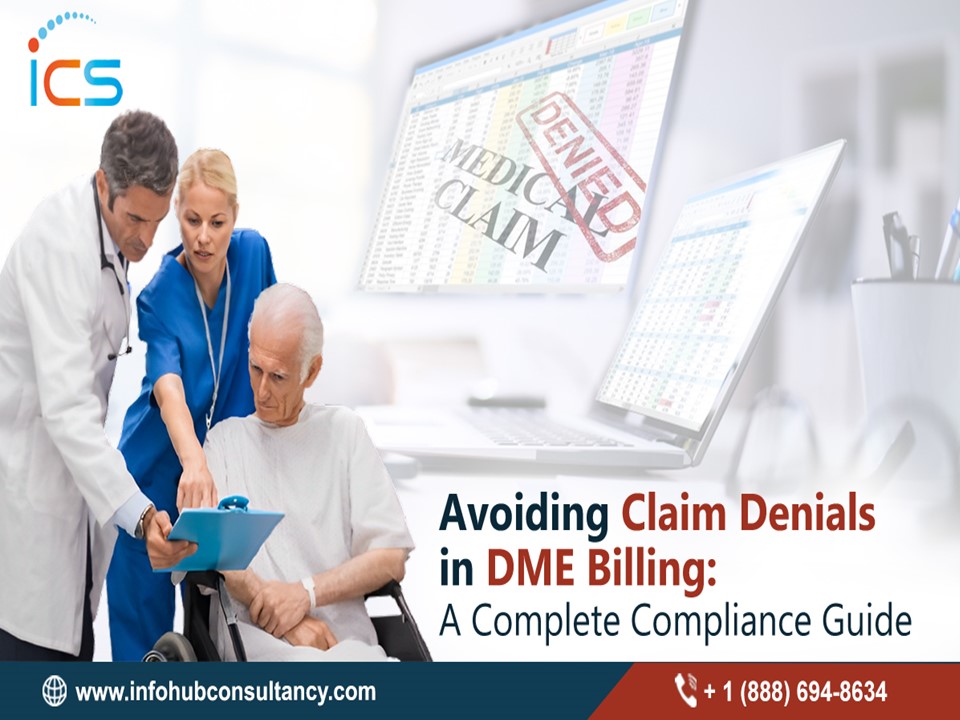
Title: Avoiding Claim Denials in DME Billing: A Complete Compliance Guide
1
(No Transcript)
2
Avoiding Claim Denials in DME Billing A Complete
Compliance Guide
It is important to prioritize Durable Medical
Equipment (DME) billing compliance as it
establishes regulatory requirements and
fundamental business needs. Thereby, DME
providers need to construct systematic approaches
that focus on accuracy, providing transparency
and operational efficiency due to Medicare and
commercial payer guidelines. In fact, DME claims
possess a high error rate due to missing
documentation, coding errors, and non-compliance
factors which have resulted in billions in losses
and triggered multiple audit activities. DME
providers need to implement strategic compliance
measures and automated monitoring systems in
order to protect their operations. This detailed
DME billing compliance guide will show DME
providers how to prevent claim denials. Read
detailed blog https//infohubconsultancy.com/blo
g/avoiding-claim-denials-in-dme-billing-a-complete
-compliance-guide/
inquiry_at_infohubconsultancy.com
3
Avoiding Claim Denials in DME Billing A Complete
Compliance Guide
DME Billing Compliance Guidelines Achieving
billing compliance in Durable Medical Equipment
(DME) requires more than just basic accuracyit
demands precision and timely action. The
following are the compliance guidelines 1.
Proper Documentation Clear, patient-specific
documentation is essential for compliance. Avoid
generic templates and focus on justifying medical
necessity with individualized notes, including
equipment type, usage purpose, and clinical need.
Each medical claim requires documentation
evidence with accurate timestamps and compliance
with HIPAA regulations. Accurate documentation
creates transparency and defends against denial
claims or audits because it displays detailed
care developments.
inquiry_at_infohubconsultancy.com
4
Avoiding Claim Denials in DME Billing A Complete
Compliance Guide
2. Correct Code Selection The correct choice of
HCPCS and ICD-10 codes is fundamental for
submitting clean medical claims. Also, use
correct modifiers and avoid outdated or
mismatched codes. Moreover, stay updated with CMS
revisions and always cross-check coding with
payer-specific requirements. Wrong codes can lead
to denials or fraud flagseven when services were
legitimateso using real-time coding tools or
expert review processes is strongly
recommended. 3. Insurance Verification Insurance
verification isnt just about eligibilityit
includes checking frequency limits, rental vs.
purchase rules, pre-auth requirements, and co-pay
responsibilities. Automating this process can
prevent delays and claim denials. Also, verifying
secondary coverage is essential for maximizing
reimbursement and avoiding coordination issues.
Efficient verification reduces billing errors and
protects patients and providers from financial
surprises.
inquiry_at_infohubconsultancy.com
5
Avoiding Claim Denials in DME Billing A Complete
Compliance Guide
4. Timely Filing Missing claim submission
deadlineseven by a daycan result in total
revenue loss. Payers often set strict limits (90
days to 1 year). It is essential to implement
filing deadline alerts and development of
workflows which will help prevent documentation
delays or prior authorizations. Timely filing is
not just about speedit reflects professionalism
and ensures steady cash flow while keeping your
compliance risk low. 5. Keep Staff Well-Trained
in Compliance Regular training ensures staff
remain updated on DME billing rules, especially
new coding changes, documentation expectations,
and payer-specific regulations. Beyond technical
skills, it promotes a compliance-oriented
culture. Investing in workshops, webinars, and
refreshers also helps avoid billing mistakes and
reduces risk. Therefore, well-informed outsourcing
DME billing teams can resolve issues faster and
submit claims more accurately, supporting better
revenue outcomes.
inquiry_at_infohubconsultancy.com
6
Avoiding Claim Denials in DME Billing A Complete
Compliance Guide
6. Conduct Regular Internal Audits Internal
audits will detect major flaws including billing
mistakes and document failures that threaten to
develop into critical problems. A formal review
process can automatically find unidentified
risks, raise quality standards, and ensure
adherence to payer guidelines. Through
transparency, providers gain the ability to take
prompt corrective actions in order to become more
resistant to audits and compliance
investigations. 7. Collaborate with Referring
Physicians Building strong communication with
referring physicians helps ensure the
completeness and correctness of supporting
documentation. Educating them on billing
requirementslike clearly specifying medical
necessityminimizes discrepancies. This
collaboration strengthens documentation chains,
supports clean claim submissions, and aligns the
clinical and billing workflows, all while
improving the continuity and quality of patient
care.
inquiry_at_infohubconsultancy.com
7
Avoiding Claim Denials in DME Billing A Complete
Compliance Guide
Conclusion Developing a compliance-first billing
infrastructure has become essential because
regulatory vigilance continues to grow in
strength so DME providers must ensure their
long-term success. A well-developed DME billing
process relies on precise documentation,
continuous training, internal audit functions,
and physician-cooperation practices. When
providers follow these practices, they achieve
lower audit and denial risks while improving
operational quality and patient
satisfaction. Outsourcing offshore DME billing
companies such as Info Hub Consultancy Services
allows providers to learn about DME billing
compliance complexities and its obstacles. The
team at Info Hub Consultancy Services delivers
customized techniques to streamline difficult
billing operations, boost staff output, and
protect your financial resources. Our company
offers expert services that help you develop
superior DME billing approaches while conducting
compliance checks to secure your business.
inquiry_at_infohubconsultancy.com
8
Avoiding Claim Denials in DME Billing A Complete
Compliance Guide
Ready to transform your DME billing operations
and ensure complete compliance? Schedule a
meeting with Info Hub Consultancy Services
todaylets build a future-ready DME billing
solution together. Read detailed blog
https//infohubconsultancy.com/blog/avoiding-claim
-denials-in-dme-billing-a-complete-compliance-guid
e/
inquiry_at_infohubconsultancy.com
9
Avoiding Claim Denials in DME Billing A Complete
Compliance Guide
FAQs 1. What is considered non-compliant
behavior in DME billing?Non-compliant behavior
includes billing for equipment not delivered or
submitting claims without physician-signed
documentation. 2. Are DME suppliers responsible
for verifying patient eligibility?DME suppliers
need to check patient eligibility status in
advance to prevent denied claims before
dispensing medical equipment. 3. How often do
Medicare DME rules change?Depending on policy
revisions, Medicare DME guidelines may be updated
quarterly or annually. 4. Can a DME claim be
resubmitted after denial?If corrected and within
the payers timely filing limit, denied DME
claims can be appealed or resubmitted.
inquiry_at_infohubconsultancy.com
10
Avoiding Claim Denials in DME Billing A Complete
Compliance Guide
5. Is prior authorization required for all DME
items?No, only certain high-cost or frequently
misused items require prior authorization from
payers. 6. Do DME providers need to enroll with
every insurance payer?A provider needs to be
enrolled and credentialed with all insurance
payers before they can legally submit billing
claims. 7. What happens if the equipment is
rented for longer than the approved
period?Billing beyond the authorized rental
period can result in denied payments and
compliance penalties.
inquiry_at_infohubconsultancy.com
11
Avoiding Claim Denials in DME Billing A Complete
Compliance Guide
8. Are home assessments mandatory before billing
for certain DMEs?A home assessment may be
required for some equipment types, like hospital
beds or mobility devices. 9. How long should DME
billing records be kept for audit
purposes?Typically, billing records must be
retained for at least 7 years or longer per state
law or payer policy. 10. Can telehealth
evaluations be used for DME prescriptions?Yes,
in many cases, telehealth visits can be used to
support DME prescriptions if the payer allows
them.
inquiry_at_infohubconsultancy.com
12
We at Info Hub Consultancy Services (ICS), a
leading medical billing company in India offer
medical billing solutions to healthcare
organizations, physicians, medical institutions,
and groups. Our revenue management cycle helps
in reducing operational expenses and increasing
the overall revenue. Info Hub Consultancy
Services (ICS) was founded in 2010 and is now
one of the leading service providers of highly
motivated, certified coders, and billers in the
US medical billing industry.
inquiry_at_infohubconsultancy.com
13
Info Hub Consultancy (ICS) Services Pvt. Ltd. Sf
No 558/2, Udayampalyam Rd, Nava India,
Coimbatore, Tamil Nadu 641028 Tel 1 (888)
694-8634 Email - inquiry_at_infohubconsultancy.com
inquiry_at_infohubconsultancy.com
Recommended

