

Creating Resilient Teams in the Hybrid Workplace PowerPoint PPT Presentation
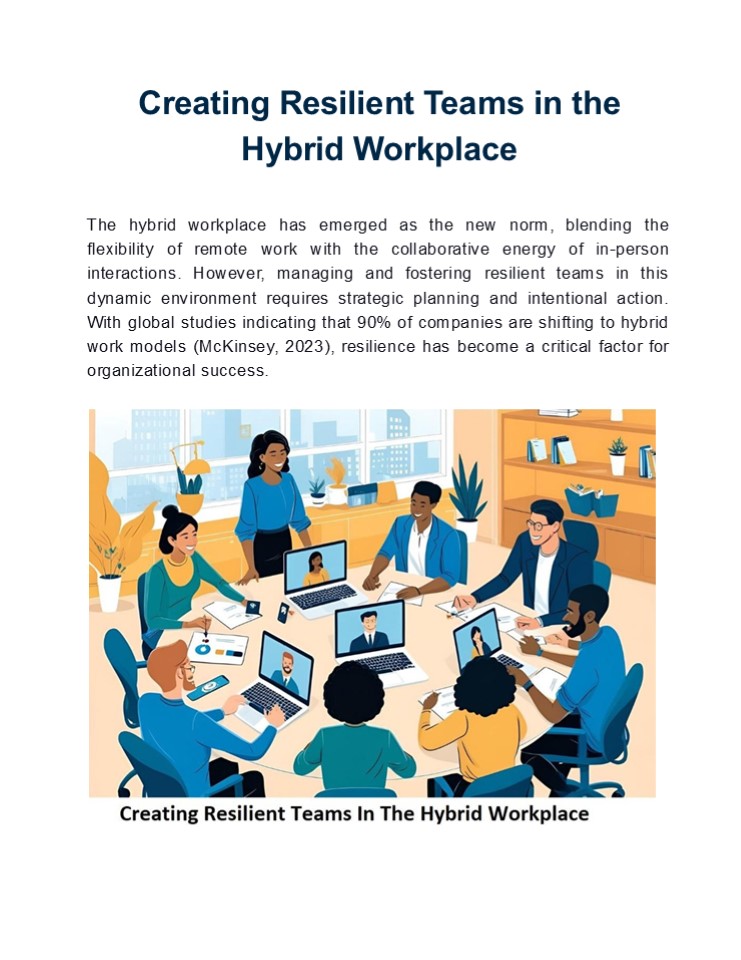
Title: Creating Resilient Teams in the Hybrid Workplace
1
Creating Resilient Teams in the Hybrid Workplace
The hybrid workplace has emerged as the new norm,
blending the flexibility of remote work with the
collaborative energy of in-person interactions.
However, managing and fostering resilient teams
in this dynamic environment requires strategic
planning and intentional action. With global
studies indicating that 90 of companies are
shifting to hybrid work models (McKinsey, 2023),
resilience has become a critical factor for
organizational success.
2
The Importance of Resilient Teams in a Hybrid
Workplace Resilience is the ability to adapt,
recover, and thrive amidst challenges. In a
hybrid setting, where employees navigate between
home offices and shared workspaces, resilience
ensures consistency in performance and team
cohesion. Resilient teams are not only better
equipped to handle disruptions but also more
likely to drive innovation and maintain
productivity.
Key Challenges in The Hybrid Workplace
1. Communication Barriers Remote and in-office
employees may experience disconnects, leading to
misunderstandings and reduced collaboration.
2. Employee Burnout Balancing personal and
professional responsibilities in a hybrid
setting can increase stress.
3. Uneven Access to Resources Disparities in
technology and infrastructure can hinder some
employees from performing at their best.
4. Cultural Drift The lack of shared physical
space may dilute an organizations culture and
values.
Strategies to Build Resilient Teams
1. Foster Open Communication
Transparent and consistent communication is the
foundation of resilience. Regular check-ins,
clear expectations, and leveraging technology for
seamless interaction ensure that all team
members feel informed and valued. Tools like
Slack, Microsoft Teams, and Zoom facilitate
real-time communication, bridging the gap between
remote and in-office employees.
3
2. Prioritize Employee Well-Being
Organizations must actively support mental health
and well-being. According to a report by the
Employee Benefit Research Institute, companies
with robust wellness programs report a 12
increase in employee engagement. Flexible
schedules, mental health resources, and
encouraging work-life balance can significantly
reduce burnout and promote resilience.
3. Invest In Training and Development
Building resilient teams requires upskilling.
Training programs that enhance adaptability,
problem-solving, and emotional intelligence are
essential. Studies show that companies investing
in continuous learning see a 22 increase in team
agility.
4. Leverage Technology for Collaboration
Equipping employees with the right tools ensures
smooth collaboration. Cloud-based platforms like
Google Workspace and project management tools
such as Asana or Trello empower teams to work
efficiently regardless of location.
5. Build A Culture of Trust
The glue that keeps hybrid teams together is
trust. Encouraging autonomy, achievements, and
creating a feedback-driven environment strengthen
trust and resilience. A recent study highlighted
that 86 of employees are more productive in
cultures that prioritize trust.
recognizing
4
Latest Trends in Building Resilient Teams 1.
Data-Driven Insights
Using analytics to monitor team performance and
engagement provides actionable insights. Tools
like Microsoft Viva and Workday help leaders
identify challenges and implement timely
interventions.
2. Emphasis on Inclusion
Hybrid workplaces must prioritize diversity,
equity, and inclusion (DEI). Inclusive policies
ensure every team member feels valued,
contributing to overall resilience.
3. AI And Automation
Artificial intelligence is transforming team
management. AI-driven tools offer predictive
analytics, personalized learning pathways, and
automation of routine tasks, allowing teams to
focus on strategic objectives.
4. Enhanced Cybersecurity
With hybrid models expanding digital footprints,
cybersecurity is paramount. Ensuring data
protection fosters a safe and resilient working
environment.
Statistics and Market Insights
Hybrid Work Adoption By 2025, most organizations
are expected to adopt a hybrid work model, with a
projected CAGR of 18.3 from 2023 to 2032 (Global
News Wire).
?
5
Employee Preferences A 2023 Buffer survey
revealed that 97 of employees desire flexibility
in their work arrangements, underscoring the
importance of hybrid models.
?
Resilience Metrics Companies with high
resilience scores experience 59 lower turnover
rates and 21 higher profitability (Forbes).
?
Conclusion
Building resilient teams in a hybrid workplace is
no longer optional but essential for long-term
success. By prioritizing communication,
well-being, and continuous can create
learning
and
leveraging
the
latest
technologies,
organizations
adaptable and cohesive teams ready to face any
challenge.
Recommended

