

Choosing the Right Clipart for Cohesive Infographics PowerPoint PPT Presentation
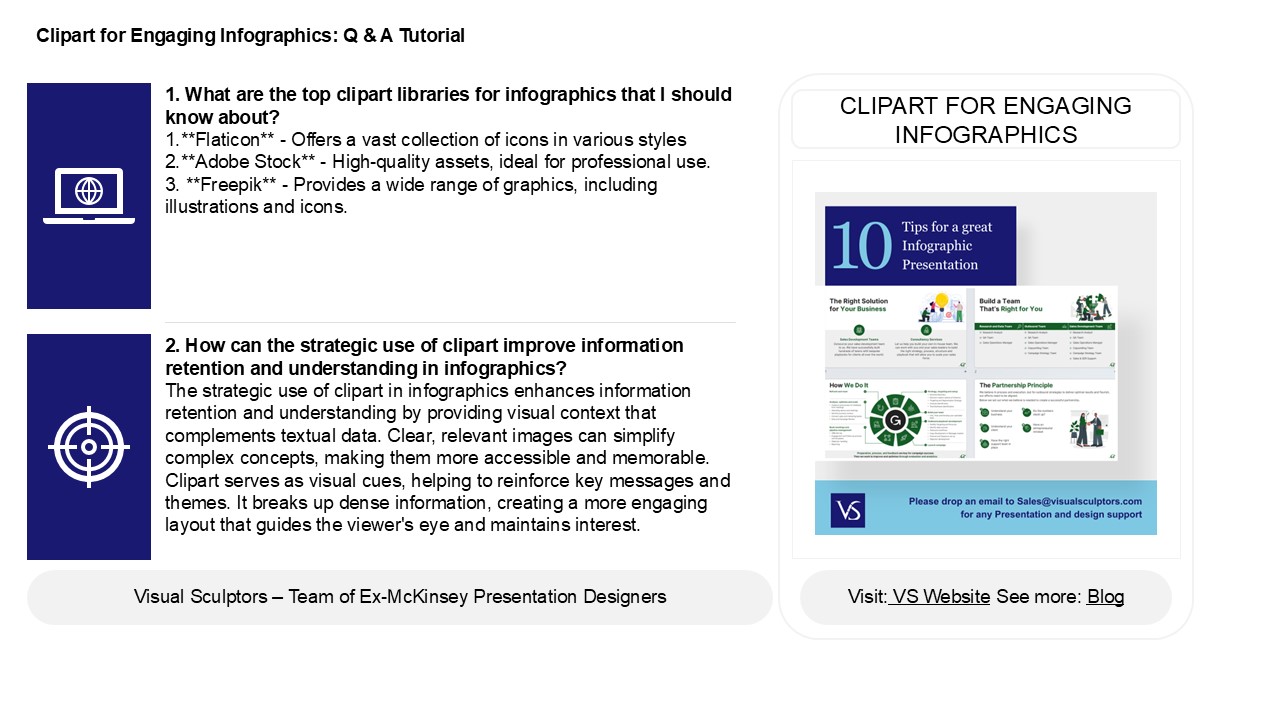
Title: Choosing the Right Clipart for Cohesive Infographics
1
Clipart for Engaging Infographics Q A Tutorial
1. What are the top clipart libraries for
infographics that I should know
about? 1.Flaticon - Offers a vast collection
of icons in various styles 2.Adobe Stock -
High-quality assets, ideal for professional
use.3. Freepik - Provides a wide range of
graphics, including illustrations and icons.
CLIPART FOR ENGAGING INFOGRAPHICS
2. How can the strategic use of clipart improve
information retention and understanding in
infographics? The strategic use of clipart in
infographics enhances information retention and
understanding by providing visual context that
complements textual data. Clear, relevant images
can simplify complex concepts, making them more
accessible and memorable. Clipart serves as
visual cues, helping to reinforce key messages
and themes. It breaks up dense information,
creating a more engaging layout that guides the
viewer's eye and maintains interest.
2
Clipart for Engaging Infographics Q A Tutorial
3. What are some best practices for selecting and
integrating clipart into an infographic design to
maintain a cohesive theme? To maintain a cohesive
theme in infographic design, select clipart that
aligns with your color palette and overall style.
Ensure the clipart is consistent in terms of line
thickness and illustration style (e.g., flat,
outline, or 3D). Limit the number of different
clipart pieces to avoid visual clutter and use
them to support the content rather than distract
from it. Position clipart strategically to
enhance the flow of information and consider
transparency or layering for a more integrated
look. Always ensure that the clipart is
high-quality and properly licensed for your use.
4. In what ways can clipart be customized or
adapted to better fit the branding and messaging
of an infographic? Clipart can be customized by
altering colors to match brand palettes,
modifying shapes and sizes for coherence, and
adding brand logos or icons for recognition.
Incorporating specific fonts associated with the
brand enhances visual consistency. Additionally,
clipart can be adapted by changing styles (e.g.,
from cartoonish to professional) and integrating
relevant imagery that reflects the infographic's
message. Finally, layering or combining clipart
with original graphics can create a unique look
that aligns with the overall branding strategy.
5. What are the potential copyright
considerations when using clipart in
infographics, and how can one ensure
compliance? When using clipart in infographics,
consider copyright ownership and licensing terms.
Many clipart images are protected by copyright,
meaning you need permission or a license to use
them. To ensure compliance, use clipart from
reputable sources that offer clear licensing
agreements, such as royalty-free or Creative
Commons images. Always check the usage rights and
provide attribution if required. Alternatively,
create original designs or purchase clipart from
stock image sites. Keeping documentation of
licenses can also help safeguard against
potential copyright infringement.
Recommended

