

KSA Security Services Market Size, Share and Analysis PowerPoint PPT Presentation
Title: KSA Security Services Market Size, Share and Analysis
1
Understanding the KSA Security Services
Market Landscape in 2025- Key Trends
and Opportunities In todays rapidly transforming
Middle East, security has become more than a
necessityits a strategic priority. Saudi
Arabia, one of the regions economic powerhouses,
has seen a significant surge in demand for
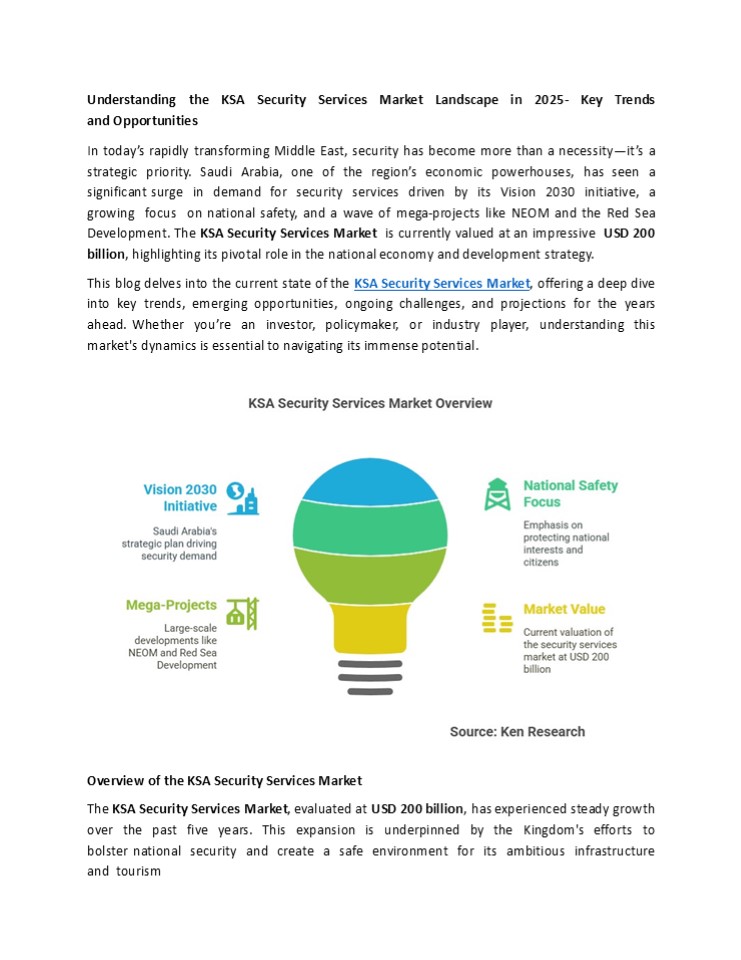
security services driven by its Vision 2030
initiative, a growing focus on national
safety, and a wave of mega-projects like NEOM and
the Red Sea Development. The KSA Security
Services Market is currently valued at an
impressive USD 200 billion, highlighting its
pivotal role in the national economy and
development strategy. This blog delves into the
current state of the KSA Security Services
Market, offering a deep dive into key trends,
emerging opportunities, ongoing challenges, and
projections for the years ahead. Whether youre
an investor, policymaker, or industry
player, understanding this market's dynamics
is essential to navigating its immense potential.
Overview of the KSA Security Services Market The
KSA Security Services Market, evaluated at USD
200 billion, has experienced steady growth over
the past five years. This expansion is
underpinned by the Kingdom's efforts to
bolster national security and create a safe
environment for its ambitious infrastructure
and tourism
2
- projects. While exact CAGR figures vary, the
overall trajectory has been upward, reflecting
the sustained investment in both public and
private sector security. - The market can broadly be segmented by
service type (manned guarding, electronic
security systems, cybersecurity services),
end-users (residential, commercial, government,
and industrial), and geography (major cities
like Riyadh, Jeddah, and the NEOM region).
Manned guarding currently holds the largest
share, given its traditional prevalence, but
there is rapid growth in tech-enabled services
such as surveillance systems, AI-driven
analytics, and cybersecurity. - Historically, the KSA Security Services
Market has responded directly to regional
and global eventsterror threats, geopolitical
instability, and large-scale events like the Hajj
pilgrimage have pushed the need for robust
security mechanisms. Today, this demand is
further amplified by the digital transformation
and smart city initiatives being championed
across the Kingdom. - Key Trends Shaping the KSA Security Services
Market - Integration of Smart Technologies One of the
most prominent trends in the KSA Security
Services Market is the integration of smart
surveillance and monitoring systems into
traditional security frameworks. AI-powered
cameras, facial recognition, motion sensors, and
real-time analytics are becoming standard in
commercial and government projects. With NEOM
aiming to be a fully smart city, the demand for
cutting-edge security tech is expected to
skyrocket. - Rise in Cybersecurity Services With increased
digitalization, cybersecurity is no longer a
nicheits a necessity. Government bodies,
critical infrastructure, and even small
businesses are investing heavily in protecting
their data and digital assets. As Saudi Arabia
becomes a regional tech hub, the cybersecurity
segment is poised for exponential growth within
the broader KSA Security Services Market. - Outsourcing of Security Functions More
companies and institutions are turning to
specialized security service providers rather
than managing in-house teams. This shift is
driven by cost-efficiency, access to trained
professionals, and the need for comprehensive
services including risk assessment, surveillance,
and emergency response. - Demand Surge from Mega-Projects Projects like
NEOM, The Red Sea Development, and - Qiddiya are creating an unprecedented need
for security services. These massive
undertakings require 24/7 monitoring, access
control, and coordinated emergency response
systemsmaking them key revenue drivers for
the KSA Security Services Market. - Regulatory Support and Reforms The
Saudi government has been proactive in - introducing new policies to streamline and
regulate the security industry. Licensing
requirements, training standards, and technology
adoption mandates have improved the
3
quality and accountability of service
providers, fostering a healthier
competitive environment across the KSA Security
Services Market. Also read the market analysis of
Indonesia Security Services Industry Future
Opportunities Growth Opportunities in the KSA
Security Services Market As the market
matures, several untapped opportunities stand
out. First is the cybersecurity sector,
particularly solutions catering to SMEs and
startups. While large enterprises already invest
in cyber protection, smaller businesses are
still catching uprepresenting a major
growth avenue. Second, smart residential security
is gaining traction. With the rise of gated
communities and high-end apartments in cities
like Riyadh and Jeddah, the demand for integrated
home security solutions is increasing. This
includes remote surveillance, AI-powered alarm
systems, and real- time mobile alerts. Additionall
y, international players are eyeing the KSA
Security Services Market for expansion or
collaboration opportunities. Joint ventures,
technology transfers, and franchising models
could be instrumental in meeting rising demand
and bringing global best practices into the
Kingdom. For investors and businesses, aligning
with national infrastructure goals and forming
partnerships with local authorities can pave the
way for scalable growth and long-term
presence. Challenges and Risks in the KSA
Security Services Market Despite its promising
outlook, the KSA Security Services Market is not
without challenges. One of the primary hurdles is
the shortage of skilled personnel. While
technology adoption is high, a lack of training
and expertise can hinder the efficient deployment
and use of advanced systems. Regulatory
compliance also remains a challenge for new
entrants. Meeting licensing criteria and adhering
to local standards requires thorough
understanding and preparation. Moreover, data
privacy concerns surrounding surveillance
and cybersecurity solutions must be
managed delicately to gain user trust. Supply
chain disruptions, particularly in sourcing
high-tech equipment, are another constraint
further amplified by global geopolitical tensions
and trade restrictions. To mitigate these risks,
companies must invest in training programs, build
local partnerships, and focus on innovation-led
differentiation to stay competitive in the KSA
Security Services Market. Future Outlook of the
KSA Security Services Market
4
Looking ahead, the KSA Security Services Market
is expected to maintain its growth momentum over
the next 35 years. By 2030, the market could
potentially exceed USD 300 billion, driven by
continued urbanization, technological
integration, and government reforms. We can
expect increased AI integration, greater use
of IoT-based solutions, and broader
acceptance of cloud-based surveillance and data
analytics. Additionally, as NEOM and similar
smart cities become operational, security
solutions will need to evolve to handle
complex, interconnected environments. The
regulatory environment is also expected to
become more robust, with clear frameworks
supporting data privacy, surveillance ethics, and
AI governance. Conclusion The KSA Security
Services Market stands at a critical
juncturefueled by economic ambition,
technological evolution, and growing safety
concerns. With a current market size of
USD 200 billion and expanding demand across
sectors, the opportunity landscape is vast. From
smart surveillance to cybersecurity, and
from mega-projects to residential security,
this market offers diverse avenues for
innovation and investment. The question now
is How will businesses and investors adapt to
the changing security paradigm in Saudi
Arabia? Read my other blogs in Asia Pacific
Aerospace Plastics Market Trends and Opportunities
Recommended

