

The Role of Conservation in Jawai’s Leopard Population PowerPoint PPT Presentation
Title: The Role of Conservation in Jawai’s Leopard Population
1
The Role of Conservation in Jawais Leopard
Population Jawai, located in the Aravalli Hills
of Rajasthan, is a beautiful and unique
destination known for its stunning landscapes and
rich wildlife. One of its most famous residents
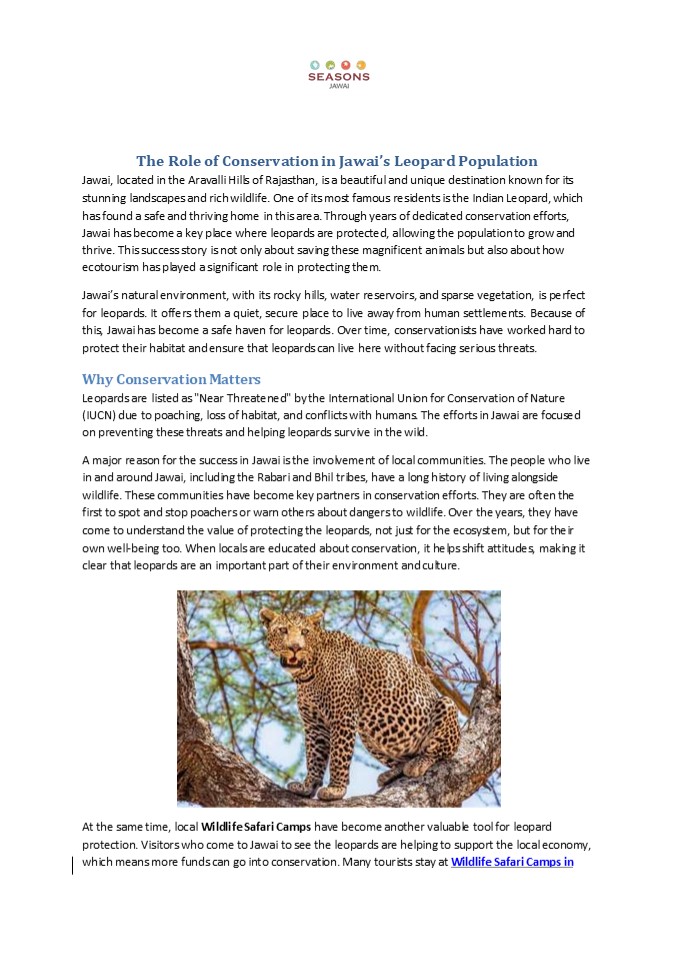
is the Indian Leopard, which has found a safe and
thriving home in this area. Through years of
dedicated conservation efforts, Jawai has become
a key place where leopards are protected,
allowing the population to grow and thrive. This
success story is not only about saving these
magnificent animals but also about how ecotourism
has played a significant role in protecting
them. Jawais natural environment, with its rocky
hills, water reservoirs, and sparse vegetation,
is perfect for leopards. It offers them a quiet,
secure place to live away from human settlements.
Because of this, Jawai has become a safe haven
for leopards. Over time, conservationists have
worked hard to protect their habitat and ensure
that leopards can live here without facing
serious threats. Why Conservation
Matters Leopards are listed as "Near Threatened"
by the International Union for Conservation of
Nature (IUCN) due to poaching, loss of habitat,
and conflicts with humans. The efforts in Jawai
are focused on preventing these threats and
helping leopards survive in the wild. A major
reason for the success in Jawai is the
involvement of local communities. The people who
live in and around Jawai, including the Rabari
and Bhil tribes, have a long history of living
alongside wildlife. These communities have become
key partners in conservation efforts. They are
often the first to spot and stop poachers or warn
others about dangers to wildlife. Over the years,
they have come to understand the value of
protecting the leopards, not just for the
ecosystem, but for their own well-being too. When
locals are educated about conservation, it helps
shift attitudes, making it clear that leopards
are an important part of their environment and
culture.
At the same time, local Wildlife Safari Camps
have become another valuable tool for leopard
protection. Visitors who come to Jawai to see the
leopards are helping to support the local
economy, which means more funds can go into
conservation. Many tourists stay at Wildlife
Safari Camps in
2
Jawai, where they can safely observe leopards in
the wild, without disturbing them. These eco-
friendly camps play an important role by showing
visitors how wildlife can be protected while also
offering a once-in-a-lifetime experience. How
Eco-Tourism Supports Conservation Eco-tourism is
a growing industry that has become a powerful
tool for wildlife conservation, and Jawai is an
excellent example of this. The region has become
a popular destination for wildlife enthusiasts
who want to see leopards in their natural
habitat. The number of visitors has increased
over the years, which has not only brought more
awareness to leopard conservation but has
also helped the local economy grow. For those who
want a comfortable experience while being close
to nature, Luxury Resorts in Jawai Rajasthan
offer a perfect blend of relaxation and
adventure. These resorts offer top-notch
services, but they are also built to have a
minimal impact on the environment. Protecting the
Leopards Home In addition to community
involvement and eco-tourism, habitat protection
is a vital part of leopard conservation in Jawai.
The leopards depend on the regions natural
environment the rocky hills, the dry forests,
and the open grasslands to survive. However,
human development, such as building roads and
expanding agriculture, can lead to the
destruction of these habitats. To prevent this,
efforts have been made to restore and protect the
leopards habitat. Local authorities, along with
conservation groups, have set up protected areas
where development is limited. Theyve also worked
on creating wildlife corridors, which are
pathways that allow animals to move safely
between areas without coming into contact with
human activity. Looking Ahead A Bright Future
for Jawais Leopards The future of Jawais
leopards looks promising, thanks to the ongoing
conservation work and the growing support from
local communities, wildlife organizations, and
eco-tourists. The region serves as a great
example of how people and wildlife can live side
by side, and how ecotourism can play a big part
in protecting endangered species. The continued
success of conservation in Jawai will depend on
keeping a balance between development and
protecting the environment. The role of Luxury
Resorts in Jawai Rajasthan and Wildlife Safari
Camps in Jawai such as Seasons Resort will remain
crucial in this effort. These places not only
offer an amazing wildlife experience but also
generate funds that can go directly into
protecting the leopards and their habitat. As
tourists visit and enjoy the beauty of Jawai,
they also contribute to the survival of one of
Indias most iconic wild animals. In conclusion,
the conservation efforts in Jawai have made a
huge difference in the survival of the Indian
Leopard. As long as we continue to work together
to protect their environment, Jawais leopards
will thrive for generations to come.
Recommended

