

How Advanced Planning Saves Money on Custom Sock Orders PowerPoint PPT Presentation
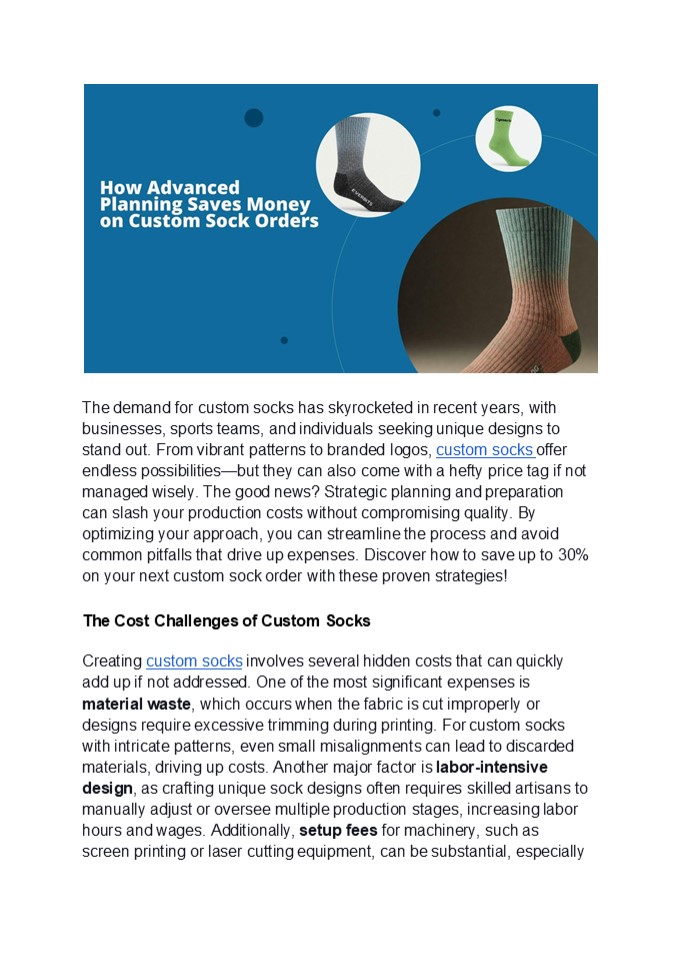
Title: How Advanced Planning Saves Money on Custom Sock Orders
1
The demand for custom socks has skyrocketed in
recent years, with businesses, sports teams, and
individuals seeking unique designs to stand out.
From vibrant patterns to branded logos, custom
socks offer endless possibilitiesbut they can
also come with a hefty price tag if not managed
wisely. The good news? Strategic planning and
preparation can slash your production costs
without compromising quality. By optimizing your
approach, you can streamline the process and
avoid common pitfalls that drive up expenses.
Discover how to save up to 30 on your next
custom sock order with these proven
strategies! The Cost Challenges of Custom
Socks Creating custom socks involves several
hidden costs that can quickly add up if not
addressed. One of the most significant expenses
is material waste, which occurs when the fabric
is cut improperly or designs require excessive
trimming during printing. For custom socks with
intricate patterns, even small misalignments can
lead to discarded materials, driving up costs.
Another major factor is labor-intensive design,
as crafting unique sock designs often requires
skilled artisans to manually adjust or oversee
multiple production stages, increasing labor
hours and wages. Additionally, setup fees for
machinery, such as screen printing or laser
cutting equipment, can be substantial, especially
2
for small batches where the cost per unit rises
due to initial configuration time. Unplanned
production exacerbates these challenges by
introducing inefficiencies at every turn. Without
a clear strategy, businesses may order excess
materials, misjudge production timelines, or fail
to optimize design layouts, leading to wasted
resources and delayed deliveries. This lack of
foresight often results in rushed corrections,
further inflating costs as teams scramble to meet
deadlines. Consider a relatable example a small
business specializing in custom socks for local
sports teams decides to fulfill a bulk order of
500 pairs without proper planning. They order
extra fabric to account for potential errors but
overestimate their needs, leaving 20 of the
material unused. The design team spends extra
hours manually refining a complex logo, doubling
labor costs. Setup fees for the printing
machines, spread across a short run, also hike
the price per pair. In the end, the business
overspends by 25, cutting into its profit
margins and straining its budget, all due to a
lack of advanced planning for its custom sock
production. Advanced Planning Techniques Effectiv
e planning is the cornerstone of reducing costs
in custom sock production. One key step is
digital design optimization, which involves using
software to refine custom sock designs before
production begins. This process ensures patterns
and logos are scaled and aligned perfectly,
minimizing material waste by maximizing fabric
usage. For instance, adjusting the placement of a
team logo on custom socks can reduce the need for
excess trimming, saving both time and
resources. Another critical technique is batch
scheduling, where production is organized into
efficient runs based on order size and design
similarity. By grouping similar custom sock
designs together, businesses can reduce machine
setup times and streamline workflows, avoiding
the downtime that comes with frequent equipment
recalibration. To support these techniques,
several tools and software can enhance efficiency
in pattern layout. Programs like Adobe
Illustrator or specialized
3
textile design software such as Optitex allow for
precise digital mockups, ensuring custom socks
are optimized for minimal waste. Additionally,
nesting software like Gerber Accumark
automatically arranges patterns on fabric sheets
to fit the maximum number of custom sock designs,
reducing scrap material by up to 15. These tools
empower manufacturers to visualize and adjust
layouts digitally, catching potential issues
before cutting begins. Equally important is the
role of supplier communication in cost reduction.
Establishing a clear dialogue with fabric and
equipment suppliers ensures the timely delivery
of materials tailored to custom sock needs,
avoiding overstocking or rush fees. For example,
discussing production schedules with a supplier
can lock in bulk fabric discounts or negotiate
lower setup costs for specialized printing
machines. Regular updates on order progress also
help align expectations, preventing costly
last-minute changes that could disrupt the custom
sock production line. By fostering this
partnership, businesses can leverage supplier
expertise to identify cost-saving opportunities,
making the entire process more economical. Prepar
ation for Success Thorough preparation is
essential to ensure a smooth and cost-effective
production process for custom socks. A key aspect
of this is conducting pre-production checks,
starting with material selection. Choosing the
right fabric for custom socks, such as a durable
cotton-polyester blend, can prevent issues like
stretching or fading during printing, reducing
the likelihood of wasted materials. Next,
ensuring accuracy is critical. This involves
verifying that they match the digital designs
precisely, and checking for alignment and detail
clarity to avoid misprints on custom socks that
could lead to costly reprints. Finally, equipment
readiness must be confirmed before production
begins. This means inspecting printing machines,
laser cutters, and drying units to ensure theyre
calibrated and functioning, preventing breakdowns
that could delay the custom sock production
schedule.
4
To streamline these preparations, creating a
checklist or timeline is highly recommended. A
checklist might include tasks like "Confirm
fabric quality with supplier," "Run a test
print," and "Calibrate printer settings for
custom sock designs." A timeline could allocate
specific days for each stepsay, Day 1 for
material sourcing, Day 2 for verification, and
Day 3 for equipment testingensuring all bases
are covered systematically. This structured
approach keeps the production of custom socks on
track, minimizing the risk of oversights that
could inflate costs or cause delays. Equally
crucial is the importance of testing a small
batch before full production. Producing a trial
run of, say, 10 pairs of custom socks allows
businesses to identify potential issues, like
color bleeding or misalignment, without risking
an entire order. For example, if a small batch
reveals that the ink smudges on a particular
fabric, adjustments can be made before printing
hundreds of custom socks, saving both time and
resources. This step acts as a safeguard,
ensuring that the final run meets quality
standards while keeping expenses in
check. Real-World Savings The impact of
advanced planning and preparation becomes clear
when applied to real-world scenarios,
particularly in custom sock production. Consider
a case study a mid-sized retailer producing
1,000 pairs of custom socks for a local marathon
event. Initially, without planning, they faced
25 material waste due to inefficient layouts and
misaligned prints, costing an extra 500 in
fabric and ink. After implementing digital design
optimization and batch scheduling, they reduced
waste to just 5, saving 400, a 20 reduction.
Testing a small batch also caught a color
mismatch early, avoiding a 300 reprint cost.
This strategic approach saved 700 in total,
boosting their profit margin significantly. Beyon
d immediate savings, these methods offer
long-term benefits that enhance custom sock
production over time. Consistent quality is a
major advantage, as optimized and rigorous
pre-production checks ensure every pair meets the
same high standard, building customer trust and
reducing returns. For instance, a brand producing
custom socks with a signature design can maintain
its reputation without the variability that
5
- plagued earlier, unplanned runs. Additionally,
faster turnarounds become possible with
streamlined workflows and ready equipment,
enabling the retailer to fulfill orders more
quickly. This efficiency can lead to repeat
business, as the marathon organizer returns for
future events, confident in the timely deliveries
of their custom socks. - Conclusion
- By adopting advanced planning and preparation,
producing custom socks can become both
cost-effective and efficient, saving you money
while maintaining high quality. From optimizing
designs to testing small batches, these
strategies tackle the biggest cost challenges
head-on, ensuring every pair of custom socks
meets your expectations without breaking the
bank. Ready to take your custom sock production
to the next level? Connect with EverLighten today
and benefit from - 100 Customization Tailor every detail to your
vision. - 100 Quality Check Every sock meets rigorous
standards. - Free Design Help Expert guidance at no extra
cost. - Worldwide Delivery Get your socks anywhere,
anytime. - 24/7 Support Assistance whenever you need it.
- Unlimited Revisions Perfect your design with no
limits. - Low MOQ Start small without high minimums.
- Reach out to EverLighten now to start saving on
your next custom sock order! - FAQs
- How much can I save with advanced planning for
custom socks? With techniques like digital design
optimization and batch scheduling, you can save
up to 20-30 by reducing material waste,
reprints, and labor costs. - What tools are best for optimizing custom sock
designs? Software like Adobe Illustrator for
design creation and Gerber Accumark for nesting
patterns can help optimize layouts, minimizing
waste during custom sock production. - Why is testing a small batch important for custom
socks? Testing a small batch helps identify
issues like color mismatches or misalignments
early, preventing costly errors in a full
production run of custom socks.
6
- How does supplier communication reduce costs for
custom socks? - Clear communication with suppliers can secure
bulk discounts, align delivery schedules, and
avoid rush fees, all of which lower the overall
cost of custom sock production. - What long-term benefits come from planning custom
sock production? - Advanced planning ensures consistent quality,
faster turnarounds, and reduced waste, leading to
better customer satisfaction and repeat business
for your custom socks.
Recommended

