

Healing After Hernia Repair PowerPoint PPT Presentation
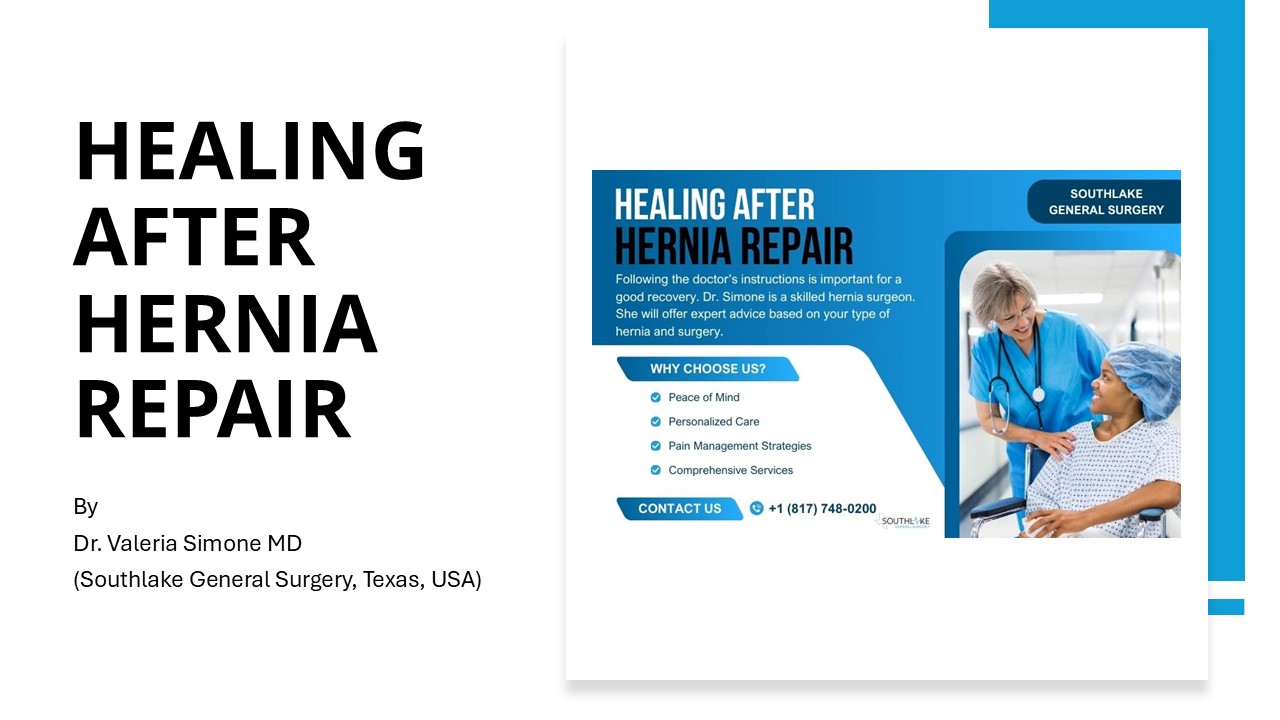
Title: Healing After Hernia Repair
1
HEALING AFTER HERNIA REPAIR
- By
- Dr. Valeria Simone MD
- (Southlake General Surgery, Texas, USA)
2
Overview
- Healing after hernia repair needs patience and
care. The journey of healing varies for each
individual and requires patience. If you follow
your healthcare providers advice closely, you
can help your body heal and recover more quickly. - Every step matters. This includes taking care of
yourself after surgery and slowly going back to
your daily activities. Always listen to your body
and take your time during this healing process.
3
Key Highlights
- Recovery time after hernia surgery is not the
same for everyone. - Many people can leave the hospital on the same
day and go back to work in a few days or up to
two weeks. - You should feel better in a few days and see
progress by the end of the week. - It is important to avoid strenuous activities,
like heavy lifting, for at least four weeks. - You can start walking and do some light exercise
sooner if you feel ready.
4
Immediate Post-Surgery Care
- After your surgery, your doctors will give you
important instructions. Its really important to
follow these rules carefully. They will help you
heal and lower the risk of complications. You
will probably go home on the same day as
your hernia surgery. Be sure to have someone
ready to drive you and help you during the first
24 hours. - In the beginning, you should rest and let your
body heal. You can also try some light
activities, such as walking, when you can. This
will help stop blood clots and improve blood
flow. It can help you heal faster and reduce the
risk of constipation.
5
Importance of Rest and Activity Limitations
- After your hernia repair, you need to rest and
also move around. A lot of rest is good for
healing your surgical site. You should avoid
strenuous activities that can stress your
abdominal muscles. By doing this, you will
recover faster. - Rest is important. It is also good to add light
activities to your day. Walking, for example,
helps blood flow, stops constipation, and keeps
your muscles healthy. Start with short walks
around your home. As you feel better, you can
walk longer distances. - Always pay attention to your body. If you feel
pain or discomfort, stop what you are doing and
take a break. Its better to take it slow than to
push yourself too hard. Doing this can help you
feel better faster.
6
Pain Management Strategies for Hernia Repair
Recovery Time
- After hernia surgery, pain can feel different for
each person. It can also change based on what the
doctor did during the surgery. Your medical team
will probably give you pain medication to help
with any discomfort as you heal. It is important
to take these medications as your doctor says,
even if your pain feels mild. - You can take common pain relievers like
acetaminophen or ibuprofen for mild to moderate
pain. Your doctor may also give you medication
for pain relief. Always remember that you should
speak with your doctor first. They can tell you
if these medicines are safe for you. Your health
history, allergies, and other medicines you take
can affect their safety. - You can feel better by doing simple things along
with your medicine. Using ice packs on the
affected area can help with pain and swelling.
When you are resting, try to lift the surgical
area to reduce swelling. Always talk to your
medical team for advice that fits your needs.
7
Signs to Monitor for Complications Post Hernia
Repair
- Hernia repair is a safe surgery most of the time.
Still, its important to watch for any problems.
If you get a fever over 101 degrees Fahrenheit,
feel cold chills, or have severe pain that does
not improve with pain medication, call your
doctor right away. You should also act fast if
you notice redness, swelling, or any discharge at
the incision site. Stay alert for these signs of
complications - If you notice swelling, redness, warmth, and feel
pain in your leg, it could mean you have a blood
clot or deep vein thrombosis (DVT). - If you feel short of breath or have chest pain,
it might mean you have a pulmonary embolism. This
can happen if a blood clot moves to your lungs. - Its important to spot and deal with problems
early. This can make you feel better and reduce
the chance of long-term health issues. By being
aware and taking action, you can look after your
health after surgery.
8
Short-Term Recovery Guidelines
- After your hernia repair, your body needs time to
heal. Some tips can help you feel better and
recover faster. These tips usually involve
changing your daily activities, diet, and
lifestyle. - Listen closely to your doctors instructions
about how to take care of your wound. Pay
attention to the medications you should use and
the activities you should stay away from. If you
follow these steps, it will help your body heal.
This will make you feel better and lower the
chance of problems.
9
Gradual Increase in Physical Activities for
Recovery After Hernia Repair
- As your cut gets better and the pain goes down,
you can do more activities. Its good to start
slow and then make your exercises a bit harder or
longer. Begin with quick walks and easy jobs at
home. Dont lift heavy things or do tough
movements that might hurt your stomach muscles. - About two weeks after your surgery, you can start
driving again. You can also do some light
exercises. This includes activities like cycling,
swimming, or using an elliptical machine. Pay
attention to your body. If you experience any
pain or discomfort, please pause and rest for a
moment. - Before starting a new exercise plan, you should
talk to your surgeon or a physical therapist.
They are able to observe your healing progress.
They will provide you with useful suggestions
tailored to your needs. The type of surgery you
underwent will be taken into account.
10
Dietary Recommendations for Healing After Hernia
Repair
- Eating well is key to your recovery after hernia
surgery. Choosing nutritious foods helps your
body heal and strengthens your immune system. Be
sure to add plenty of fruits, vegetables, and
whole grains to your meals. These foods offer
important vitamins, minerals, and fiber. - Its very important to drink enough fluids,
especially water, for your recovery. Drinking
lots of fluids can help you avoid dehydration. It
helps with digestion, too, and can keep
constipation from occurring. After surgery, if
you take some pain medicines, you might
experience constipation. - Its a good idea to eat foods that have a lot of
protein. Protein is key for your body. It helps
to fix and grow tissues. Some good sources of
protein are lean meats, poultry, fish, beans,
lentils, and low-fat dairy products.
11
Importance of Follow-up Appointments
- Seeing your healthcare team for follow-up
appointments is very important for your recovery.
These visits allow your surgeon to see how you
are doing. They can answer your questions and
make sure you are healing properly. - During these appointments, your doctor will
examine your incision site. They will check your
pain level. If necessary, they might adjust your
medicine. This is a great time to talk about any
issues you are facing, like trouble sleeping,
constipation, or handling daily tasks. - It is important to talk openly with your
healthcare team as you recover. If you stick to
the doctors instructions, ask questions, and
share your concerns, you will receive the care
you need. This can help you feel better and
return to your daily life. - Lets explore more Healing After Hernia Repair
Expert Advice Southlake General Surgery
12
Make an Appointment
- To feel better after having a hernia repair, you
should visit Dr. Valeria Simone, MD, at Southlake
General Surgery in Texas, USA. You can contact
our healthcare expert today at 1 (817) 7480200.
You can also make an online appointment with us. - Following the doctors instructions is important
for a good recovery. Dr. Simone is a skilled
hernia surgeon. She will offer expert advice
based on your type of hernia and surgery. This
will help create a care plan that meets your
needs. Trust the Hernia Center of Southlake
General Surgery for full support during your
healing process.
13
- Medically Reviewed By Dr. Valeria Simone, MD
- Board-certified General Surgeon at Southlake
General Surgery, Texas, USA. - Follow us on Facebook and YouTube.
- Source Healing After Hernia Repair Expert
Advice Southlake General Surgery
14
THANK YOU!
SOUTHLAKE GENERAL SURGERY
1545 E. Southlake Blvd, Suite 270 Southlake, TX
EMAIL info_at_southlakegeneralsurgery.com
VISIT US AT www.southlakegeneralsurgery.com
Recommended

