

Why SMS OTP is Critical for Secure Online Banking PowerPoint PPT Presentation
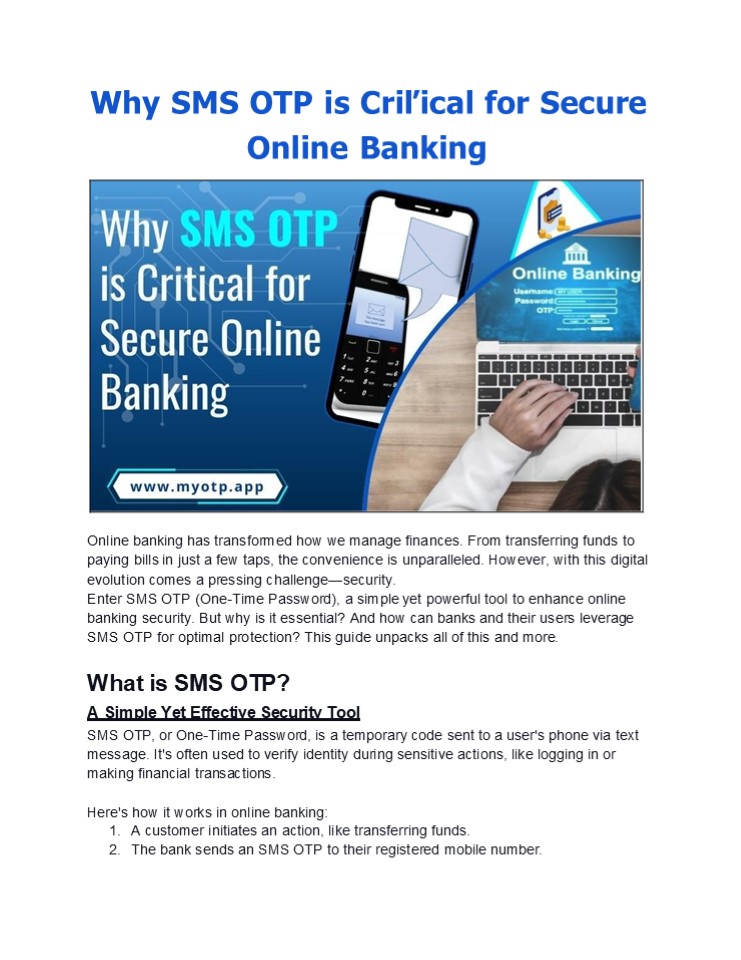
Title: Why SMS OTP is Critical for Secure Online Banking
1
Why SMS OTP is Crilical for Secure Online Banking
- Online banking has transformed how we manage
finances. From transferring funds to paying bills
in just a few taps, the convenience is
unparalleled. However, with this digital
evolution comes a pressing challengesecurity. - Enter SMS OTP (One-Time Password), a simple yet
powerful tool to enhance online banking security.
But why is it essential? And how can banks and
their users leverage SMS OTP for optimal
protection? This guide unpacks all of this and
more. - What is SMS OTP?
- A Simple Yet Effective Security Tool
- SMS OTP, or One-Time Password, is a temporary
code sent to a user's phone via text message.
It's often used to verify identity during
sensitive actions, like logging in or making
financial transactions. - Here's how it works in online banking
- A customer initiates an action, like transferring
funds. - The bank sends an SMS OTP to their registered
mobile number.
2
- 3. The customer enters the OTP on the platform,
proving their identity. - Example Imagine Lisa wants to transfer 500 to a
friend. Once she inputs the transfer details, her
bank sends a 6-digit OTP to her phone. She enters
the code to complete the transaction. Without
this step, the transaction won't proceed,
safeguarding her account from unauthorized
access. - The Growing Need for Secure Authentication in
Banking - Why Passwords Are No Longer Enough
- Cyberattacks are on the rise, and financial
institutions are prime targets. According to the
FBI, fraud losses from business email scams
exceeded 2.7 billion in the U.S. in 2022 alone.
Hackers exploit weak passwords, phishing tactics,
and vulnerable systems to gain access to
financial accounts. - Traditional passwords can no longer stand alone
as a reliable defense. They're often reused, easy
to guess, or compromised in data breaches. This
is where SMS OTP steps in as a robust second
layer of authentication. - SMS OTP vs. Cybercrime
- By requiring real-time verification, SMS OTP
reduces the chances of unauthorized logins and
fraudulent transactions. Even if a hacker knows a
user's password, they'd still need the OTP sent
to the user's secured device to complete any
action. - Also read How Fintech Apps in the USA Are
Leveraging 2FA SMS APIs - Benefits of SMS OTP in Online Banking
- Why should banks and their customers rely on SMS
OTP? Here are the key advantages - Enhanced Security
- While sms is sent for verification, each OTP is
unique and valid for a limited time, making it
challenging for hackers to intercept or reuse. - Two-Factor Authentication (2FA)
3
- SMS OTP acts as an alert system. Whenever an
action is initiated, users are instantly
notified, enabling them to stop any fraudulent
attempts in real-time. - User Convenience
- Unlike complex security measures, SMS OTP is easy
to use. It doesn't require users to download
extra apps or remember additional information. - Common Use Cases in Banking
- SMS OTP isn't a one-size-fits-all solution it's
versatile. Banks use it for various high-risk
tasks, including - Login Authentication Verifies users during the
login process. - Fund Transfers and Bill Payments Adds a layer of
security to significant financial transactions. - Password Resets Ensures that only the account
owner can reset their credentials. - Cardless ATM Withdrawals Allows users to
withdraw cash without a physical card by using an
SMS OTP. - Limitations of SMS OTP (and How Banks Handle
Them) - While SMS OTP is a powerful tool, it does have
its limitations. - SIM Swap Attacks
- Hackers can perform SIM swap fraud by
transferring a victim's number to their device.
To combat this, banks use additional security
measures like device recognition and transaction
monitoring. - Delivery Delays
- Network issues can delay SMS delivery, causing
frustration. Banks tackle this by offering
alternatives like email OTPs or app-based
authentication to ensure seamless user access. - Dependency on Mobile Availability
- If a user doesnt have access to their phone,
they cant receive OTPs. Some banks offer backup
codes or biometric authentication (e.g.,
fingerprints) as fallback options.
4
- Mobile-First Banking Users
- With the growing trend of mobile-first banking
customers, SMS OTP will remain essential for
ensuring seamless and secure experiences. - Use in Multi-Factor Authentication (MFA)
- SMS OTP is becoming a core part of MFA
strategies, which mix multiple security layers to
safeguard user accounts. - Why SMS OTP for Web Applications Like Banking
Matters - For banks, prioritizing secure authentication
isn't optional it's essential. With cyber risks
mounting, SMS OTP offers a protection mechanism
that's reliable, user-friendly, and scalable. - If you're looking to integrate SMS OTP into your
banking app or financial system, consider
platforms like MyOTP.App. Their SMS OTP API
services provide fast, reliable, and customizable
solutions tailored to your needs. - Secure Banking Begins Here
- Banking professionals and tech-savvy users alike
agree that strong authentication makes all the
difference in online banking. SMS OTP bridges the
gap between convenience and high security,
protecting both users and institutions from
evolving threats. - Start upgrading your security today. Explore
MyOTP.Apps SMS OTP API platform to integrate
seamless OTP verification into your banking
applications.
Recommended

