

Density Functional Theory Richard M' Martin University of Illinois PowerPoint PPT Presentation
1 / 43
Title: Density Functional Theory Richard M' Martin University of Illinois
1
Density Functional TheoryRichard M. Martin
University of Illinois
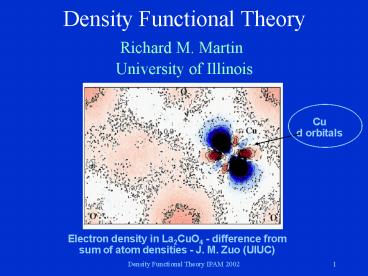
Cud orbitals
Electron density in La2CuO4 - difference from sum
of atom densities - J. M. Zuo (UIUC)
2
Outline
- DFT is an approach to Interacting Many-Body
Problems - Hohenberg-Kohn Theorems Levy-Lieb Construction
- Kohn-Sham Ansatz allows in principle exact
solution for ground state of many-body system
using independent particle methods - Classes of functionals LDA, GGA, OEP, .
- Examples of Results
- Locality Principles and linear scaling
- Electric polarization in crystals - deep issues
that bring out stimulating questions about DFT,
and the differences between the Hohenberg-Kohn
and Kohn-Sham approaches
3
Questions for you
- Why were orbitals mentioned on the introductory
slide and not simply density - Can you tell whether La2CuO4 is an insulator or a
metal just by looking at the density?If so, what
aspects of the density? - Is Kohn-Sham theory the same as Density
Functional Theory? - If not, what is the difference? What did
Kohn-Sham add? What did they subtract? - Do locality principles in independent particle
methods carry over to the real many-body world? - Is the electric polarization of a ferroelectric
an intrinsic ground state property? Is it
determined by the density?
4
(No Transcript)
5
(No Transcript)
6
(No Transcript)
7
Assumesnon-degenerateground state
H-K Functional
8
(No Transcript)
9
(No Transcript)
10
What have we gained so far?
- Apparently Nothing!
- The only result is that the density determines
the potential
- We are still left with the original many-body
problem
- But the proofs suggest(ed) the next step
11
Kohn-Sham Ansatz
- If you dont like the answer, change the
question
- Replace the original interacting-particle problem
with a different problem more easily solved
- Kohn-Sham auxiliary systemnon-interacting
electrons assumed to have the same density as
the interacting system
12
Auxiliary System
13
- Replace interacting problem with auxiliary
non-interacting problem
- Each term in figure is uniquely relatedto each
other term!
- The ansatz has been shown to be fulfilled in
several simple cases but not in general
- We will proceed assuming the ansatz is justiified
14
(No Transcript)
15
(No Transcript)
16
(No Transcript)
17
Negative energyelectron positive hole
Kinetic energypositive
18
Exchange-correlation hole in homogeneous
electron gas
- Exchange dominates at high density (small rs)
- Correlation dominates at low density (large rs)
Gori-Giorgi, Sacchetti and Bachelet,PRB 61, 7353
(2000).
19
(No Transcript)
20
Exchange hole in Ne atom
Gunnarsson, et al, PRB 20, 3136 (79).
- Spherical average close to LDA!
21
Exchange hole in Si Crystal
- VariationalMonte Carlo
Hood, et al, PRB 57, 8972(98).
22
Examples of Results
- Hydrogen molecules - using the LSDA (from O.
Gunnarsson)
23
Examples of Results
- Phase transformations of Si, Ge
- from Yin and Cohen (1982)
Needs and Mujica (1995)
24
Graphite vs Diamond
- A very severe test
- Fahy, Louie, Cohen calculated energy along a path
connecting the phases - Most important - energy of graphite and diamond
essentially the same!
0. 3 eV/atom barrier
25
(No Transcript)
26
Less compressible than Diamond
- Bulk Modulus B (Gpa) Exp Th
(LDA)C 444 467Os 462 444
Cynn, et al, PRL March 14 (2002)
27
(No Transcript)
28
(No Transcript)
29
(No Transcript)
30
Phonons - LDA and GGA
Baroni, et al, RMP 73, 515 (2000).
- Calculated by response function method
LDA
GGA
Exp
31
The Band Gap Problem
- Often said that the eigenvalues have no meaning
just Lagrange multipliers - Energy to add or subtract an electron in the
non-interacting system - not an excitation energy
of the interacting system - Naïve use of the eigenvalues as exciation
energies is the famous band gap problem - To understand the effcets we first examine the
potential
32
(No Transcript)
33
(No Transcript)
34
Exchange potential in atoms
- 2-electron systems
- LDA Vxc is too shallow
Almbladh and Pedroza, PR A 29, 2322 (84).
35
(No Transcript)
36
The Band Gap Problem
- Excitations are NOT well-predicted by the
standard LDA, GGA forms of DFT
The Band Gap Problem
Orbital dependent DFT is more complicated but
gives improvements - treat exchange better,
e.g, Exact Exchange
Ge is a metal in LDA!
M. Staedele et al, PRL 79, 2089 (1997)
37
Status of Band Gap Problem
- It should be possible to calculate all excitation
energies from the Kohn-Sham approach - But not clear how close Kohn-Sham eigenvalues
should be to true excitation energies - Not clear how much of the band gap problem is
due to approximate functionals - Size of derivative discontinuity?
38
Locality and Linear Scaling
- DFT provides a fundamental basis for
nearsightedness (W. Kohn) -- if properties in a
region are determined only by densities in a
neighborhood -- so that an Order N method must
be possible - Used, e.g., by W. Yang in his divide and conquer
method - Orbital picture in Kohn-Sham method provides the
concrete methods
39
Linear Scaling Order-N Methods
- Computational complexity N number of atoms
(Current methods scale as N2 or N3) - Divide and Conquer
- Greens Function
- Fermi Operator Expansion
- Density matrix purification
- Generalized Wannier Functions
- Spectral Telescoping(Review by S. Goedecker in
Rev Mod Phys)
40
Example of Our workPrediction of Shapes of Giant
Fullerenes
S. Itoh, P. Ordejon, D. A. Drabold and R. M.
Martin, Phys Rev B 53, 2132 (1996).See also C.
Xu and G. Scuceria, Chem. Phys. Lett. 262, 219
(1996).
41
Simulations of DNA with the SIESTA code
- Machado, Ordejon, Artacho, Sanchez-Portal, Soler
- Self-Consistent Local Orbital O(N) Code
- Relaxation - 15-60 min/step ( 1 day with
diagonalization)
Iso-density surfaces
42
Conclusions - I
- DFT is a general approach to interacting
many-body problems Kohn-Sham approach makes it
feasible - Ground state properties are predicted with
remarkable success by LDA and GGAs. Structures,
phonons (5), . - Excitations are NOT well-predicted by the LDA,
GGA approximations The Band Gap
Problem Orbital dependant functionals
increase the gaps - agree better with
experiment Derivative discontinuity
natural in orbital functionals
43
Conclusions - II
- Locality inherent for properties of a region that
depend only on the density in a
neighborhood Forces, stress, .. Order N
linear scaling method should be possible - Density matrix shows the locality in the quantum
system Several feasible methods for insulators - Carries over to interacting many-body system
- Some propreties are not local in real
space Fermi surface of a metal, etc. But states
near Fermi energy have universal behavior that
should make linear scaling possible - When is the functional an extremely non-local
functional of the density? A polarized
insulator, where the Kohn-Sham theory must be
fundamentally revised
Recommended

