

ARGON GEOCHRONOLOGY EXPERIMENT AGE PI Tim Swindle July 21, 2004 PowerPoint PPT Presentation
1 / 12
Title: ARGON GEOCHRONOLOGY EXPERIMENT AGE PI Tim Swindle July 21, 2004
1
ARGON GEOCHRONOLOGY EXPERIMENT (AGE) PI Tim
SwindleJuly 21, 2004
- OBJECTIVES
- Develop instrument to perform in-situ
geochronology based on noble gases. Subsystems
include - Laser-Induced Breakdown Spectroscopy to measure
elemental abundances - Furnace to heat rock to 15000C
- Sample mass determination (via volume
determination and elemental composition) - Mass spectrometer (Paul ion trap) to measure
noble gases
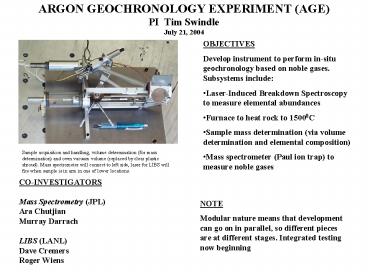
Sample acquisition and handling, volume
determination (for mass determination) and oven
vacuum volume (replaced by clear plastic shroud).
Mass spectrometer will connect to left side,
laser for LIBS will fire when sample is in arm in
one of lower locations.
- CO-INVESTIGATORS
- Mass Spectrometry (JPL)
- Ara Chutjian
- Murray Darrach
- LIBS (LANL)
- Dave Cremers
- Roger Wiens
NOTE Modular nature means that development can go
on in parallel, so different pieces are at
different stages. Integrated testing now beginning
2
FY 04 Milestones
- LIBS
- Successful environmental testing
- Demonstration of capabilities at Mars ambient
pressure - Calibration of multiple elements in basalt
samples - Mass Spectrometry
- Completion of Paul trap
- Completion of improved flight electronics
- Furnace construction
- Construction of improved versions
- Demonstration of reusable design (furnace, seal)
- Mass measurement (by volume)
- Extensive (successful) tests of three different
basalts - Demonstration of limitations for some
mineralogies
3
Laser-Induced Breakdown Spectroscopy (LIBS, at
LANL)
- Successful environmental testing of Ocean Optics
HR2000 spectrometer - Vibration tests
- Passed MSL standards
- Some trouble at twice MSL standards, can be
strengthened - Thermal tests (prototype)
- -45 to 50C test
- No peak drift (right)
4
LIBS (LANL)
- HR2000 Spectrograph
- Basalt spectrum in IR region
- 50 shots averaged
- 7 Torr CO2 (optimal pressure)
- Other elements can be obtained by adding
spectrographs in other regions
elements seen in second order
5
LIBS (LANL)
- Resolution of HR2000 compares well with LLA
ESA3000 - 80K high resolution lab echelle spectrograph
(comparison below left) - Calibration of multiple basalts samples gives
lt10 errors (below right)
Soil spectrum
Average of absolute value of accuracy. Accuracy
data generated by measuring 8 samples. For each
sample, accuracy determined by comparing actual
value to that generated by calibration curve
constructed on basis of other 7 samples.
6
Furnace (UA)
- Latest version approaching mechanical brassboard
- All seals metal gaskets or welds (except for one
required to be reusable)
Simplified schematic of AGE furnace
7
Mass calibration
- Mass (of 5-10mg samples) measured by measuring
volume and knowing density (by knowing elemental
composition) - Calibrated for three basalts melted in 1 atm.
pressure - Accurate to better than 10 (see figure)
- Samples with compositions with higher melting
temperatures (e.g., dunites, analogs of Chassigny
Martian meteorite) dont fully melt, so technique
not effective
Data for calibration of basalt samples.
Calibration factor is used to account for
effects of meniscus, etc. After this is applied,
standard deviation is 7, well within 10 target
for uncertainties.
8
Mass spectrometry (JPL)
- Paul ion trap
- Second generation Paul trap has been constructed
- Improved flight electronics completed
- Testing underway
First generation of JPL Paul trap
9
AGE Plans (7/2004)
Left Oven attached to Quadrupole Mass
Spectrometry Analyzer in April. Demise of QMSA
delayed testing, but current round is with more
sensitive Paul trap
- Continue current tests
- Work toward integrated test of system
- Integrated furnace mass spectrometer tests to
assess performance of both, develop protocols - Mass calibration, handling tests with potentially
difficult samples - Major concerns
- Background noble gas signal derived from furnace
(species, size) - Continue to explore limitations of components in
terms of sample types
10
Geochronology with a Paul ion trap mass
spectrometer
Status 1. Proof of Concept - Isotopic
abundance measurements Done
with an ion trap 2. Design, build, and
test low dead volume analysis chamber
In progress 3. Design, build and test
miniature MS rf Electronics In progress
11
3He-4He mixture 11000 concentration
Neon isotopes
Krypton isotopes
Xenon isotopes
12
Financial issues
- Note Due to funding mechanism, most of funding
does not go through PI - Arizona funding
- Spending at budgeted pace
- Began 6 mos. late
- Completed PIDDP first
- No-cost extension discussed
Recommended

