

What is the Internet And What is the Internet Style of Learning PowerPoint PPT Presentation
1 / 13
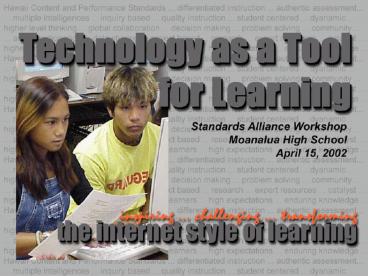
Title: What is the Internet And What is the Internet Style of Learning
1
(No Transcript)
2
- What is the Internet? And What is the Internet
Style of Learning? - It is a network, a community, that nurtures
higher levels of communication and
collaboration from its members - It allows for active participation--encouraging
learners to share data, ideas, materials that
can enrich the learning community - It is "real world," allowing for authentic
problem and inquiry based learning - It is engaging--challenging the thinking and
problem solving skills of learners - It is dynamic, ever evolving--more process than
product
3
It is a network, a community, that nurtures
higher levels of communication and collaboration
from its members.
Students in a ThinkQuest Junior team collaborated
over the Internet with children in Japan to
explore the causes of war and the ways to insure
peace Through Our Eyes and Hearts and Minds
4
networks, communication, collaborationcontinued
Students in the Imagining the Future Project
engaged in video conferences with experts such as
Jaron Lanier, father of Virtual Reality and
tele-immersion. Project participants also chatted
with other teams across the country as well as
the project management team in New York.
5
It allows for active participationencouraging
learners to share data, ideas, materials that can
enrich the learning community.
Visitors to the Eyes and Hearts and Minds site
can write historical fiction or role-play the
President in WWII. Visitors to Exploring New
Worlds can engage in a debate about space
settlement.
6
It is real world, allowing for authentic
problem and inquiry based learning.
TQJunior Team members engaged in online
discussion with scientists about their research
and conclusions Students in the MOHS Learning
Center, MeneWorks, respond to current issues via
their Social Studies Forum online.
7
real world continued
Students in MeneWorks social studies visited the
Virtual Vietnam Wall, experience the multi-media
presentation of primary source material and tried
to make sense of the issues and perspectives
themselves via the class online forum. Team
members of the Hearts and Minds site,
researched WWII Internment camps and created
their own multimedia presentations.
8
It is engagingchallenging the thinking and
problem solving skills of learners.
In the TQJr site Balance Beyond Survival,
students created a UniverCITY that taught city
planning from the perspective of the past,
present, and future. In Journey to New Worlds,
the students created a space simulation,
researching and caculating the variables behind
that decision making process.
9
It is dynamic, ever evolvingmore process than
product.
Students in Mene Works create portfolios to
document their learning. These are works in
progress, to evolve throughout their high school
careers. The Hearts and Minds TQJunior team
added a section to their site to cover the Ehime
Maru incident. And September 11 resulted in more
site additions.
10
It is, indeed, a catalyst
immediacy--wide audience--non-linear nature of
communication Metaphor LitCircles on
E-mail constant modeling--process made more
apparent--perfection is within the reach of
all Webzines Portfolios
11
Websites and Content Standards
Through Our Eyes and Hearts and Minds WWII
Past, Present and Future http//library.thinkquest
.org/J0110055 Journey to New Worlds Space and
Hawaiian Voyaging http//tqjunior.thinkquest.org/6
073 Balance Beyond Survival Learning from the
Past to Plan for the Future http//library.thinkqu
est.org/J001483 Media-Central MeneWORKS Online
Learning Community http//www.mohs.k12.hi.us/media
-central/
12
Websites and Content Standards
Educational Technology Content Standards
1-6 Visual Art Content Standard 1 Career and Life
Skills Content Standards 1 and 3 Social Studies
Content Standards Democracy Citizenship/Particip
ation Political Analysis Change, Continuity,
Causality Historical Empathy Historical Inquiry
Historical Perspectives and Interpretations Lan
guage Arts Content Standards Reading and
Literature Response Attitudes and
Engagement Writing Range Composing Process
Conventions and Skills Attitudes and Engagement
13
"Education is the building of community and the
belief in high expectations, taking risks,
believing in people. Darrel Galera
Recommended

