

Ionospheric irregularities observed with a GPS network in Japan PowerPoint PPT Presentation
1 / 1
Title: Ionospheric irregularities observed with a GPS network in Japan
1
Ionospheric irregularities observed with a GPS
network in Japan TOHRU ARAMAKI1,Yuichi
Otsuka1,Tadahiko Ogawa1,Akinori Saito2 and
Takuya Tsugawa2 1Solar-Terrestrial
Environment Laboratory, Nagoya University,
2Graduate School of Science, Kyoto University
ltIntroductiongt The Global Positioning System
(GPS) provides a way to investigate ionospheric
irregularities through measurements of total
electron content (TEC) along a ray path from GPS
satellite to receiver. To reveal the statistical
characteristics of ionospheric irregularities, we
have analyzed TEC data obtained from more than
1,000 GPS receivers in Japan with a time
resolution of 30 s.
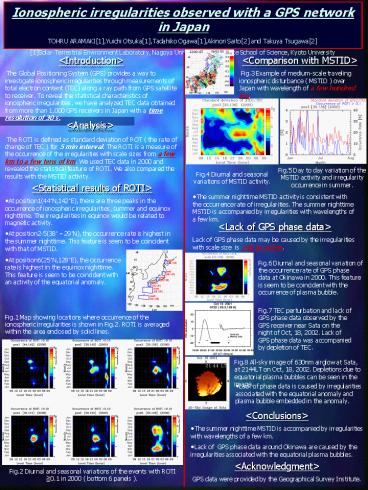
ltComparison with MSTIDgt Fig.3 Example of
medium-scale traveling ionospheric disturbance (
MSTID ) over Japan with wavelength of a few
hundred km.
ltAnalysisgt
The ROTI is defined as standard deviation of ROT
( the rate of change of TEC ) for 5 min interval.
The ROTI is a measure of the occurrence of the
irregularities with scale sizes from a few km to
a few tens of km. We used TEC data in 2000 and
revealed the statistical feature of ROTI. We also
compared the results with the MSTID activity.
Fig.5 Day to day variation of the MSTID activity
and irregularity occurrence in summer.
Fig.4 Diurnal and seasonal variations of MSTID
activity.
ltStatistical results of ROTIgt ?At
position1(44N,142E), there are three peaks in
the occurrence of ionospheric irregularities,
summer and equinox nighttime. The irregularities
in equinox would be related to magnetic
activity. ?At position2-5(3829N), the
occurrence rate is highest in the summer
nighttime. This feature is seem to be coincident
with that of MSTID.
?The summer nighttime MSTID activity is
consistent with the occurrence rate of
irregularities. The summer nighttime MSTID is
accompanied by irregularities with wavelengths of
a few km.
ltLack of GPS phase datagt
Lack of GPS phase data may be caused by the
irregularities with scale size is 240 to 310 m.
?At position6(25N,128E), the occurrence rate is
highest in the equinox nighttime. This feature is
seem to be coincident with an activity of the
equatorial anomaly.
Fig.6 Diurnal and seasonal variation of the
occurrence rate of GPS phase data at Okinawa in
2000. This feature is seem to be coincident with
the occurrence of plasma bubble.
Fig.7 TEC perturbation and lack of GPS phase data
observed by the GPS receiver near Sata on the
night of Oct, 18, 2002. Lack of GPS phase data
was accompanied by depletion of TEC.
Fig.1 Map showing locations where occurrence of
the ionospheric irregularities is shown in Fig.2.
ROTI is averaged within the area enclosed by
solid lines.
Fig.8 All-sky image of 630nm airglow at Sata, at
2144LT on Oct, 18, 2002. Depletions due to
equatorial plasma bubbles can be seen in the
image.
?Lack of phase data is caused by irregularities
associated with the equatorial anomaly and plasma
bubble embedded in the anomaly.
ltConclusionsgt ?The summer nighttime MSTID is
accompanied by irregularities with wavelengths of
a few km. ?Lack of GPS phase data around Okinawa
are caused by the irregularities associated with
the equatorial plasma bubbles.
ltAcknowledgmentgt GPS data were provided by the
Geographical Survey Institute.
Fig.2 Diurnal and seasonal variations of the
events with ROTI ?0.1 in 2000 ( bottom 6 panels
).
Recommended

