

Like AP Exams Tests, these Titrations have Some Major Curves PowerPoint PPT Presentation
1 / 35
Title: Like AP Exams Tests, these Titrations have Some Major Curves
1
- Like AP Exams Tests, these Titrations have Some
Major Curves - Sec 15.4 Titration and pH Curves
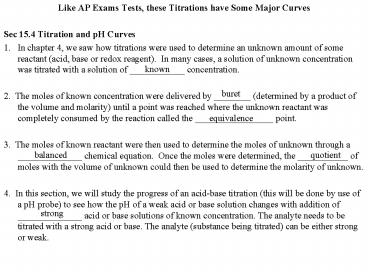
- 1. In chapter 4, we saw how titrations were
used to determine an unknown amount of some
reactant (acid, base or redox reagent). In many
cases, a solution of unknown concentration was
titrated with a solution of ____________
concentration. - 2. The moles of known concentration were
delivered by ________ (determined by a product of
the volume and molarity) until a point was
reached where the unknown reactant was completely
consumed by the reaction called the
_________________ point. - 3. The moles of known reactant were then used to
determine the moles of unknown through a
______________ chemical equation. Once the moles
were determined, the ___________ of moles with
the volume of unknown could then be used to
determine the molarity of unknown. - 4. In this section, we will study the progress
of an acid-base titration (this will be done by
use of a pH probe) to see how the pH of a weak
acid or base solution changes with addition of
______________ acid or base solutions of known
concentration. The analyte needs to be titrated
with a strong acid or base. The analyte
(substance being titrated) can be either strong
or weak.
known
buret
equivalence
balanced
quotient
strong
2
- Strong Acid-Strong Base Titrations
- Here differing volumes of 0.100 M NaOH with 50.0
ml of 0.200 M Nitric acid will be mixed. - Write the net ionic equation for the reaction.
- H (aq) OH- (aq) ? H2O (l)
- A
- What is the pH before any NaOH is added?
- H 0.200 M
- pH - log H
- pH - log 0.200
- pH 0.699
- B
- What is the pH after addition of 10.0 ml of 0.100
M NaOH? - H (aq) OH- (aq) ? H2O (l)
- (50.0 ml(0.200 M)) (10.0 ml(0.100 M))
- Initial 10.00 mmol 1.000 mmol
- Final 9.00 mmol 0.000 mmol
H 9.00 mmol / 60.0 ml pH - log H pH
-log 9.00 mmol / 60.0 ml pH 0.82
3
- C. What is the pH after addition of 20.0 ml of
0.100 M NaOH? - H (aq) OH- (aq) ?
H2O (l) - (50.0 ml(0.200 M)) (20.0 ml(0.100 M))
- Initial 10.00 mmol 2.000 mmol
- Final 8.00 mmol 0.000 mmol
- D. What is the pH after addition of 50.0 ml of
0.100 M NaOH? - H (aq) OH- (aq) ? H2O
(l) - (50.0 ml(0.200 M)) (50.0 ml(0.100 M))
- Initial 10.00 mmol 5.000 mmol
- Final 5.00 mmol 0.000 mmol
- E. What is the pH after addition of 100.0 ml of
0.100 M NaOH? - H (aq) OH- (aq) ? H2O (l)
- (50.0 ml(0.200 M)) (100.0 ml(0.100 M))
- Initial 10.00 mmol 10.00 mmol
- Final 0.00 mmol 0.00 mmol
- This is the equivalence point of the titration
H 8.00 mmol / 70.0 ml pH - log H pH
-log 8.00 mmol / 70.0 ml pH 0.94
H 5.00 mmol / 100.0 ml pH - log H pH
-log 5.00 mmol / 100.0 ml pH 1.30
H 1.0.10-7 M pH - log H pH -log
1.0.10-7 pH 7.00
4
- F. What is the pH after addition of 150.0 ml of
0.100 M NaOH? - H (aq) OH- (aq) ? H2O (l)
- (50.0 ml(0.200 M)) (150.0 ml(0.100 M))
- Initial 10.00 mmol 15.00 mmol
- Final 0.00 mmol 5.00 mmol
- Titration complete
- Now lets titrate a weak acid (acetic acid) with
a strong base (NaOH)
OH- 5.00 mmol/ 200.0 ml pH 14.00 log
OH- pH 14.00 log 5.00 mmol/ 200.0 ml pH
14.00 1.602 pH 12.40
OH- 10.00 mmol/ 250.0 ml pH 14.00 log
OH- pH 14.00 log 10.00 mmol/ 250.0 ml pH
14.00 1.397 pH 12.60
G. What is the pH after addition of 200.0 ml of
0.100 M NaOH? H (aq) OH- (aq) ?
H2O (l) (50.0 ml(0.200 M)) (200.0
ml(0.100 M)) Initial 10.00 mmol 20.00
mmol Final 0.00 mmol 10.00 mmol
5
- Titration of Weak Acid with Strong Base
- Here we will study the titration of 50.0 ml of
0.10 M acetic acid with 0.10 M NaOH. Note that
before equivalence point is reached, as NaOH is
added, a _________ is formed (weak acid with its
_____________________ base). - At a point half of the way to the equivalence
point of the titration the pH __________ (this
is very important)! - Therefore, titration curves can be used to
determine ___ values for weak acids (or ___
values for weak bases). - Note The equivalence point is not quite the same
as _________________ but should be nearly equal,
as will be explored later. - Write the net ionic equation
- HC2H3O2 (aq) OH- (aq) ? H2O (l) C2H3O2- (aq)
buffer
conjugate
pKa
Ka
Kb
endpoint
6
- Weak Acid/Strong Base Titrations
- Here differing volumes of 0.10 M NaOH with 50.0
ml of 0.10 M acetic acid will be mixed. - Write the net ionic equation for the reaction.
- HC2H3O2 (aq) OH- (aq) ? H2O (l) C2H3O2- (aq)
- A
- What is the pH before any NaOH is added?
- HC2H3O2 (aq) ? H (aq) C2H3O2- (aq)
- Initial 0.10 M 0 M
0 M - Final 0.10 M x x
x - B
- What is pH after 10.0 ml of 0.10 M NaOH is added?
- HC2H3O2 (aq) OH- (aq) ? H2O (l)
C2H3O2- (aq) - (50.0 ml(0.10 M)) (10.0 ml(0.10 M))
- Initial 5.00 mmol 1.00 mmol
0 mmol - Final 4.00 mmol 0 mmol
1.00 mmol - HC2H3O2 (aq) ? C2H3O2- (aq)
H (aq) - Initial 4.00 mmol / V 1.00 mmol / V
0
1.8.10-5 HC2H3O2- / HC2H3O2 1.8.10-5
x2 / 0.10 x x (1.80 .10-6)1/2 pH - log
H pH -log 1.80 .10-61/2 pH 2.87
1.8.10-5 HC2H3O2- / HC2H3O2 1.8.10-5 x
(1.00 mmol / V) (4.00 mmol / V) x 1.8 .10-5
(4.00) pH - log H pH -log 1.80 .10-5
(4.00) pH 4.14
7
- C
- What is pH after 25.0 ml of 0.10 M NaOH is added?
- HC2H3O2 (aq) OH- (aq) ? H2O
(l) C2H3O2- (aq) - (50.0 ml(0.10 M)) (25.0 ml(0.10 M))
- Initial 5.00 mmol 2.50 mmol
0 mmol - Final 2.50 mmol 0 mmol
2.50 mmol - Acid and conjugate base are equal. This is
called the ½ titration point (pH pKa at that
point) - pH - log Ka
- pH - log (1.8.10-5)
- pH 4.74 D
- What is pH after 40.0 ml of 0.10 M NaOH is added?
- HC2H3O2 (aq) OH- (aq) ? H2O
(l) C2H3O2- (aq) - (50.0 ml(0.10 M)) (40.0 ml(0.10 M))
- Initial 5.00 mmol 4.00 mmol
0 mmol - Final 1.00 mmol 0 mmol
4.00 mmol - HC2H3O2 (aq) ? C2H3O2- (aq)
H (aq) - Initial 1.00 mmol / V 4.00 mmol / V
0 - Final 1.00 mmol / V x 4.00 mmol /V x x
1.8.10-5 HC2H3O2- / HC2H3O2 1.8.10-5 x
(4.00 mmol / V) (1.00 mmol / V) x 1.8 .10-5
/4.00 pH - log H pH -log 1.80 .10-5
/4.00 pH 5.35
8
- E
- What is pH after 50.0 ml of 0.10 M NaOH is added?
- HC2H3O2 (aq) OH- (aq) ? H2O
(l) C2H3O2- (aq) - (50.0 ml(0.10 M)) (50.0 ml(0.10 M))
- Initial 5.00 mmol 5.00 mmol
0 mmol - Final 0.00 mmol 0 mmol
5.00 mmol - Not a buffer (only conjugate base present) This
is the equivalence point!! - You must divide by the volume of solution
here, it will not cancel!!!!! - C2H3O2- (aq) H2O (aq) ? OH-
(aq) HC2H3O2(aq) - Initial 5.00 mmol / 100.0 ml
0 M 0 M - Final 0.0500 M x x x
1.0.10-14 OH-HC2H3O2 1.8.10-5
C2H3O2- 5.556 .10-10 x2 0.0500 x
(5.556 .10-10 0.0500)1/2 pH 14.00 log
OH- pH 14.00 log 5.556 .10-10 0.0500)1/2
pH 14.00 5.278 pH 8.72
9
- F
- What is pH after 60.0 ml of 0.10 M NaOH is added?
- HC2H3O2 (aq) OH- (aq) ? H2O
(l) C2H3O2- (aq) - (50.0 ml(0.10 M)) (60.0 ml(0.10 M))
- Initial 5.00 mmol 6.00 mmol
0 mmol - Final 0.00 mmol 1.00 mmol
5.00 mmol - Not a buffer (strong base and conjugate base
present) - contribution of conjugate can be
neglected!!!! - OH- 1.00 mmol / 110.0 ml
- pH 14.00 log OH-
- pH 14.00 log 1.00 mmol / 110.0 ml
- pH 14.00 2.041
- pH 11.96
- G For 75.0 ml 2.50 mmol OH- remaining.
- OH- 2.50 mmol / 125.0 ml
- pH 14.00 log 2.50 mmol / 125.0 ml
- pH 14.00 1.699
Titrations curves of Strong vs. Weak acids
10
Titration curve for a diprotic weak acid (H2C2O4)
pH PKa2
pH PKa1
HC2O4- (aq) OH- (aq) ? C2O4-2 (aq) H2O (l)
H2C2O4 (aq) OH- (aq) ? HC2O4- (aq) H2O (l)
Homework Day 1 51 57 (use NaOH volumes of 0.0
ml 8.0 ml 12.5 ml 24.0 ml 25.0 ml 26.0 ml)
pg. 775-776 You are not required to do the other
volumes, if you need extra practice try them. Day
2 52 59 (same volumes as day 1) Day 3 61
63 64 Additional 1 Determine the pH of at the
equivalence when 50.00 ml of 0.0426 M weak acid
(Ka 3.5.10-8) it titrated with 0.1028 M
NaOH Additional 2 A student dissolves 0.0100
mol of an unknown weak acid in 100.0 ml of water
and titrates the solution with 0.100 M NaOH.
After 40.0 ml of 0.100 M NaOH were added, the pH
of the resulting pH of the resulting solution was
4.00. Calculate the Ka of the weak acid.
11
- An Indication of Things to Come
- Sec 15.5 Acid/Base Indicators
- 2 Methods for determining the equivalence point
of an acid/base titration. - 1. Use of a ___ meter to monitor pH as titrant is
added to analyte. Here the equivalence point is
indicated on a _________ of pH vs. volume of
titrant. The equivalence can be seen in the
___________ of the large region of change in pH
(called a point of inflection). - 2. Use of an acid/base _____________ (a weak acid
or base and its conjugate where each has a
different __________). The indicator shows the
______________ (not necessarily the same as
equivalence point). - How is an appropriate indicator chosen?
- The answer depends upon the pH of the solution
that youre titrating at the equivalence point. - The pH of the solution should be within or 1
of the pKa of the indicator. - Heres why An indicator is visible when the
ratio of acid or base to conjugate is 1 to 10. - An example Strong base is added to weak acid
such that the pH increases with addition of NaOH.
The indicator responds to the pH change because
it has its own Ka. Therefore, the _______ of In-
to HIn is dictated by the pH of the solution.
pH
graph
middle
indicator
color
endpoint
ratio
12
- HIn (aq) ? H (aq) In- (aq)
- Initial 110 0
- As base is added to the acidic solution the
relative amounts will change - Final 100 10
- What would be the pH of the solution when this
ratio is 110? - Ka HIn- / HIn
- H Ka HIn/ In-
- H Ka 10 / 1
- pH pKa log 10
- pH pKa 1
- How about if we are titrating a base with strong
acid using the same indicator? - HIn (aq) ? H (aq)
In- (aq) - Initial 0
110 - Final 10
100 - Ka HIn- / HIn
- H Ka HIn/ In-
- H Ka 1 / 10
- pH pKa log 0.1
- pH pKa 1
13
- Phenolphthalein has a range of 7 to 9 and is
commonly used for strong acid/strong base
titrations. See figure 15.9 pg. 751 - fig. 15.10 pg. 751 shows that by not picking the
proper indicator leads to an inaccurate volume of
the equivalence point. (If methyl red were
chosen, the calculate molarity of the acid
analyte would be too _______ (this is a result of
less moles calculated then are actually present).
The value of the Ka from the ½ titration point
would be too _________ (due to the smaller pH at
the ½ titration point, the smaller the pH, the
higher the H). - Sample 15.11 pg. 746
- pKa -log (1.0.10-7)
- pKa 7.00
- Since base is added to the acidic solution, the
color will first be visible when the pH is 1 less
than the pKa or 6.00
low
high
14
Acid titrated with strong base
Ka of indicator is 10-8
pKa 8 so pH is 7 when color change is first
visible
15
Acid titrated with strong base
Ka of indicator is 10-8
Ka In- H HIn
pH 6.5
pH 7
pH 6
10-8 In- 110 10-7 HIn
10-8 In- 132 10-6.5 HIn
10-8 In- 1100 10-6 HIn
Indicator color change is not visible
Indicator color change is visible
Indicator color change is not visible
H Ka HIn In-
H 10-8 10 1
H 10-7
pH -log 10-7 7
16
Base titrated with strong acid
Ka of indicator is 10-8
pKa 8 so pH is 9 when color change is first
visible
17
Base titrated with strong acid
Ka of indicator is 10-8
Ka In- H HIn
pH 9
pH 10
pH 9.5
10-8 In- 101 10-9 HIn
10-8 In- 321 10-9.5 HIn
10-8 In- 1001 10-10 HIn
Indicator color change is not visible
H Ka HIn In-
Indicator color change is visible
Indicator color change is not visible
H 10-8 1 10
H 10-9
pH -log 10-9 9
18
- Sec 15.6 Solubility Equilibria and the Solubility
Product - Read first paragraph of this section pg. 751 to
see applications of solubility. - 1. Earlier in the year, we learned the
solubility rules (pg. 152) for _________
compounds. However, the rules were pretty vague
in places (terms like slightly and
_______________ soluble). Now, we will learn how
soluble these compounds truly are, in fact even
__________________ compounds have a small degree
of solubility which will be explored in this
section. - 2. Lets consider Calcium Sulfide in water (a
________________ soluble salt). - CaS (s) ? Ca2 (aq) S-2 (aq)
- When the salt is thrown in water it will break up
to a small degree creating ____ and ____ ions
until a state of dynamic equilibrium is reached
(at this point the numbers of Ca2 (aq) and S-2
(aq) formed are equal to the numbers of CaS
compounds being formed from the ions). The
equilibrium constant is called the solubility
product constant ( ). - Ksp Ca2 S-2
- (pure solids are omitted from K expressions)
- Lets write the equilibrium and solubility
product constant for Calcium Fluoride. - CaF2 (s) ? Ca2 (aq) 2 F- (aq)
- Ksp Ca2 F-2
- (Ksp values are constant at a given temperature
regardless of particle _______. Particle size
affects the _______ of dissolution, not the value
of Ksp).
ionic
marginally
insoluble
slightly
Ca2
S-2
Ksp
size
rate
19
- 4. Solubility is the _________ of moles per
liter of an ionic compound that will break apart
to form ions in a solution (it will be considered
to be x in these equilibrium problems). It is
measured in ____________ (be sure to include
molarity units on homework problems where you
determine solubility (x)). - 5. This solubility can vary by the addition of a
"common ion" (which is an application of Le
Chatelier's principle). - Example
- How will the addition of sodium fluoride affect
the solubility of calcium fluoride? - CaF2(s) ? Ca2 (aq) 2 F- (aq)
- The addition of F- will ____________ the
solubility of CaF2 - b. How will the addition of silver nitrate affect
the solubility of calcium fluoride? - AgNO3 is a ______________ salt.
- AgNO3 (aq) ? Ag (aq) NO3- (aq)
- Ag will form an insoluble compound with _____.
- Ag (aq) F- (aq) ? AgF (s)
- The removal of F- from the CaF2 will shift that
equilibrium to the ________, - thereby ___________ the solubility of CaF2.
- See sample Exercises 15.12
- CuBr (s) ? Cu (aq) Br- (aq)
- Initial 0
0 - Final x
x
number
molarity
decrease
soluble
F-
right
increasing
Ksp CuBr- Ksp x2 Ksp 2.0.10-42 Ksp
4.0.10-8
20
- Sample 15.13
- Bi2S3 (s) ? 2 Bi3(aq) 3 S-2 (aq)
- initial 0 0
- final 2x 3x
- (x 1.0.10-15 M)
- Ksp (2x)2(3x)3
- Ksp (4x2)(27x3)
- Ksp 108 x5
- Ksp 108 (1.0.10-15)5
- Ksp 1.1.10-73
- Sample 15.14
- Cu(IO3)2(s) ? Cu2 (aq) 2 IO3- (aq)
- initial 0 0
- final x 2x
- Ksp (x)(2x)2
- Ksp 4x3 (this time we are determining the
solubility (x)) - x (Ksp / 4)1/3
- x (1.4.10-7 / 4)1/3 x 3.3.10-3 M
21
- Relative Solubilities (pg. 756)
- 1. For salts that produce the same __________ of
ions in water, the larger the Ksp value, the
__________ the solubility. - Look up solubility product constants of AgI, CuI,
and CaSO4 (pg. 756). - Place them in order from greatest to least
soluble. - Here the solubility of each is x (Ksp)1/2
- Therefore, the larger the Ksp , the larger the
solubility. - CaSO4 (s) gt CuI (s) gt AgI (s)
- 2. For salts that produce different numbers of
ions, you must calculate the _______________ (x)
. - Look up solubility product constants of CuS,
Ag2S, and Bi2S3. - Place them in order from greatest to least
soluble. - For CuS x (Ksp)1/2 For Ag2S x (Ksp /
4)1/3 For Bi2S3 x (Ksp / 108)1/5 - x (8.5.10-45)1/2 x
(1.6.10-49 / 4)1/3 x (1.1.10-73 /
108)1/5 - x 9.2.10-23 M x 3.4.10-17 M x
1.0.10-15 M - Bi2S3 (s) gt Ag2S (s) gt CuS (s)
- Common Ion Effect on solubility (pg. 757). Same
as used in acid-base equilibrium. - Determine the solubility of silver chromate in an
aqueous 0.100 M solution of silver nitrate - Ag2CrO4 (s) ? 2Ag (aq) CrO4-2 (aq)
- initial 0.100 M 0
- final 0.100 M 2x x
numbers
greater
Molar solubility
Ksp Ag2 CrO4-2 Ksp 0.1002 x
(neglecting 2x) x 9.0.10-12 / 0.1002 x
9.0.10-10 M
22
- Sample 15.15
- CaF2(s) ? Ca2 (aq) 2F- (aq)
- initial 0 0.025 M
- final x 0.025 M 2x
- Ksp (x)(0.025)2
- x 4.0.10-11 / (0.025)2
- x 6.4.10-8 M
- pH and Solubility (pg. 759)
- A salt such as magnesium hydroxide is not very
soluble in water - (write the equilibrium below).
- Mg(OH)2 (s) ? Mg2 (aq) 2OH- (aq)
- 2. Hydroxide will react with ___________ ion
(H) to form water. - Decreasing the pH, ______________ the H and will
shift the equilibrium ______________ (due to OH-
reacting with the increased H) so the solubility
of Mg(OH)2 will ___________________. - 4. Increasing the pH, ______________ the H and
will shift the equilibrium ______________ (since
water alone will supply 1.0.10-7 M H) so the
solubility will ___________________.
hydrogen
increasing
right
increase
decreases
left
decrease
23
- 5. When dealing with a hydroxide salt and the
solution is ________________ to a certain pH,
solve for the OH- concentration and treat it as
the common ion that it is. - Example What is the solubility of aluminum
hydroxide in pure water and what is it in a
solution that is buffered to a pH of 12.00? - In pure water, OH- 1.0.10-7 M
- Al(OH)3 (s)? Al3 (aq) 3OH- (aq)
-
initial 0 1.0.10-7 M - final x 1.0.10-7 M
3x - Ksp x (1.0.10-7)3
- x 2.10-32 / (1.0.10-7)3
- x 2.10-11 M
- In a solution buffered to pH 12.00, OH-
1.0.10-2 M - Al(OH)3 (s)? Al3 (aq) 3OH- (aq)
-
initial 0 1.0.10-2 M - final x 1.0.10-2
M 3x - Ksp x (1.0.10-2)3
- x 2.10-32 / (1.0.10-2)3
- x 2.10-26 M
buffered
24
- The solubility salts may be altered by the
addition of acid (or OH- as we saw in the last
example) of AgCl or Ag3PO4 which compound will
have its solubility altered by addition of HNO3?
- Write a reaction to show why this change occurs
- The solubility of AgCl will not be altered
because NO3- does not react with H - The solubility Ag3PO4 increase by an addition of
HNO3 because the H will react with the phosphate
to create hydrogen phosphate. - Ag3PO4 (s) ? 3Ag (aq) PO4-3 (aq)
- H (aq) PO4-3 (aq) ? HPO4-2 (aq)
Homework pg. 774-777 (dont need to write out
answer to 20 and 89) 73 75 77 79 83 85a,b
86b 87
25
Predictions of Heavy Precipitation Sec 157
Precipitation and Qualitative Analysis In this
section we will predict whether a
___________________ will form when 2 solutions of
ionic compounds are mixed (these compounds can
form an insoluble product, but whether it will
form depends upon the initial concentrations of
the solutions). In order to predict whether a
precipitate will form, we will compare ___ to Ksp
(much like we did in Chapter 13 to see if a
system was at equilibrium and determine which way
the equilibrium would shift). 1. If Q is
________ than K, a precipitate will form
(equilibrium shifts left). 2. If Q is ________
than K, a precipitate will not form. Sample
Exercise 15.16 pg. 760. If a precipitate will
form when the solutions are mixed, it will be
________________ Ce(IO3)3 (s) ? Ce3 (aq)
3IO3- (aq) Q Ce3o IO3-o 3 mmoles
Ce3 750.0 ml (0.00400mmolCe(NO3)3 /ml)(1mol
Ce3/ 1mol Ce(NO3)3) 3.000 mmol Ce3 molarity
Ce3 3.000 mmol Ce3/ 1050.0 ml 0.0028571 M
Ce3 mmoles IO3- 300.0 ml (0.0200 mmol KIO3
/ml) (1mol IO3-/ 1mol KIO3) 6.000 mmol
IO3- molarity IO3- 6.000 mmol IO3- / 1050.0 ml
5.7143 .10-3 M
precipitate
Q 0.0028571 0.00571433 Q 5.33.10-10 Q
is greater than Ksp so a precipitate will form
Q
greater
smaller
Ce(IO3)3
26
Sometimes you may wish to determine more than if
a precipitate forms, but what will be the
________________ of all ions in the solution. An
Example 100.0 ml of 0.0500 M Pb(NO3)2 is mixed
with 200.0 ml of 0.100 M NaI. a. Will a
precipitate form ? (determine Q and compare to
Ksp) (Ksp 1.4.10-8) PbI2 (s) ? Pb2 (aq) 2
I- (aq) Q Pb2o I-o 2 mmol Pb2 100.0 ml
(0.0500 mmol/ml) 5.000 mmol molarity Pb2
5.000 mmol / 300.0 ml 0.016667 M mmol I-
200.0 ml (0.100 mmol/ml) 20.00 mmol molarity I-
20.00 mmol / 300.0 ml 0.066667 M b. What
will the concentration of all ions present in the
solution? Lets deal with spectator ions first
Na NO3- The concentration of these ions depends
solely upon dilution. Na will be the same as
the diluted concentration of I- NaI (aq) ? Na
(aq) I- (aq) Na 0.0667 M (we must
remember that the I- concentration will change as
it will form a precipitate with Pb2) NO3-
will be twice the diluted concentration of Pb2
Pb(NO3)2 (aq)? Pb2(aq)2 NO3- (aq) NO3- 2
(0.016667 M) 0.0333M
concentration
Q 0.016667 0.0666672 Q 7.41.10-5 Q is
greater than Ksp so a precipitate will form
27
- To determine the concentration of the
precipitating ions - 1. Perform the stoichiometry for the production
of precipitate - (the K for the precipitation for the ions is
1/Ksp or very large). - 2. Use the ion that is in excess as a common
ion for the dissolution of the salt. - Pb2 (aq) 2 I- (aq)? PbI2 (s)
- Initial 5.000 mmol 20.00 mmol
- Final 0.000 mmol 10.00 mmol 5.000
mmol - Concentration of I- 10.00 mmol / 300.0 ml
0.0333 M - Now consider the Ksp to determine the minute
amount of Pb2 that is in solution - PbI2 (s) ? Pb2 (aq) 2 I- (aq)
- Initial 0
0.033333 M - Final x 0.033333
M 2x - Ksp x 0.0333332
- x (1.4.10-8) /0.0333332
- x Pb2 1.3.10-5 M
28
An Example 150.0 ml of 0.0100 M Mg(NO3)2 is
mixed with 250.0 ml of 0.100 M NaF. a. Will a
precipitate form (determine Q and compare to
Ksp)? (Ksp 6.4.10-9) MgF2 (s) ? Mg2 (aq) 2
F- (aq) Q Mg2o F-o 2 mmol Mg2 150.0 ml
(0.0100 mmol/ml) 1.500 mmol molarity Mg2
1.500 mmol / 400.0 ml 0.003750 M mmol F-
250.0 ml (0.100 mmol/ml) 25.00 mmol molarity F-
25.00 mmol / 400.0 ml 0.06250 M Didnt ask
for the concentration of spectator ions
Mg2 (aq) 2 F- (aq)? MgF2 (s) Initial
1.500 mmol 25.00 mmol Final 0.000 mmol
22.00 mmol 1.500 mmol Concentration of F-
22.00 mmol / 400.0 ml 0.0550 M
Q 0.003750 0.062502 Q 1.46.10-5 Q is
greater than Ksp so a precipitate will form
MgF2 (s) ? Mg2 (aq) 2 F- (aq)
Initial 0 0.05500 M
Final x 0.05500 M 2x Ksp x
0.055002 x (6.4.10-9) /0.055002 x Mg2
2.1.10-6 M
29
Selective Precipitation 1. Mixture of _________
ions in solution are often separated by selective
precipitation where a certain _____________ is
added which will precipitate with one or more of
the metal ions in the solution. Example A
solution contains both Ba2 and Ag1 ions. If
NaCl is added to the mixture, the ____ will
precipitate with the Cl- and the ____ will remain
in solution. If both metals form a precipitate
you can calculate which requires a smaller anion
concentration to form the precipitate. Sample
Exercise 15.18 pg. 763. Solution contains
1.0.10-4 M Cu and 2.0.10-3 M Pb2. Which will
require the least amount of I- in order to
precipitate? Determine the I- required to
precipitate with these concentrations of metal
ions
metal
anion
Ag
Ba2
CuI (s) ? Cu1 (aq) I- (aq)
1.0.10-4 M ? Ksp
CuI- I- Ksp / Cu I- (5.3.10-12)
/1.0.10-4 I- 5.3.10-8 M
PbI2 (s) ? Pb2 (aq) 2 I- (aq)
2.0.10-3 M ? Ksp Pb2 I-2 I- (Ksp
/ Pb2)1/2 I- (1.4.10-8 /
2.0.10-3)1/2 I- 2.6.10-3 M
since the Cu1 requires the least amount of I- in
order to precipitate, it will precipitate first
when a concentration of 5.3.10-8 M is reached and
will separate from the Pb2
30
- Selective Precipitation
- 2. Metal Sulfides vary greatly in their
solubility, for example FeS is much ______
soluble than MnS. Therefore, if sulfide is added
to a solution containing Fe2 and Mn2 (provided
their concentrations are nearly equal), the _____
will precipitate leaving ____ in solution. - Further, sulfide ion is the conjugate _____ of
the very weak acid HS- (HS- is the conjugate base
of the acid H2S Ka values on pg. 764). - S-2 (aq) H2O (l) ? HS- (aq) OH- (aq)
- HS- (aq) H2O (l) ? H2S (aq) OH- (aq)
- In basic solutions, there is a lot more S-2 than
there is in acidic solution. Therefore, at low
___ values (acidic solutions) the metals that
form the most insoluble salts with sulfide will
precipitate out of solution (leaving the more
soluble sulfide salts remain in solution). - This allows separation of ions to occur by
regulating the pH of the solution. - See figure 15.11 pg. 764
- Read Qualitative Analysis section and see fig.12
pg. 765 - Homework
- pg. 778 s. 90 91 93 94 95
- Additional A solution is 1.10-4 M in NaF Na2S
and Na3PO4. What will be the order of
precipitation if a source of Pb2 is slowly added
to the solution (calculate the Pb2 required to
precipitate with each)
less
Fe2
Mn2
base
pH
31
Pretty Complex Material Sec 15.8 Equilibria
Involving Complex Ions 1. A complex ion is the
combination of a ________ ion and some molecule
or ion which when bonded together have an overall
charge. 2. The attaching molecule or ion donates
an electron pair to an empty ___ orbital of the
metal ion. This attaching molecule or ion (or
electron donor) is called a __________ base (the
metal is a Lewis acid or an electron pair
acceptor). pg. 696-699 From the K lab Fe3
(aq) SCN- (aq) ? Fe(SCN)2 (aq) 3. The number
of attaching ligands (a name giving to the
attaching molecules or ions) is referred to as
the ___________________ number. See table 21.12
pg. 999 4. A single ligand that can donate more
than 1 pair of electrons is called a
________dentate ligand. (EDTA is an example of a
polydentate ligand). table 21.13 pg.
1000. Important Complex ions to know for the AP
Exam a. Ag with ammonia makes Ag(NH3)2 b.
Cu2 with ammonia makes Cu(NH3)42 c. Aluminum
oxide or aluminum hydroxide make Al(OH)4-1 with
hydroxide. Naming (see rules pg. 1001) and
examples 21.1 and 21.2 pg. 1001-1002
metal
d
Lewis
coordination
poly
32
- 5. Metal ions add ligands stepwise (or 1 at a
time). - Example Ag (aq) NH3 (aq) ? AgNH3 (aq) K1
2.1.103 - AgNH3 (aq) NH3 (aq) ? Ag(NH3)2
(aq) K2 8.2.103 - Ligand will be given in a large excess
- Further, neglect NH3 reacting with water because
the Kb is much smaller than K1 and K2 and can
thereby be neglected. - Example Determine the concentration of all
species when 100.0 ml of 2.0 M NH3 is mixed with
100.0 ml of 0.0010 M silver nitrate. - Step 1 Treat the reaction stoichiometrically
as the sum of the 2 reactions. - Ag (aq) 2NH3(aq) ?
Ag(NH3)2 (aq) K K1K 2 1.722.107 - 100.0 ml (0.0010 M) 100.0 ml (2.0 M)
- Initial 0.100 mmol 200 mmol
0 mmol - Final 0 199.8 mmol
0.100 mmol - Step 2 Determine the Ag(NH3) utilizing K2
- AgNH3 (aq) NH3 (aq) ? Ag(NH3)2
(aq) K2 8.2.103 - ? 199.8 mmol / 200.0 ml 0.100
mmol / 200.0 ml - ? 0.999 M
0.000500 M 0.00050 M - Step 3 Determine Ag utilizing K1
- Ag (aq) NH3 (aq) ? AgNH3 (aq) K1 2.1.103
- ? 0.999 M 6.1.10-8 M
8.2.103 0.000500 AgNH3
0.999 AgNH3 0.000500 / (8.2.103
0.999) AgNH3 6.1.10-8 M
2.1.103 6.104 .10-8 Ag
0.998 Ag (6.104.10-8 M )/(2.1.103
(0.999M)) Ag 2.9.10-11 M
33
Sample 15.19 pg. 768 Example Ag (aq)
S2O3-2(aq) ? AgS2O3-1 (aq) K1 7.4.108
AgS2O3- (aq) S2O3-2 (aq) ? Ag(S2O3-2)2-3
(aq) K2 3.9.104 Ag (aq)
2 S2O3 -2(aq) ? Ag(S2O3)2 -3 (aq) K K1K 2
2.886.1013 150.0 ml (0.00100 M) 200.0 ml (5.00
M) Initial 0.1500 mmol 1000 mmol
0 mmol Final 0
999.7 mmol 0.1500 mmol Step 2 Determine
the Ag(S2O3)- utilizing K2 AgS2O3- (aq)
S2O3-2 (aq) ? Ag(S2O3)2-3 (aq) K2
3.9.104 ? 999.7 mmol / 350.0 ml
0.1500 mmol / 350.0 ml ?
2.856 M 4.2857.10-4 M
Ag(S2O3)2-3 4.29.10-4 M Step 3 Determine
Ag utilizing K1 Ag (aq) S2O3-2 (aq) ?
AgS2O3- (aq) K1 7.4.108 ?
2.856 M 3.848.10-9 M K1 AgS2O3- /
(AgS2O3-2)
Ag 3.848.10-9 /
(7.4.108(2.856)
Ag 1.8.10-18 M
3.9.104 0.00042857 AgS2O3-
2.856 AgS2O3- 0.00042857 / (3.9.104
2.856) AgS2O3- 3.8.10-9 M
34
Complex ions and Solubility Insoluble ionic
compounds are made soluble by the formation of a
complex ion of the metal ion with some ligand.
Aqua regia (a 31 mixture of hydrochloric and
nitric acids) dissolves gold in this fashion. Au
(s) 6H (aq) 3NO3- (aq) ? AuCl4- (aq) 3 NO2
(aq) 3 H2O (l) An example dissolving silver
chloride by the addition of ammonia. AgCl (s) ?
Ag (aq) Cl- (aq) Ksp 1.6.10-10 Ag (aq)
NH3 (aq) ? AgNH3 (aq) K1 2.1.103 AgNH3
(aq) NH3 (aq) ? Ag(NH3)2 (aq) K2
8.2.103 AgCl (s) 2NH3(aq) ? Ag(NH3)2 (aq)
Cl- (aq) K KspK1K2 Determine the solubility of
silver chloride in 10.0 M ammonia solution. AgCl
(s) 2 NH3(aq) ? Ag(NH3)2 (aq) Cl-1 (aq) K
2.755.10-3 Initial 10.0 M 0 M
0 M Final 10.0M 2x
x x
2.755.10-3 x2 / (10.0 M 2x)2 cant neglect
x doesnt meet 5 rule (2.755 .10-3)1/2 x /
(10.0 M 2x) x (2.755.10-2)1/2(10.0 M 2x)
x 0.5249 M 0.1050 x 1.1050 x 0.5249 M x
0.5249 M / 1.1050 x 0.48 M
(solubility only 1.3.10-5 M in pure water)
35
Homework 97 100 101 102 103 118a (pg.
778-780) Additional 1 Copper (II) sulfate
dissolves in water to form a blue solution. As
ammonia is added (the pH rises) and a white
precipitate is formed. As more and more ammonia
is added the precipitate disappears and the
solution turns blue again. Write reactions to
describe this phenomenon.
Recommended

