

Let x(n) be a sequence of length L (it PowerPoint PPT Presentation
1 / 41
Title: Let x(n) be a sequence of length L (it
1
DFT and Convolution
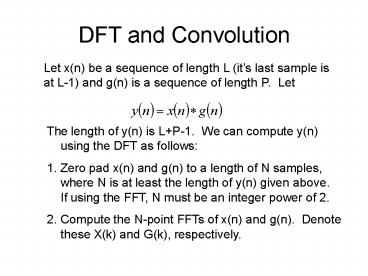
Let x(n) be a sequence of length L (its last
sample is at L-1) and g(n) is a sequence of
length P. Let
- The length of y(n) is LP-1. We can compute y(n)
using the DFT as follows - Zero pad x(n) and g(n) to a length of N samples,
where N is at least the length of y(n) given
above. If using the FFT, N must be an integer
power of 2. - Compute the N-point FFTs of x(n) and g(n).
Denote these X(k) and G(k), respectively.
2
DFT and Convolution
- Multiply X(k) and G(k), point-by-point. Denote
the result Y(k). - Compute the inverse N-point of Y(k) to obtain
y(n).
3
DFT and Convolution
If we wish to use fast convolution to filter a
signal continuously streaming through a process
(greater than N samples in length), it must be
divided into subsequences of N samples which are
processed individually and then reassembled. The
techniques for reassembling them are called
overlap-save and overlap-add. Cartinhour
mentions these, but does not explain how they
work or how they are used. I may present an
example later in the semester, if time permits
4
Problems
5
A DSP Chip
The Analog Devices ADSP-2181
Were finally going to take a look at how a
Digital Signal Processor chip works, and how to
use it. First, though, lets take a look at a
general purpose microprocessor, and why its not
very suitable for DSP applications
6
A DSP Chip
Heres the architecture of a first-generation,
von Neumann processor
Data Bus
TMP.
Data
Instruction.
Registers
ALU.
Memory (Program and Data)
Accum.
Prog. Cntr
Addr. Reg.
Address
Address Bus
Control Timing
7
A DSP Chip
- Notice that the von Neumann processor has one
memory space which is used for both program and
data. - It has one data bus, and one address bus.
- To execute an instruction, do the following
- Fetch the instruction.
- If an operand is needed, fetch it.
- If a second operand is needed, fetch it.
- Perform the operation
- Write the result to memory.
8
A DSP Chip
This worst-case, two-operand instructions
requires 5 cycles, and must access memory four
times. This limits throughput, which is very
important in DSP Using a single memory space for
both program and data causes a bottleneck. One
way of speeding things up is to separate the
program memory from the data memory
9
A DSP Chip
Data Bus
Instruction Bus
Instruction.
Computation Unit
Data Memory
Program Memory
Sequencer
DAG
Address
Address
Data. Addr
Prog. Addr
10
A DSP Chip
This is called Harvard architecture An
instruction and an operand may be fetched at the
same time. A result can be written to Data Memory
while the next instruction is being fetched from
Program Memory The DAG (Data Address Generator)
calculates addresses, which would have been done
by the ALU. This reduces the load on the
computation unit. The architecture of a DSP chip
is optimized for executing an algorithm
repeatedly, very fast.
11
A DSP Chip
A top-level block diagram of the 2181 is shown on
the next slide. Note that in addition to an ALU,
it has a dedicated Multiplier/Accumulator (MAC)
for multiplying data samples by weighting
factors, and a dedicated shifter for scaling data
to prevent overflow and underflow It also has two
Data Address Generators, which are useful for
implementing circular buffers.
12
(No Transcript)
13
A DSP Chip
Some example code an FIR filter
/ADSP-2181 FIR Filter Routine -serial port 0
used for I/O -internally generated serial
clock -40.000 MHz processor clock rate is divided
to generate a 1.5385 MHz serial clock -serial
clock divided to 8 kHz frame sampling
rate/ include ltdef2181.hgt define taps
15 define taps_less_one 14 .section/dm
dm_data .var/circ data_buffertaps / dm data
buffer /
14
A DSP Chip
/ The following lines set up a circular buffer
in data memory, which is used as a delay line of
samples / . section/dm dm_data .var/circ
data_buffertaps / dm data buffer / / This
section sets up a circular buffer in program
memory which will hold the filter coefficients.
The data width is 24 bits. This buffer is loaded
from the named file by the linker. / section/pm
pm_data .var/circ/init24 coefficienttaps
"coeff.dat"
15
A DSP Chip
/ The following lines of code set up the
interrupt table. / .section/pm
Interrupts start jump main rti rti rti /
0x0000 Reset vector / rti rti rti rti /
0x0004 IRQ2 / rti rti rti rti / 0x0008
IRQL1 / rti rti rti rti / 0x000c IRQL0
/ rti rti rti rti / 0x0010 SPORT0 Transmit
/ jump fir_start rti rti rti / 0x0014
SPORT0 Receive / rti rti rti rti / 0x0018
IRQE / rti rti rti rti / 0x001c BDMA
/ rti rti rti rti / 0x0020 SPORT1 Transmit
or IRQ1 / rti rti rti rti / 0x0024 SPORT1
Receive or IRQ0 / rti rti rti rti /
0x0028 Timer / rti rti rti rti / 0x002c
Power Down (non-maskable) /
16
A DSP Chip
/ This portion of the code sets up the DAG
registers for the two circular buffers
/ .section/pm pm_code main l0 length
(data_buffer) / setup circular buffer length
/ l4 length (coefficient) /setup circular
buffer / m0 1 / modify 1 for increment
/ m4 1 / through buffers / i0
data_buffer / point to start of buffer / i4
coefficient / point to start of buffer / ax0
0 cntr length(data_buffer) / initialize loop
counter / do clear until ce clear dm(i0,m0)
ax0 / clear data buffer /
17
A DSP Chip
/ This slide and the next contain code which
sets up the control registers. The following
lines set up the internal serial clock, and the
receive frame sync rate. / / setup divide
value for 8KHz RFS/ ax0 0x00c0 dm(Sport0_Rfsdi
v) ax0 / 1.5385 MHz internal serial clock
/ ax0 0x000c dm(Sport0_Sclkdiv) ax0
18
A DSP Chip
/ more control register setup / /
multichannel disabled, internally generated
sclk, receive frame sync required, receive width
0, transmit frame sync required, transmit width
0, external transmit frame sync, internal
receive frame sync,u-law companding, 8-bit words
/ ax0 0x69b7 dm(Sport0_Ctrl_Reg) ax0 ax0
0x1000 / enable sport0 / dm(Sys_Ctrl_Reg)
ax0 icntl 0x00 / disable interrupt nesting
/ imask 0x0060 / enable sport0 rx and tx
interrupts only /
19
A DSP Chip
/ The processor will sit in this loop, until
data is received from SPORT0 / mainloop idle
/ wait here for interrupt / jump mainloop /
jump back to idle after rti /
20
A DSP Chip
fir_start si rx0 / read from sport0
/ dm(i0,m0) si / transfer data to buffer
/ mr 0, my0 pm(i4,m4), mx0 dm(i0,m0) /
setup multiplier for loop / cntr
taps_less_one / perform loop taps-1 times / do
convolution until ce convolution mr mr mx0
my0 (ss), my0 pm(i4,m4), mx0 dm(i0,m0) /
perform MAC and fetch next values / mr mr
mx0 my0 (rnd) / Nth pass of loop with
rounding of result / if mv sat mr tx0 mr1 /
write result to sport0 tx / rti / return from
interrupt /
21
A DSP Chip
Highly Recommended Read Chapter 2 of the
ADSP-218x DSP Instruction Set Reference
22
FIR Filter Design
Weve seen how to design a simple FIR lowpass
filter using a rectangular window.
- We will now see how to design lowpass, highpass,
bandpass and band-reject (bandstop) filters using
two techniques - The Kaiser window (a better window than the
rectangular window - The Parks-McClellan algorithm
23
FIR Filter Design
Both methods result in filters which have linear
phase characteristics
Where A(w) is a real-valued function, and
N is the length of the impulse response.
Within the passband, A(w) is real and
nonnegative. This means the resulting filter has
linear phase, not merely general linear phase
24
FIR Filter Design
Within the passband, A(w) is real and
nonnegative. This means the resulting filter has
linear phase, not merely general linear phase.
These equations apply
Outside the passband, the filter may have jump
discontinuities in its phase characteristic
(general linear phase), but since this isoutside
the passband, they have little significance.
25
The Window Method
Weve seen how to design lowpass filters using a
rectangular window.
The rectangular window truncates the impulse
response to a length of N samples.
26
The Window Method
Heres another way of writing the impulse
response
Where wc is the cutoff frequency, and w(n) is the
rectangular window function.
27
The Window Method
The window function is
The frequency response of the resulting filter
can be written
28
The Window Method
The frequency response of the resulting filter
can be written
W(ejw) is the DTFT of the rectangular window, and
Hi(ejw) is the frequency response function of the
ideal lowpass filter.
29
The Window Method
When this convolution is performed, the shape of
the main lobe and sidelobes of W(ejw) modify the
shape of the frequency response. Instead of
being rectangular, the frequency response has
ripple in the passband and the stopband.
30
(No Transcript)
31
The Window Method
It would be good to reduce the amount of ripple.
Maybe this can be done by using a window whos
shape is different. In particular, if the
windows DTFT has sidelobes which are smaller in
magnitude relative to the mainlobe, the ripple
will be reduced. A tapered window will have
smaller sidelobes, and a wider main lobe both
desirable characteristics.
32
The Window Method
As an example, heres the Hamming window
A 29-point Hamming window is plotted on the next
slide
33
(No Transcript)
34
The Window Method
Next, a plot of the impulse response of a 29-tap
FIR lowpass filter, wc 0.46p, based on an ideal
lowpass, followed by its frequency response Note
the magnitude of the impulse responses
sidelobes, and the passband ripple
35
(No Transcript)
36
(No Transcript)
37
The Window Method
The next plot is the impulse response shown
previously, but windowed by a Hamming
window. This is followed by the filters
frequency response. Note the reduced sidelobe
magnitude, and the reduced passband ripple
However, the transition from passband to
stopband is not as sharp. The sharpness can be
restored by increasing the filter length.
38
(No Transcript)
39
(No Transcript)
40
The Window Method
The Hamming window tapers the impulse response.
Other windows taper the impulse response more,
or less, than the Hamming window. The
rectangular window is an extreme example it
tapers the impulse response LESS!! A window which
tapers more will have a wider main lobe (less
sharp transition), but smaller sidelobes (less
ripple).
41
The Window Method
If were given a filter specification, it will
usually include the cutoff frequency. This may
be wc (radians per sample) or fs (Hertz). It
will also give the width of the transition band,
and the minimum stopband attenuation. We must
choose the window function, and the filter length
in order to meet the specification.
Recommended

