

Structure and Reactions of Exotic Nuclei Pisa, 24-26 February 2005 INFN-PI32 PowerPoint PPT Presentation
Title: Structure and Reactions of Exotic Nuclei Pisa, 24-26 February 2005 INFN-PI32
1
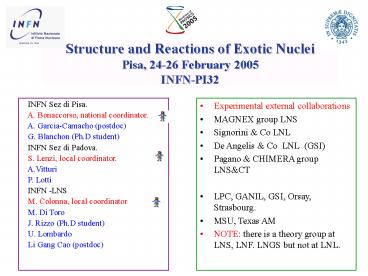
Structure and Reactions of Exotic NucleiPisa,
24-26 February 2005INFN-PI32
INFN Sez di Pisa. A. Bonaccorso, national
coordinator. A. Garcia-Camacho (postdoc)
G. Blanchon (Ph.D student) INFN Sez di
Padova. S. Lenzi, local
coordinator. A.Vitturi P. Lotti INFN
-LNS M. Colonna, local coordinator M. Di
Toro J. Rizzo (Ph.D student) U. Lombardo
Li Gang Cao (postdoc)
- Experimental external collaborations
- MAGNEX group LNS
- Signorini Co LNL
- De Angelis Co LNL (GSI)
- Pagano CHIMERA group LNSCT
- LPC, GANIL, GSI, Orsay, Strasbourg.
- MSU, Texas AM
- NOTE there is a theory group at LNS, LNF. LNGS
but not at LNL.
2
- We intend to build up an efficient theory network
to link Reaction Mechanism studies with Structure
studies to support, confort and orientate
experimental activities. - We hope to attract some part of the Napoli and
Milano nuclear structure groups in order to have
a wider range of competences. - In Pisa there is no experimental activity in
Nuclear Physics.
3
In your opinion which percentage of the work
currently done world-wide in Nuclear Structure
will ever be tested by experiment?
- Some part is solely theoretical, and cannot be
tested. - Another part can, in principle, be tested, but
will not be within our life time. - A good proportion is tested because the theory is
adjusted to experiment, but may be betrayed by
other experiments in future. - About 1/3 (?) will survive experiments even if
some part of the calculation is adjusted. But
this question makes sense after you define the
"measure" of work.
4
Can a good percentage of our theoretical work
be considered unrelated to experiments ?Is
all experimental work well oriented?
Experiments M?
Structure theory K?
Reaction theory K?
5
How to make our field more efficient?
- Reorganization
- Up from the bottom approach thesis jointly
supervised by a theoretician and an
experimentalist. Students will be better
educated, thesis will be more readeable, we
will be forced to find not too technical
problems, relationships theoretician-experimentali
sts will improve. - Mobility will automatically be implemented.
6
Our current interests and activities
- Isospin Dynamics in Reactions with Exotic Beams
1) Isospin dynamics in low energy dissipative
collisions 2) Isospin in Nuclear fragmentation. - Finite Nuclear Systems in Brueckner Theory 1)
BHF calculations of asymmetric and polarized
matter. 2) Construction of the energy functional.
3) Ground states and excitations of finite
nuclei. 4) Neutron star crust. - Structure and collective modes 1) Study of the
pairing correlations in low-density nuclear
systems. 2) Microscopic estimate of inelastic
excitation to the low-lying continuum dipole
strength via microscopic continuum RPA
calculations. 3) Study of isospin symmetry in
low- and high-spin states in medium-mass NZ
nuclei up to 100Sn. Study of the interplay of T0
and T1 pairing. 4) Study of nuclear structure
with algebraic models. - Reaction mechanisms 1) Elastic scattering and
microscopic calculations of optical potentials.
2) Breakup and transfer of weakly bound nuclei.
3) One and two neutron halo systems. 4) Unbound
nuclei studied via transfer and fragmentation.
TO THE SPEAKERS Please state at some stage of
your talk which is your Italian Connection
7
Short history of Italian Networks
- At University national level the class Nuclear
Physics contains both th. and exp. - This has helped people to find each other useful
and keep very close contact. New jobs, promotions
etchave usually been decided together. - At INFN level instead the exp are one group
(III), - separated also from high energy, while we
belong to the theory group (IV) dominated by
high energy guys..this is a disaster for jobs
and promotions - but for research money and organization we
have so called iniziative specifiche
(dedicated projects), divided by area
Recommended

