

The governing equation for groundwater flow can be written using PowerPoint PPT Presentation
1 / 13
Title: The governing equation for groundwater flow can be written using
1
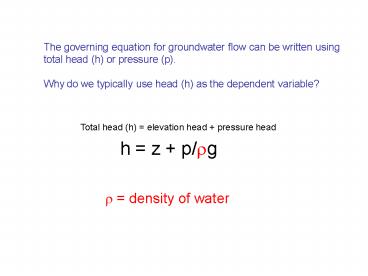
The governing equation for groundwater flow can
be written using total head (h) or pressure
(p). Why do we typically use head (h) as the
dependent variable?
? density of water
2
Hydraulic conductivity is dependent on density
and viscosity of water.
K k ?g / ?
K hydraulic conductivity (L/T) k permeability
(L) ? density ? viscosity g acceleration
Density and viscosity are dependent on
temperature of water.
3
Mean temperature of groundwater (?C) at a depth
of 10m. Annual variation is 5 - 10 ?C.
4
Rule of thumb The average groundwater
temperature at around 10 m below surface is 1 to
2 ?C warmer than the average air temperature.
5
3.98 ?C
K k ?g / ?
K hydraulic conductivity (L/T) k permeability
(L) ? density ? viscosity g acceleration
For constant density, K is larger at warmer
temperatures.
6
Isotherms showing a plume of hot water in the
aquifer (Winslow 1962)
7
If temperature is a variable, we need to couple
the groundwater flow model to a heat transport
model.
groundwater flow
Head
Heat flow
Temperature (with advection of groundwater)
Conduction only
8
Cross section through a groundwater
basin Boundary conditions for a coupled
groundwater flow and heat flow model
Specified head specified temperature
No flow No heat flux
No flow No heat flux
No flow specified heat flux
9
Head - Shallow Basin
Results from SHEMAT
10
Head Deep Basin
Results from SHEMAT
11
Temperature - Shallow Basin 10 18 ?C
Results from SHEMAT
12
Temperature - Deep Basin 10 28 ?C
Results from SHEMAT
13
In applications of groundwater models to shallow
problems in freshwater aquifers, we typically
assume groundwater has a constant temperature and
density and viscosity of water are constants.
Therefore, we can use total head, h, as the
dependent variable and hydraulic conductivity, K.
In applications of groundwater models to
geological problems (e.g., earthquakes, fluid
movement along deep-seated faults, plate
tectonics), temperature is an important variable
and the governing equation is written in terms of
pore pressure, p, allowing density and viscosity
to vary. Permeability, k, is used instead of
K. The flow model is coupled to a heat transport
model that calculates temperatures.
Furthermore, density is not constant when brines
are present or in coastal aquifers where sea
water is present. A governing equation that
allows for variation in density is used in these
applications as well.
Recommended

