

NVIS:%20An%20Interactive%20Visualization%20Tool%20for%20Neural%20Networks PowerPoint PPT Presentation
Title: NVIS:%20An%20Interactive%20Visualization%20Tool%20for%20Neural%20Networks
1
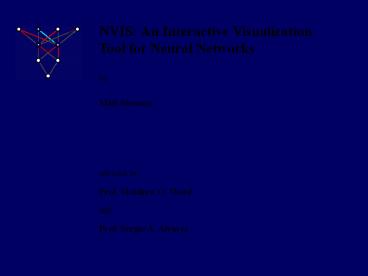
NVIS An Interactive Visualization Tool for
Neural Networks
by
Matt Streeter
advised by
Prof. Matthew O. Ward
and
Prof. Sergio A. Alvarez
2
What is a Neural Network?
- Weighted, directed graph, organized into layers
- Set of neurons (nodes) and synapses (edges), with
signals transmitted between neurons via synapses
- Valuable tool for pattern recognition and
function approximation
3
Why create a visualization tool for neural
networks?
- Understand how neural networks work, gain insight
into problem being solved
- Understand how genetic algorithm evolves networks
- Other tools exist, but do not show neuron
activations or genealogical relationships
4
Feedforward network visualization
- Synapse strength represented by length and
brightness of colored bars (linear scale). Blue
lines indicate positive weights red lines
indicate negative
- Diameter of white circles represents neurons
output or activation
- Each weight acts as a slider
5
Compact matrix representation
- Purpose is to allow many networks to be displayed
on the screen at once
- One matrix for each level of weights
- Row x, column y of matrix n represents weight
from node y of layer n to node x of layer n1
(same colors)
6
Generations family trees
- Row of compact matrix for each generation,
ordered by fitness
- User can select any network in the population
history
- Separate window shows family tree of selected
network
7
Interactive environment
- Set evolution strategy, network architecture, and
training set
- Graph representation and family tree available
for any network in population history
- Load/save networks
- Real-time fitness graph
8
Designing networks
- By dragging weights, user can design a network to
solve a problem, or refine a network that has
already been trained
- Real-time display of fitness score easy to see
importance of particular weight
- Not a practical way to find a network to solve a
problem
9
Understanding genetic drift
- Genetic drift is tendency for members of
artificial populations to all be alike
- Initial diversity in generations 0-2, rapidly
lost in generations 3-5
- Best (leftmost) network in generation 3 is parent
of best network in generation 4, grandparent of
best 8 in generation 5, and ancestor of all later
networks (not shown)
10
Changing weights local optima
- Error backpropagation algorithm performs
gradient-based search (local optimum)
- Weight dragged while backprop is running will
either snap back to original optimum, or all
weights will shift to new optimum
- Can estimate the length of a local optimum with
respect to each axis in weight-space
11
Extracting domain knowledge
- Positive weights in all but first layer effect
of input nodes therefore directly related to
incident weights
- Higher crime rates (C) tend to reduce value of
house higher number of rooms (R) tends to
increase value
- Analysis could be applied to problem domains
where no a priori knowledge exists
12
Future work
- Graph representation does not scale well
- Implement a variety of evolutionary algorithms
(breeding selection schemes)
- Depict network architectures other than
feedforward
- User evaluation
13
For more information . . .
- Visit http//www.wpi.edu/mjs/mqp
- See technical report WPI-CS-TR-00-11, available
at
http//www.cs.wpi.edu/Resources/techreports/index.
html
Questions?
Recommended

