

The Dynamic Radio Sky at High Time Resolution: Pulsars, Transients, and Bursts PowerPoint PPT Presentation
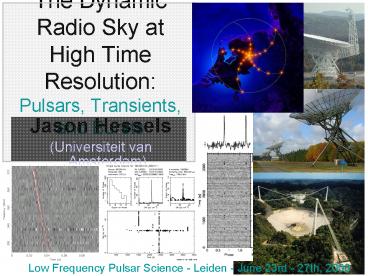
Title: The Dynamic Radio Sky at High Time Resolution: Pulsars, Transients, and Bursts
1
The Dynamic Radio Sky at High Time
ResolutionPulsars, Transients, and Bursts
- Jason Hessels
- (Universiteit van Amsterdam)
Low Frequency Pulsar Science - Leiden - June 23rd
- 27th, 2008
2
Transient Radio Sky
The transient radio sky, especially on short
timescales, is a mostly unexplored domain...
(W?)2?SD2/TLarge portions of phase space empty
and/or unexplored!
3
Scattering
x 104
Kolmogorov Spectrum
NB at 1GHz!
Bhat et al 2004
Scattering roughly proportional to DM, but there
is a wide scatter around this relation.
4
Parameter Space Coverage
timescale 1ms - 1s
5
Search techniques
Diagnostic Plot
6
10,000 DM trials required!!!
7
PSR J005861An Extreme Nuller
GBT350 surveys have made some interesting
single-pulse finds we want to keep looking at
low frequencies
8
New very low DM cand.DM 1.8 pc cm-3, D 200
pc?(LOFAR-type source)
Follows expected DM sweep?
Only 1.5 ms wide
Seen only once in 2 hours of observing
10 ms
9
Upcoming prospects
LOFAR
- Single pulses from B032954 blindly detected
using just 6 LOFAR HBA tiles (1/8 of a Dutch
station). - 13 core / 7 remote Dutch stations ready mid 2009.
- Can detect single pulses from 100 known pulsars
with 13-station LOFAR core.
10
PSR B032954 Period 714.5ms
Bright single pulses detected with LOFAR HBA
(160-240MHz)
DM 26.8 pc cm-3
RFI excision
One of the brightest pulses
11
PSR J005861An Extreme Nuller
- Null fraction gt 95.
- Among the highest NFs
- Short bursts also contain nulls.
- Similar to PSR J1502-5653
(Wang, Manchester, Johnston 07) - Many similar pulsars exist?
12
GBT350 Survey
(Hessels et al. 2007, Hessels et al. 2008 in
prep.)
- 350-MHz survey for pulsars and radio transients
with the GBT. - Low(ish) expected DMs (important for MSPs).
- 0.6 deg FWHM beam / 120-s pointings.
- Covers entire Northern Galactic Plane (1000 sq.
deg.). - 33 new pulsars so far (doubling of pop!).
- 6 sources in single pulse search.
- Single-pulse follow-up with Westerbork.
13
GBT350 Survey
14
J005566
P 1.39s ?DM 14.5 pc cm-3
lt--- No RFIExcision!
15
WSRT Burst Monitor with APERTIFMonitor the Virgo
Cluster
1000-2000 Galaxies 1.2 x 10¹⁵ Msun D 20
Mpc Catch live radio burst from supernova (c.f.
Soderberg et al. 2008 1 per week?)
16
LOFAR Pulsar Survey Sims(from Joeri van Leeuwen
and Ben Stappers)
Potential for a 1,000 new pulsars!Either map
low-luminosity distribution or find all pulsars
beamed towards us and within 1.4 kpc.
17
LOFAR Pulsar Survey Sims(from Joeri van Leeuwen
and Ben Stappers)
Pulsars peak in brightness around 150MHz, but
were limited by scattering. Luminosity law
below L400 1 mJy kpc2 is uncertain.
18
Large Phased Array
19
Suspicion of interpulse
20
(No Transcript)
21
WSRT LFFE observations of (the integrated)
polarized emission of pulsars
- Ger de Bruyn
- Michiel Brentjens, Gianni Bernardi, Roberto Pizzo
a.o. - ASTRON, Dwingeloo Kapteyn Institute,
Groningen
Low-frequency pulsar science Leiden, Lorentz
centre, 24-June-08
22
WSRT 325 MHz discovery images of J02184232
(Mar89)
What was unusual ? Very distorted images in
Q and U Also they appeared to be due to a very
faint source ! Distortion due to time variable
ionospheric Faraday rotation in 12h synthesis
?RM 3 rad/m2 !!
I
I V Q
U
23
PSRJ02184232 properties (from Navarro
et al, 1995)
24
RM resolution improves rapidly at lower
frequencies
15m of data on J02184232 in frequency range
138-157 MHz. High RMSF-sidelobes due to 4 MHz
gap in the middle
25
Discovering new pulsars in RM-space ?
- Advantages, assuming linearly polarized over many
pulses - very wide FOV searches possible with arcsec
positions - peculiar ones detectable (low duty cycle, short
period ?) - - relatively insensitive to ionospheric phase
errors - SNR aspects
- WSRT 1.5 mJy noise in 12h at 150 MHz (B20
MHz). - LOFAR 0.1 mJy noise in 4h at 150 MHz (B32
MHz. - A pulsar like J02184232 would thus have a SNR of
300, respectively 4000. This could be even
better at still lower frequency if SI - 3 - Discovering many polarized pulsars, even unpulsed
ones, would be a great asset in calibrating
LOFAR and ionosphere at very low frequencies - A workgroup in the LOFAR Magnetism and Transient
(pulsar) KSPs has started to look into this.
26
Long Wavelength Array
- 2080 MHz
- Dipole-based array stations
- 50 stations across New Mexico
- 400-km baselines ? arcsecond resolution
27
RFI Environment
HF COMM
TV audio and video carriers
FM radio
Frequency (MHz)
28
LWAPhased Development
Time Phase Description
1998-present 0 Existing 74 MHz VLA
2005present I Long Wavelength Development Array (funded by NRL/ONR)
20072010 II 9-station Long Wavelength Intermediate Array
20102012 III LWA Core
20122014 IV High-Resolution LWA
2009 V LW Operations Science Center
29
(No Transcript)
30
(No Transcript)
31
(No Transcript)
32
(No Transcript)
Recommended

