

Introduction: Clinical Neuropsychology Thomas A' Hammeke, PhD Medical College of Wisconsin Milwaukee PowerPoint PPT Presentation
1 / 30
Title: Introduction: Clinical Neuropsychology Thomas A' Hammeke, PhD Medical College of Wisconsin Milwaukee
1
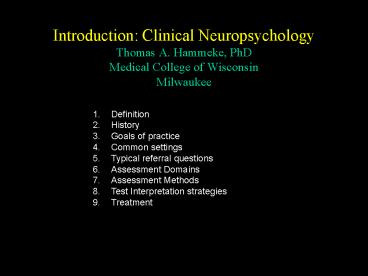
Introduction Clinical Neuropsychology Thomas A.
Hammeke, PhDMedical College of
WisconsinMilwaukee
- Definition
- History
- Goals of practice
- Common settings
- Typical referral questions
- Assessment Domains
- Assessment Methods
- Test Interpretation strategies
- Treatment
2
Introduction Definitionala Houston Conference
Policy Statement, 2001
A clinical neuropsychologist is a professional
psychologist trained in the science of
brain-behavior relationships. The clinical
neuropsychologist specializes in the application
of assessment and intervention principles based
on the scientific study of human behavior across
the lifespan as it relates to normal and abnormal
functioning of the central nervous system.
3
Introduction History
Study of nomothetic principles versus individual
differences Localization versus
Holism (Phrenology/Gall,Spurzheim vs
Flourens) Behavioral Neurology (Lesion
model) Aphasia (Language) Broca (1860)
Wernicke (1874) Agnosia (Recognition) Lissauer
(1890) Apraxia (Skilled Movement) Liepmann
(1900) Alexia (Reading) Dejerine
(1892) Experimental Psychology Perception
Psychophysics Learning and Memory
Ebbinghaus Attention Intelligence Clinical
Psychology Application of scientific principles
to clinical issues
4
Introduction History
Significant Events The World Wars I
II - localized brain lesions Structural and
Functional Neuroimaging - CT, MRI, PET, SPECT,
fMRI, MEG Advances in medicine and life-saving
techniques - keeps patients alive long enough
for study
5
Introduction Goals of Practice
- Assist in Diagnosis
- Determine presence of cognitive deficit
- Determine if cognitive deficit is organic or
psychological - Determine lateralization or localization of
brain dysfunction - Determine consistency of test findings with
neurobehavioral syndromes or suspected etiology - 2. Establish baseline to evaluate course or
treatment effects - 3. Define profile of strengths and weaknesses
- Plan rehabilitation or health management
strategies - Determine readiness for return to work or
school - Determine vocational of dispositional placement
- Determine cognitive competency or decisionality
- 4. Assist in establishing prognosis
6
Introduction Common Settings
- Individual Consultation Practice
- Rehabilitation Hospital
- Psychiatric Hospital
- Hospital or Group Medical Practice
- Medical School
7
Introduction Common Settings(Who refers
patients)
- Neurology Psychiatry
- Neurosurgery Internal Medicine
- Rehabilitation Pain Management
- Emergency Medicine Cardiology
- Oncology Sports Medicine
- Infectious disease Organ Transplant
8
Intro Typical Referral Questions
- My 45 year-old patient is depressed and complains
of forgetfulness. Does she have memory
impairment and if so is it due to brain
dysfunction or depression? - My 30 year-old patient was in an auto accident
and had a loss of consciousness. Does he have
brain damage? Is he ready to return to work as
an accountant? - My 70 year-old mother is becoming forgetful. Is
she able to live alone and drive her car safely?
9
Intro Typical Referral Questions
- My 10 year-old son is having trouble in school.
His spelling is poor and he is slow at reading.
What is wrong with him? - My 22 year-old patient has epilepsy that cannot
be controlled with medication. Is she a good
candidate for brain surgery to control her
seizures? - My 75 year-old father had a brain stroke. What
type of rehabilitation would help him recovery?
10
Intro Assessment Domains
- Clinical interview (both patient and informant)
- Presenting problems
- Daily living skills
- Social, educational vocational history
- Medical history and current status
- Psychiatric history and current status
- Medical record review (if possible)
- Cognitive Assessment
- Intelligence Memory
- Language Attention
- Concentration Speed of thinking
- Spatial skills Perceptual skills
- Planning organizing Problem solving
- Emotional/Personality Issues Motor skills
11
Intro Assessment Methods
- Flexible versus Fixed Battery of tests
- Brief Screening/Problem-focused
- versus Comprehensive Battery
- Screening instruments
- MMSE
- Blessed
- Comprehensive NP exam
- battery of NP tests
- Cognistat
- RBANS
12
Neuropsychological Test Score Distributions
13
Intro Test Interpretation Strategies
1. Level of performance (Deficit measurement) 2.
Differential Score Approach (Hold vrs Dont
Hold) 3. Pathognomonic Sign 4. Right - left
body side differences 5. Right left hemisphere
differences 6. Pattern or syndrome analysis
14
Intro Treatment
- Education
- Rehabilitation Planning
- Cognitive remediation
- Disability adjustment counseling
15
Major Neurobehavioral Sydromes(after K. Hamsher,
1983)
Memory Functions Immediate
Recent Remote 1. Dementia --
-- 2. Confusional States -- --
3. Dementia with Confusion --
-- -- 4. Primary Amnesia
-- 5. Attentional
Disorder (Aprosexia) -- 6.
Aphasias 7. Nonaphasic Focal Deficit Syndromes
of Dominant Hemisphere 8. Focal Deficit
Syndrome of Nondominant Hemisphere 9. Frontal
Lobe Syndromes 10. Developmental Syndromes (e.g.,
ADHD, Developmental Learning Disabilities)
16
Major Neurobehavioral Sydromes
- Dementia Decline in multiple cognitive
abilities from an individuals previous state of
functioning whereby there is impairment in memory
and at least one other cognitive domain. This
loss occurs in the context of normal state of
consciousness (clear not clouded sensorium) and
impairs activities of daily living. - Usually progressive (e.g., Alzheimers disease)
- But can be static (e.g., severe brain trauma) or
- reversible (Vitamin B12 or folic acid
deficiency)
17
Major Neurobehavioral Sydromes
- Confusional States A disturbance in
consciousness associated with marked impairment
in the capacity to sustain attention. - Two subtypes
- - Hyperkinetic / delirium
- - Hypokinetic / stupor
- Usually due to toxic-metabolic factors
- Usually reversible
18
Major Neurobehavioral Sydromes
- 4. Primary Amnesia A condition of marked
impairment in the capacity to form new memories
(anterograde amnesia) that occurs without
impairment in any other cognitive functions
(i.e., normal consciousness and intelligence). - Condition usually involved dysfunction in
discrete brain circuits that support formation of
new memories.
19
Major Neurobehavioral Sydromes
- 5. Attentional Disorder (Aprosexia) A
condition of intermittent attentional problems
that intermittently interfere with the execution
of cognitive operations. - - Attentional problems are much less profound
and consistent than in Confusional States. - - Condition commonly seen in chronic pain and
psychiatric states of depression and anxiety.
20
Major Neurobehavioral Sydromes(after K. Hamsher,
1983)
Memory Functions Immediate
Recent Remote 1. Dementia --
-- 2. Confusional States -- --
3. Dementia with Confusion --
-- -- 4. Primary Amnesia
-- 5. Attentional
Disorder (Aprosexia) -- 6.
Aphasias 7. Nonaphasic Focal Deficit Syndromes
of Dominant Hemisphere 8. Focal Deficit
Syndrome of Nondominant Hemisphere 9. Frontal
Lobe Syndromes 10. Developmental Syndromes (e.g.,
ADHD, Developmental Learning Disabilities)
21
Neural Systems Associated with Neurobehavioral
Syndromes
- Episodic Memory Primary Amnesia
- Language Aphasia
- Spatial Attention Unilateral Neglect
- What and Where Agnosia
- Frontal Executive (Mirror Neuron)
- Frontal Lobe Syndromes
22
Episodic Memory Primary Amnesia
23
Language Aphasia
24
Spatial Attention Unilateral Neglect
25
What and Where Agnosia
26
Frontal Executive Frontal Lobe Syndromes
27
Education in Clinical Neuropsychology
- USA Houston Conference Guidelines
- Educational Opportunities in Czech Republic
- International Educational Opportunities
28
Education in Clinical Neuropsychology USA
Houston Conference Guidelines
- Knowledge Base
- Generic Psychology Core
- Generic Clinical Core
- Foundations for Study of Brain-Behavior
Relationships - Foundations for the Practice of Clinical
Neuropsychology
29
Education in Clinical Neuropsychology USA
Houston Conference Guidelines
- Skills
- Assessment
- Treatment Interventions
- Consultation (patients, families, medical,
agencies) - Research
- Teaching Supervision
30
Education in Clinical Neuropsychology USA
Houston Conference Guidelines
- Training Levels
- Doctoral Level
- Internship
- Postdoctoral / Residency
- Continuing Education
Recommended

