

Linear Collider Flavour Identification Collaboration: Case for Support PowerPoint PPT Presentation
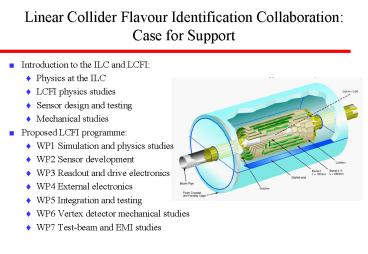
Title: Linear Collider Flavour Identification Collaboration: Case for Support
1
Linear Collider Flavour Identification
CollaborationCase for Support
- Introduction to the ILC and LCFI
- Physics at the ILC
- LCFI physics studies
- Sensor design and testing
- Mechanical studies
- Proposed LCFI programme
- WP1 Simulation and physics studies
- WP2 Sensor development
- WP3 Readout and drive electronics
- WP4 External electronics
- WP5 Integration and testing
- WP6 Vertex detector mechanical studies
- WP7 Test-beam and EMI studies
2
LCFI Collaboration
- P Allport3, D Bailey1, C Buttar2, D Cussans1, CJS
Damerell3, J Fopma4, B Foster4, S Galagedera5,
AR Gillman5, J Goldstein5, T Greenshaw3, R
Halsall5, B Hawes4, K Hayrapetyan3, H Heath1, S
Hillert4, D Jackson4,5, EL Johnson5, N Kundu4,
AJ Lintern5, P Murray5 A Nichols5, A
Nomerotski4, V OShea2, C Parkes2, C Perry4, KD
Stefanov5, SL Thomas5, R Turchetta5, M Tyndel5, J
Velthuis3, G Villani5, S Worm5, S Yang4.
1 Bristol University2 Glasgow University 3
Liverpool University 4 Oxford University 5
Rutherford Appleton Laboratory
3
The International Linear Collider
- Standard Model of particle physics is clearly
incomplete. - From 2007, LHC experiments will study pp
collisions vs 14 TeV giving large mass reach
for discovery of new physics. - Precision measurement (of masses, branching
ratios etc.) complicated by hadronic environment. - International consensus ee- LC operating at up
to vs 1 TeV needed in parallel with the LHC,
i.e. start-up in next decade. - Detailed case presented by LHC/LC Study Group
hep-ph/0410364.
- International Technology Review Panel recommended
in August 2004 that superconducting technology be
used for accelerating cavities. - Global effort now underway to design SC ILC,
director Barry Barish. - Timeline defined by ILC Steering Group foresees
formation of experimental collaborations in 2008
and writing of Technical Design Reports in 2009. - Agreement that vertex detector technology be
chosen following ladder tests in 2010.
4
Flavour and quark charge identification at the ILC
- Many of interesting measurements involve
identification of heavy quarks. - E.g. determination of branching ratios of Higgs
boson. - Are BRs compatible with the SM?
- Physics studies can also benefit from separation
of - E.g.
- Reduce combinatorial background.
- Allows determination of Higgs self-coupling.
5
Quark charge identification
- Increases sensitivity to new physics.
- E.g. effects of large extra dimensions on
- Study ALR (sL sR)/stot as a function of cos
q. - For muons, effects of ED not visible
- Changes much more pronounced for c (and b)
quarks - Requires efficient charge determination to large
cos q.
6
Quark charge identification
- Provides new tools for physics studies.
- E.g. measure top polarisation in decay
- Top decays before hadronisation.
- Anti-strange jet has 1 cos q distribution
w.r.t. top polarisation direction. - Distinguish between t and by tagging b and c
jets and determining quark charge for (at least)
one of these jets.
- Example of physics made accessible using this
technique - Determine tan b and tri-linear couplings Ab and
At through measurements of top polarisation in
b
t
W
c
7
Vertex detector performance goals
- Average impact parameter d of B decay products
300 mm, of charmed particles less than 100 mm. - d resolution given by convolution of point
precision, multiple scattering, lever arm and
mechanical stability. - Multiple scattering significant despite large vs
at ILC as charged track momenta extend down to
1 GeV. - Resolve all tracks in dense jets.
- Cover largest possible solid angle
forward/backward events are of particular
significance for studies with polarised beams. - Stand-alone reconstruction desirable.
- Implies typically
- Pixels 20 x 20 mm2
- Hit resolution better than 5 mm.
- First measurement at r 15 mm.
- Five layers out to radius of about 60 mm, i.e.
total 109 pixels - Material 0.1 X0 per layer.
- Detector covers cos q lt 0.96.
track 1
track 2
8
Constraints due to machine and detector
- Minimum beam pipe radius 14 mm.
- Pair background at this radius in 4T field
causes 0.03 (0.05) hits per BC and mm2 at vs
500 (800) GeV. - Bunch train structure
- For 109 pixels of size 20 x 20 mm2, implies
readout or storage of signals 20 times during
bunch train to obtain occupancy less than 0.3
(0.9) .
- Must withstand
- Radiation dose due to pair background of 20
krad p.a. - Annual dose of neutrons from beam and
beamstrahlung dumps 1 x 10⁹ 1 MeV equiv.
n/cm2. - Must cope with operation in 4T field.
- Must be robust against beam-related RF pickup and
noise from other detectors.
9
Conceptual vertex detector design
- Here using CCDs
- VXD surrounded by 2 mm thick Be support
cylinder. - Allows Be beam pipe to be of thickness of 0.25
mm.
- Pixel size 20 x 20 mm2, implies about 109 pixels
in total. - Standalone tracking using outer 4 layers.
- Hits in first layer improve extrapolation of
tracks to IP. - Readout and drive connections routed along BP.
- Important that access to vertex detector possible.
10
Conceptual detector design
- Amount of material in active region minimized by
locating electronics only at ends of ladders.
- Resulting material budget, assuming unsupported
silicon sensors of thickness 50 mm
Material ofbeam pipe five CCD
layerscryostatsupport shell
11
Vertex detector performance impact parameter
- Performance of vertex detector investigated and
optimised using Monte Carlo simulations. - E.g. study effect on impact parameter resolution
of variations in beam pipe radius, material
budget and number of layers in vertex detector. - Observe moderate effects due to increase in
material budget, severe degradation due to
increase in beam pipe radius.
- Impact parameter resolution
12
Flavour identification performance
- Simulate flavour ID inevents, here at Z0 pole.
- Feed information on impact parameters and
vertices identified using Zvtop algorithm into
neural net. - Modest improvement in beauty tagging
efficiency/purity over that achieved at SLD. - Improvement by factor 2 to 3 in charm tagging
efficiency at high purity. - Charm tag with low uds background interesting
e.g. for Higgs BR measurements.
- Efficiency and purity of tagging of beauty and
charm jets
13
Quark charge identification performance
- Must assign all charged tracks to correct
vertex. - Multiple scattering critical, lowest track
momenta 1 GeV.
- Sum charges associated with b vertex
- Quark charge identification for neutral B
requires dipole algorithm.
14
Sensors for the vertex detector CCDs
- Standard CCDs cannot achieve necessary readout
speed
- LCFI developed Column Parallel CCD with e2v
technologies.
15
Sensors CPCCD
- First of these, CPC1, manufactured by e2v.
- Two phase, 400 (V) ? 750 (H) pixels of size 20 ?
20 µm2. - Metal strapping of clock gates.
- Two different implant levels.
- Wire/bump bond connections to readout chip and
external electronics. - Direct connections and 2-stage source
followers - Direct connections and single stage source
followers (20 mm pitch)
16
Sensors CPC1 and CPR1
- Standalone CPC1 tests
- Noise 100 e- (60 e- after filter).
- Minimum clock potential 1.9 V.
- Max clock frequency above 25 MHz (design 1 MHz).
- Limitation caused by asymm. clock signals due to
single metal design.
- Marry with CMOS CPCCD readout ASIC, CPR1
(RAL) - IBM 0.25 µm process.
- 250 parallel channels, 20 µm pitch.
- Designed for 50 MHz.
17
Sensors CPC1 and CPR1
- Bump bonding of CPC1 and CPR1done at VTT
- CPR1 bump bonded to CPC1, signal from charge
channels - Observe 70 mV signal, expected 80 mV, good
agreement.
18
CCD radiation hardness tests
- Study CTI in CCD58 before and after irradiation
(90Sr 30 krad). - Measure decrease in charge from 55Fe X-rays as
func. of number of pixels through which charge
transferred.
- Compare data with simulations performed using
ISE-TCAD. - Extend to CPCCD.
19
Sensors ISIS
- In-situ storage image sensor.
- Signal collected on photogate.
- Transferred to small CCD register in pixel.
- Signal charge always buried in silicon until
bunch train has passed. - Column parallel readout at 1 MHz sufficient to
read out before arrival of next bunch train. - ISIS1 being built by e2v.
- 40 ? 160 µm2 cell containing 3-phase CCD with 5
pixels.
20
Sensors FAPS
- Monolithic Active Pixel Sensors developed within
UK. - Ongoing development for scientific applications
by MI3 collaboration.
- Storage capacitors added to pixels to allow use
at ILC, Flexible Active Pixel Sensors.
21
Sensors FAPS
- Present design proof of principle.
- Pixels 20 x 20 mm2, 3 metal layers, 10 storage
cells. - Test of FAPS structure with LED
- 106Ru b source tests
- Signal to noise ratio between 14 and 17.
- MAPS demonstrated to tolerate radiation doses
above those expected at ILC.
22
Mechanical considerations
- Thin ladder design.
- Stresses introduced when silicon is processed
imply unsupported option requires Si thickness
gt 50mm. - Stretching maintained longitudinal stability,
but provided insufficient lateral support. - Re-visit using thin corrugated carbon fibre to
provide lateral support. - Supporting CCD on thin Be substrate studied
- Problems observed at low Tin FEA
calculations. - Confirmed by measurements in Lab.
23
Mechanical considerations
- Importance of good matching of coefficients of
thermal expansion of silicon and substrate
demonstrated in laboratory measurements
- Now exploring use of silicon and reticulated
vitreous carbon foam sandwich - Diamond structure also recently purchased from
Element Six
24
Summary
- Progress made in understanding physics accessible
with a precise vertex detector at the ILC via - Flavour identification.
- Determination of b, c charge.
- Column Parallel CCD development progressing
- LCFI will soon have sensors of scale close to
that required for the ILC. - A major remaining challenge is the construction
of low mass CCD drive circuitry.
- Studies of ISIS and FAPS storage sensors
initiated. - Mechanical studies have demonstrated
- Unsupported Si will not result in lowest mass
sensors. - Emphasis shifted to new materials.
- Milestones of previous proposal met or surpassed
in last three years.
Recommended

