

Development of a Risk Informed Avionics Technology Insertion Roadmap PowerPoint PPT Presentation
1 / 19
Title: Development of a Risk Informed Avionics Technology Insertion Roadmap
1
Development of a Risk Informed Avionics
Technology Insertion Roadmap
Chris Wilkinson Senior Research Scientist CALCE
Electronic Products Systems Center University
of Maryland chrisw_at_wam.umd.edu,
http//www.calce.umd.edu
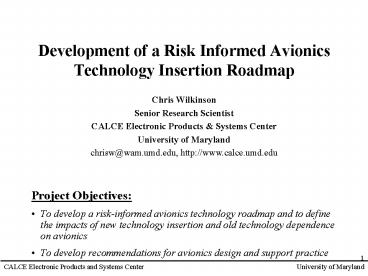
- Project Objectives
- To develop a risk-informed avionics technology
roadmap and to define the impacts of new
technology insertion and old technology
dependence on avionics - To develop recommendations for avionics design
and support practice
2
Why an Avionics Roadmap?
- The continued decline in military grade parts is
forcing avionics suppliers to switch to
commercial part/sub-system technology. - Brings problems of reduced temperature range,
rapid obsolescence, high IO SMD packaging. - Requires consequential changes to
- Parts selection process
- Aircraft cooling provisions
- Certification process
- Hardware design process
- Roadmap is collecting data on the changes
occurring in the component marketplace and
recommending the changes to the above processes
which are needed.
3
CALCE Center Programs
CALCE Electronic Products and Systems Consortium
- Risk assessment, mitigation and management of
electronic products and systems
Electronics Components Alliance
Advanced Electrical Power Systems
- Part interconnection
- High power packaging
- Software development
- Semiconductor reliability
- Package reliability
- Package design
- CADMP-II VQ software
CALCE Electronic Products and Systems
Center 5M/Year
Risk Mgmt in Avionics Systems
MEMS Technology
- Manufacturing for Sustainment (USAF ManTech
Program) - IEC and avionics working group collaboration
- Combined RF MEMS and Si/Ge HBTs (NASA JPL)
- SLIGA chip-to-chip bonding reliability (NSWC)
Laboratory Services
- Failure analysis
- Product qualification
- Materials characterization
- Measurements
4
CALCE Center Sponsors (2000)
- 3Com
- ABB
- U.S. Air Force
- ATOTECH
- Avici Systems
- BG
- Boeing
- BAE Systems
- Celestica
- Ciena
- CNES
- Rockwell Collins
- Corvis
- CSP, Inc.
- Daewoo Electronics
- DaimlerChrysler
- Delphi Delco
- DERA (U.K.)
- EADS (Aerospatiale) Matra
MTI NASA Goddard Space Center NASA Jet Propulsion
Lab Naval Surface Warfare Center Nan Ya
Plastics Neocera Nokia Radio Systems Nortel
Networks Northrop Grumman NSA Office of Naval
Research Orbital Sciences General
Motors Philips Photocircuits Price Systems
L.L.C. QualMark Raytheon Systems Company
RD Instruments Rocketdyne Sandia National
Labs Schlumberger S. C. Johnson Seagate LeCroy Smi
ths Industries Sonix Sun Microsystems Tatung Tera
dyne Textron Systems Thomson Consumer
Electronics Triquint TRW Lucas Aerospace United
Technologies UK MoD U.S. Army AMSAA U.S. Air
Force WPAFB Visteon Automotive Systems Wilcoxon
Research
Eldec Corporation Emerson Ericsson Radio Systems
AB GD Information Systems General
Motors Hewlett-Packard Honeywell Indium Solder
Intel InterCon International Rectifier Israeli
MoD Johnson Matthey Kings Electronic
Components Lab. of Physical Science Lockheed
Martin Lucent Technologies MacDermid Matra BAe MD
Robotics Microsoft Motorola
5
The Avionics Roadmap Creation Process
6
Military Temperature Range
- All avionics design will be based on parts with a
recommended operating range of 0-70oC or less
within 5 years. - Military part suppliers are exiting the market.
Of the few that are left, we do not expect any
significant players to continue military part
production beyond the next 5 years. - Industrial and automotive parts do not cover the
variety needed by avionics
7
World Semiconductor Market
Source INSTAT March 1999
8
Part Supply Voltage
- Supply voltage will continue to reduce
- 5v will largely be gone in 2 years
- Lower voltage trend is driven by the need
- for chips with smaller feature sizes
- More dies per wafer lower cost/die
- Higher speed/density increased functionality
- to maintain field strengths at or about the
current level and not increase failure rate due
to mechanisms such as - gate oxide breakdown
- hot carriers
- Low-K dielectrics will alter this trade-off
9
Low Voltage Roadmap Fairchild Semiconductor
3.3V
2.5V
gt1.8V
10
Part Packaging
- Through hole packages in all sizes will continue
to decline in favor of SMD. - Through hole now lt 7 and falling
- BGA/CSP/FC1 will be the dominant package for high
I/O applications. - High I/O SM packages have severe assembly and
solder joint reliability difficulties. Some
commercial users have resorted to sockets - CSP pad density requires redistribution layers
for routeability - Ceramic will continue to decline in favor of
plastic in all package styles.
1BGA Ball Grid Array, CSP- Chip Scale Package,
FC Flip Chip
11
Part Functionality
- The number of transistors/cm2 will continue to
follow Moores Law for the foreseeable future - Equates to ?P throughput, memory density, ASIC
gate count, etc - Projections for lithography suggest this will
happen - Gate delays will continue to fall, enabled by
factors such as low-K dielectric and copper
interconnects
12
Semiconductor Transistor Count
13
Part Design Wearout Life
- Some evidence suggests that design wearout life
may be decreasing - Wearout factors are becoming design goals for
major semiconductor manufacturers - Motorola has informed Honeywell that the design
wearout criteria for the PowerPC family is 5-7
years, 50 duty cycle1 - Intel has stated in a JEDEC meeting that the
Intel design wearout criteria is 7 years, 50
duty cycle, 1 failure rate at 7 year point1 - Nullifies constant failure rate assumption of
conventional system safety assessment process
1John Fink, Honeywell, Avionics Roadmap
Conference, University of Maryland, August 2000
14
Part Uprating
- Margin for uprateability could reduce in the long
term - Cost penalties from wider than needed temperature
range will be driven out - Higher level assembly parameter conformance
uprating methods, may be an option for ?3-5 years - Due to reducing margin between recommended
operating temperature specification and actual
part capability - Parameter re-characterization uprating may be an
option for 5-7 years with decreasing potential - Reducing internal margins leading to loss of
function - Uprating will be a solution mainly for CMOS
digital, and a limited amount of analog and mixed
signal parts
15
Key Problems Avionics Facing Avionics
- Responding to the loss of the traditional supply
chain - Managing Obsolescence
- In manufacturing, maintenance
- Continuous new technology insertion
- Reducing sustainment costs of
- Design re-design
- Maintenance support
- Certification re-certification
- Lower part temperature range capability
- Supporting legacy systems
16
Planned Recommendations
- Methods of managing avionics obsolescence
- Open v. closed architecture systems solutions
- COTS architectures
- Advantages and disadvantages of current COTS
approaches - Use of standard hardware v. IP based solutions
- Proprietary v. non-proprietary interfaces
- Rapid prototyping
- Reusable hardware and software
- Toolset needs
17
Planned Recommendations
- Maintenance and support
- The viability of continued component level
support at the depot level - Methods of cooling avionics and the provisions
needed at the aircraft level - Temperature requirements validation
- Operational constraints
- Aircraft avionics architecture constraints
- Certification and re-certification
- Methods of enabling incremental certification
18
Timetable
- CALCE tasked by avionics, airframer and end-user
members to develop an outline Avionics Roadmap,
October 1999 - 1st phase interim report presented to members,
March 2000 - Avionics Roadmap2000 Conference held at UoM,
August 2000 - 1st phase final report completed and 2nd phase
authorized by CALCE members, October 2000 - Interim Report March 2001, Final Report October
2001 - Transition the Roadmap to industry, date TBD
19
Conclusion
- The Avionics Roadmap project will
- Chart the external pressures which are compelling
avionics OEMs to design with commercial grade
components and sub-systems - Identify the changes needed in design, support
and certification - Identify the changes needed in governing
regulations and standards - Suggest ways for avionics systems OEMs to
maximize their ability to respond quickly to
obsolescence - Transition the Roadmap to an industry committee
for update and maintenance - Further information
- CHRISW_at_WAM.UMD.EDU
Recommended

