

Tiron Equilibria key results form lecture given on board PowerPoint PPT Presentation
1 / 36
Title: Tiron Equilibria key results form lecture given on board
1
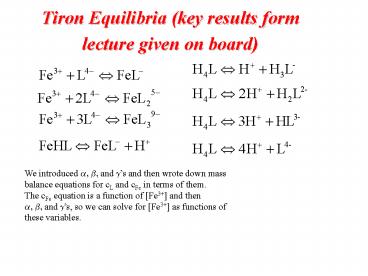
Tiron Equilibria (key results form lecture given
on board)
We introduced a, b, and gs and then wrote down
mass balance equations for cL and cFe in terms of
them. The cFe equation is a function of Fe3
and then a, b, and gs, so we can solve for
Fe3 as functions of these variables.
2
Weak Acids and Buffers
Read Chapter 10-1 to 10-5 and 11-1 to 11-3.
- Today we will learn about the properties of
buffers and develop the equations for calculating
their pHs. - We will follow the same approach as was used for
weak acids, making minor modifications. - This approach
- is exact for all pH values,
- can be readily extended to more complex
problems, - is easy to implement with MathCAD or Excel.
3
Weak Acid Review
Ka
Kw
If we also include the MB and CB equations
Mass balance
Charge balance
then we have 4 equations and 4 unknowns.
4
Use CB Eqn and ai to Calculate H
Rewrite the CB equation
to obtain
5
Solution of Equations
How we solve the below equation wo approximations
We cant solve for H as a function of CHA
so we do the reverse and Solve for CHA as a
function of H.
Go to Insert A
6
pH of Weak Acid
I II III
7
(No Transcript)
8
Now consider the following reactions
Ka
Kw
If we also include the MB and CB equations
Mass balance
Charge balance
then we have 5 equations and 5 unknowns.
9
Use CB Eqn and ai to Calculate H
Rewrite CB Eq.
to obtain one equation and one unknown.
At this point we could use Excel to produce
plots just like the ones we have seen of pH
versus CHA.
10
Or one can neglect two of the terms to obtain
Rewrite CB Eq.
How valid is the below equation?
11
Key buffer formulas
This can compared to
Henderson Hasselbalch Equation
12
Henderson Hasselbalch
or
If
then
13
Example of Buffer Formulas
14
Buffers and ICE Tables
Initial CNa 0 0 CHA
0 0 Rxtn 1 0 CNa
CNa CHA CNa 0 Rxtn 2
0 CNax CNa CHA-x CNax x
15
Compare the two reactions
Ka
Kw
For the left reaction we had a good buffer when
CHA CNa. What about the right reaction?
16
When is the right right reaction a good buffer?
Rewrite CB Eq.
17
Buffers and ICE Tables
Initial CNa 0 0
CHA 0 0 Rxtns 1-2 0
CNa CNa CHA-CNa CNa
CNa Rxtn 3 0 0 CNa
CHA-CNa CNa 0 Rxtn 4 0
0 CNa CHA-CNa -x CNax
x
18
We just have seen how to calculate the pH of a
weak acid to which we have added its
conjugate base or a strong base. Now we will
consider how to construct a titration curve for
the addition of a strong base. Here we will make
no approximations other than assume the
activity coefficients are unity.
19
Titration of HA with NaOH
Rewrite CB Eq.
to obtain one equation and one unknown.
Solve for CHA.
Is this what we really want for a titration?
20
Titration of HA with NaOH
Rewrite CB Eq.
Solve for Vt by multiplying both sides by ViVt.
For numerical calculation see Insert B.
21
Titration Plot
pH
Vt
a-Plot
Vt
22
How do we include activities in titration curves?
There are 3 key equations that we need.
23
Titration Plot
pH
Vt
a-Plot
Vt
24
Expressions for as
(1)
At the equivalence point we have equal moles. If
I designate Vte as the value of Vt at the
equivalence pt. then
(3)
(2)
Inserting (3) into (1) gives
25
Comparison of Approximate and Exact Titration
Curves
We have already seen the exact curve. Here is the
formula for the approximate curve.
or
Lets use numerical calc. to make a comparison.
26
Comparison of Approximate Expression to Exact
Result
27
How do I know that the inflection point in a
titration curve corresponds to pHpKa?
How do I know that the best buffer has a0 a1?
or
28
How do I know that the inflection point in a
titration curve corresponds to pHpKa?
We need to take the second derivative of the
below eqn and set it equal to zero to find the
inflection point.
or
29
And the final answer is
30
pH at the Equivalence Point(titration of a weak
acid with a strong base)
Ka
Kw
31
pH at the Equivalence Point
32
pH at the Equivalence Point
33
What is the pH at the equivalence point?
34
What is the pH at the equivalence point?
35
Compare the two reactions
36
Final comments
- You should be able to sketch titration curves
corresponding to addition of a base to an acid or
visa versa. - You should be able to identify those regions of
the curve that corresponds to a buffer. - You should be able to calculate the pH in any
region.
Recommended

