

Shape-based Similarity Query for Trajectory of Mobile Object PowerPoint PPT Presentation
Title: Shape-based Similarity Query for Trajectory of Mobile Object
1
Shape-based Similarity Query forTrajectory of
Mobile Object
- NTT Communication Science Laboratories, NTT
Corporation, JAPAN. - Yutaka Yanagisawa Jun-ichi Akahani
- Tetsuji Satoh
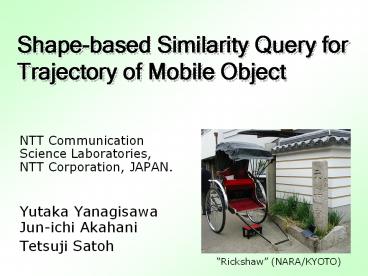
Rickshaw (NARA/KYOTO)
2
Background
- The Recent technologies allow us to track moving
objects using highly accurate positioning
devices. - There are many applications using such location
information have been developed. - Navigation Systems, Location-based Information
Systems, etc.
Digital City Kyoto A Location-based Information
System
A Navigation System
3
Motion Pattern Analysis
- Motion pattern analysis is one of the most
interesting technologies of these applications. - By analyzing their motion patterns, it is
possible to extract the behavioral
characteristics of moving objects. - The applications can predict the future behavior
of the moving objects using extracted
characteristics. - Single Motion Analysis
- focuses on the statistical characteristics of a
moving object. - Relative Motion Analysis
- focuses on the similarity between motion patterns.
We discuss the approach based on the similarity
of trajectory shapes because it is a simple and
intuitive approach.
4
Similarity of Trajectory Shapes
- This approach is called shape-based approach.
An example of an information providing system.
Exhibition hall
The trajectories of visitors are stored in a
database.
Show informationabout B, C, and D.
5
Problem
- However, there are few database systems which can
search trajectories based on shapes. - Many database systems retrieve moving objects
based on only distance.
The minimum distance between L and L2 is less
than the distance between L and L1. However, L2
is more similar in shape to L than L1
intuitively.
L
L1
Y
L2
D2
D1
Not appropriate for shape-based approach
X
6
Our Approaches
- We propose a shape-based similarity query for
searching trajectories from moving object
databases. - Moreover, we present an efficient indexing method
for retrieving moving objects based on our
proposed query.
7
Shape-based Similarity Query
8
Data Model for Trajectory
- In real world, a trajectory of a moving object
can be modeled as a continuous line in space. - However, positioning devices can not track a
moving object continuously. - In our work, a trajectory is stored as a sequence
of points (discrete line) in databases. - This model is used as a popular data model.
In Real World
In Databases
9
A Similarity of Time Series Data
- The key idea have been proposed in the technique
for time series database. - The similarity between two time series data is
defined as the Euclidean distance between the
points in n dimensional space.
W ltw1, w2, , w9gt W ltw1, w2, , w9gt
x
x
D(W, W)
(n9)
w9
w2
w1
w9
w1
t8
t
t
t1
10
A Similarity of Time Series Data
- The key idea have been proposed in the techniques
for time series database. - The similarity between two time series data is
defined as the Euclidean distance between the
points in n dimensional space.
W lt2, 3, 4, 3gt W lt1, 1, 2, 3gt
5
4
3
2
1
11
A Similarity of Time Series Data
- The key idea have been proposed in the techniques
for time series database. - The similarity between two time series data is
defined as the Euclidean distance between the
points in n dimensional space.
In this case, the distance is zero.
12
A Similarity of Time Series Data
- The distance fits to intuitive similarity of line
shapes. - There is an effective search algorithm to
calculate this distance. - We will extend the similarity for trajectory in 2
or more dimensional space.
13
Our Proposed Similarity of Trajectories
- The similarity of trajectories can be defined as
an extension of the distance of time series data. - The distance can be given as the following
expression.
14
Shape-based Similarity Queryfor Trajectories
- We define a shape-based similarity query for
trajectories as a subsequence matching query. - Because the length of trajectories are often
difference.
SSQ(L, l, q)
L A set of stored trajectories in database. l A
trajectory to be compared. q The distance from l.
Answer La A set of sub-trajectories
15
Shape-based Similarity Queryfor Trajectories
An Answer Sub-Trajectory
- The database calculates the distance between the
given trajectory l and each sub-trajectory. - If the distance is less than the given distance
q, the database adds the sub-trajectory to the
answer set of trajectories La.
16
Indexing
17
Approach
- The existing spatial structures are appropriate
for retrieving an object based on the distance. - However, these structures have no method for
searching the data based on the similarity
between trajectories.
We extend the spatial data structure for our
proposed query.
18
An Efficient Calculation Processfor the
Shape-based Similarity 1
- The essential idea was presented as a PAA
Piecewise Aggregate Approximation Keogh01. - PAA is an efficient method of approximating the
time series data for a similarity search.
Using the average sequences of a sub-sequences.
x
(N3)
W
W
t
19
An Efficient Calculation Processfor the
Shape-based Similarity 2
- The distance between the average sequences is the
lower bound of the distance between the original
two sequences.
x
D( W, W)
D( W, W)
W
W
By comparing average sequences, we can know the
lower bound of the distance between original
sequences.
t
t
20
An Efficient Calculation Processfor the
Shape-based Similarity 3
- In the case of trajectories, the distance between
the center points of trajectories is the lower
bound of the distance between the original
trajectories.
v1
Y
L
v1
L
v7
v7
X
21
Combination of PAA and Spatial Data Structure 1
- For making indexes, the database calculates the
center points of sub-trajectories. - The length of each sub-trajectory must be fixed
to the system parameter N. - In this example, N is four.
l
Y
Y
p8
l
p7
p6
p5
p3
p4
p2
p1
X
X
22
Combination of PAA and Spatial Data Structure 2
- Next, the database makes indexes to the points
using a traditional spatial data structure. - Our implemented system makes an index to every
center point using R-Tree.
The database can search objects based on the
similarity of trajectories using the spatial data
structure.
Normal R-Tree
Our Proposed Index Structure
23
Query Processing 1
- When a SSQ(L,lQ,q) is given, the database
calculates the center point of lQ at first. - Suppose that the length of stored center points
is fixed to 4 (N4) in the following example.
If a query SSQ(L,lQ,q) is given..
pQ is the center point of a given trajectory.
Y
Y
lQ
pQ
X
X
24
Query Processing 2
- Next, the database searches stored points within
the distance q from the calculated point pQ using
the spatial data structure.
Y
An index tree (R-Tree)
A
A
Candidate points
C
B
B
C
pQ
X
The region within the distance q from pQ
25
Query Processing 3
- Finally, the database checks the distance between
a given trajectory lQ and each candidate
trajectory. - If the distance is less than a given threshold q,
the candidate trajectory is added to the answer
set La.
Y
p2
Y
lQ
pQ
l1
p1
X
l1 is the original trajectory of p1.
26
Performance Study
27
Performance Study
- We conducted an experiment for evaluating our
proposed query and indexing method. - Measuring the processing time for retrieving
trajectories required by a shape-based similarity
query. - For this evaluation, two types of trajectories
are stored in a database. - tracked by GPS and generated by a simulator.
We compared the processing time using both
methods
- Our indexing method,
- A spatial data structure (R-Tree).
28
Trajectory Data 1
- This is an example of trajectory data captured by
GPS receivers on rickshaws (in Nara city). - Rickshaw is tour guide, they work in Nara / Kyoto.
A trajectory of a rickshaw in all day
Rickshaw
A GPS Receiver (eTrex/GARMIN)
29
Trajectory Data 2
- This figure displays trajectories generated by
our implemented simulator.
The simulator can generate trajectoriessuch that
people walk on a plane freely. Velocity and
direction of each object are given as random
values. But the changes of these values are slow
and continuous.
30
The Result of the Experiment
The processing time to calculate 10 random
queries is displayed
Using our index structure
Using R-Tree
Amount of Stored Points
For retrieving longer trajectories from stored
data, our proposed method has high advantages to
existing methods.
31
Conclusions
- We have proposed a shape-based similarity query
to find moving objects. - Database users can find moving objects for
analyzing their motion patterns. - Moreover, we have presented an effective indexing
method to search for the trajectories required by
our proposed queries. - We demonstrated the advantage of our proposed
method to existing spatial data structures.
32
Future Work
- We will evaluate our proposed method using these
data.
- Human Tracking by using Laser Scanners
- University of Tokyo (Dr. Zhao and Prof.
Shibasaki) - Captured at Geoinformation Forum Japan 2002
(32.096 people visited)
Motion Capture Data
- Tokyo University of Technology (Creative
Labo) - 76 moving points on bodies (120fps)
- Playing football and judo
33
Our Proposed Similarity of Trajectories
- The similarity of trajectories can be defined as
an extension of the distance of time series data.
For comparing these trajectories,
pi (xi, yi)
34
Our Proposed Similarity of Trajectories
- The similarity of trajectories can be defined as
an extension of the distance of time series data. - We extend it to 2 or more dimensional space.
Calculating distances on each plane
35
Our Proposed Similarity of Trajectories
- The similarity of trajectories can be defined as
an extension of the distance of time series data. - We extend it to 2 or more dimensional space.
Finally, integrating these distances.
..is given as the squire root of the sum of them.
36
Other Applications
- Security system for exhibition halls
- Arrangement of items in a shop
- Traffic forecaster
- Guidance system for tourists
37
An Efficient Calculation Processfor the
Shape-based Similarity 4
- The distance between the average sequences is the
lower bound of the distance between the original
two sequences.
A Simple Example
(N2)
W lt2, 3, 4, 3gt W lt1, 1, 2, 3gt
W lt2.5, 3.5gt W lt1.0, 2.5gt
5
5
4
4
3
3
2
2
1.8
1
1
Using average sequences, we can know the lower
bound.
38
Query Processing 4
- If the length of lQ is larger than N, the
database calculates several center points of lQ. - The database repeats searching process several
times for lQ if necessary.
Where N 4 and the length of lQ is 7,
These two center points are available for
searching.
Y
Y
lQ
pQ2
pQ1
X
X
39
An Efficient Calculation Processfor the
Shape-based Similarity 3
- The distance between the average sequences is the
lower bound of the distance between the original
two sequences.
A Simple Example
W lt2, 3, 4, 3gt W lt1, 1, 2, 3gt
5
4
3
2
1
40
Example
Stored Trajectory
Query
Recommended

