

Animal Production PowerPoint PPT Presentation
1 / 11
Title: Animal Production
1
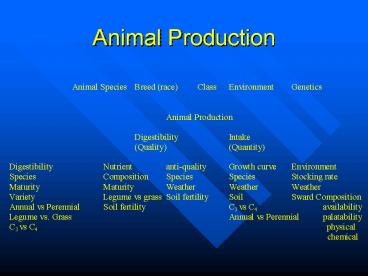
Animal Production
2
Forage/Plant Factors
- AP Fn FQl FQn
- Animal productivity in a forage based system is a
function of forage quality (FQl) and forage
quantity (FQn). The amount of forage available
to the animal is also known as forage
availability.
3
Forage Quality
- FQl fn FDg FCm)
- Forage quality is a function of forage
digestibility, the amount of material that may be
digested and utilized by the animal, and forage
composition, what nutrients in both polymolecular
(amino acids, vitamins, etc.) and molecular
(minerals) forms.
4
Digestibility
- The amount of material broken down and absorbed
by the animal - increasing digestibility of the plant increases
productivity per unit intake (efficiency) or
decreases the intake per unit performance
(productivity) - increasing digestibility increases forage intake
(when forage availability is not limited) because
food material moves through the animal faster,
allowing the animal to refill the gut.
5
Digestibility
- FDg fn Cp Pm
- Forage digestibility is a function of
chemical/nutrient composition and plant maturity - Nutrient Compositions
- Primary Components listed in least to most
digestible - Lignin
- Tannin
- Cellulose
- Hemicellulose
- Total nonstructural carbohydrates
- Secondary Components
- N, P, K
- Must balance animal/microbe needs to have optimal
digestibility
6
Plant maturity
- As the plant ages
- It decreases in digestibility
- Physiological age
- Seedling
- Vegetative
- Reproductive
- Nutrient Composition
- increased cell wall thickness
- increased lignin, tannin, etc. content
- decreased TNC and hemicellulose
- Leaf content
- leaf is more digestible than stem
- leafstem ratio decreased
7
Plant Species
- C3 vs. C4
- C4 have addition CO2 pathway
- increased yield
- increased cell wall contents
- increased vascular bundle content
- NET
- increased drought tolerance
- increased risk
- increased cost
- Annual vs. Perennial
- less lignin, tannin and cellulose
- greater leaf content
- total yield is similar
- less TNC storage in the plant roots.
- Legumes vs. Grasses
- Legumes compared to grasses
- produce nitrogen
- higher CP content
- more digestible stem
- more TNC
- less structured carbohydrates
- NE Texas
- lower yield potential
- reduced drought tolerance
- tolerate a smaller range of soil conditions
- soil pH
- soil type
- P hogs.
8
Forage Intake
- FI fn RD FA
- Forage intake is a function of the rate of
digestibility and forage availability - Increased intake is associated with increased
animal productivity - Rate of digestibility
- A has higher total intake
- Increased intake due to reduced gut fill time.
- Forage A digests quicker, allowing the animal the
room for more feed sooner. - Gut fill regulated by
- metabolic rare in grazing
- physical often in grazing
9
Forage Availability
- Grazing Systems
- Continuous grazing
- FA fluctuates constantly due to animal intake and
plant growth - increase FA
- increase selectivity (increase leaf intake)
- decrease travel (decrease energy loss)
- Rotational grazing
- Flexible system that allows rationing of forage
- Herbage allowance the amount of forage available
within a certain unit of time. Usually expressed
as lb/head/day - Grazing pressure Reciprecal of herbage allowance
(head/unit forage weight)
- The amount of forage available for immediate
animal consumption usually expressed in
weight/area. - FA fn PD PH
- forage availability is a function of plant
density and plant height - Plant structure changes both.
- Animal species difference
- sheep nibblers
- get closer to the ground
- cattle tongue adhesion
- require more leaf separation
10
Forage Acceptability
- Fac fn FPl FM)
- Forage acceptability is a function of forage
palatability and forage morphology. - Palatability Usually a chemical function.
Reflects a preference of the animal based on
inherent forage traits. - Sugars increased palatability
- Alkaloids decreased palatability
- Morphology Plant structure that inhibits or
enables animal consumption - Large leaves high animal preference
- Thorns greatly reduced animal preference
11
Summary
- Forage management combines both crop and animal
production techniques. Rules and laws are
difficult to establish. Exceptions are easy to
find. To truly understand forage management an
ecological point of view (big picture) is
required.
Recommended

