

MN50180: Corporate Finance: Semester 2, 20067 PowerPoint PPT Presentation
1 / 113
Title: MN50180: Corporate Finance: Semester 2, 20067
1
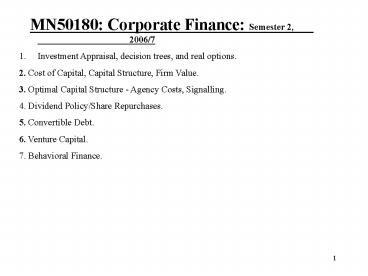
- MN50180 Corporate Finance Semester 2,
2006/7 - Investment Appraisal, decision trees, and real
options. - 2. Cost of Capital, Capital Structure, Firm
Value. - 3. Optimal Capital Structure - Agency Costs,
Signalling. - 4. Dividend Policy/Share Repurchases.
- 5. Convertible Debt.
- 6. Venture Capital.
- 7. Behavioral Finance.
2
The Major Decisions of the Firm.
- Investment Appraisal (Capital Budgeting) Which
New Projects to invest in? - Capital Structure (Financing Decision)- How to
Finance the new projects Debt or equity? - Payout Policy Dividends, Share Repurchases,
Re-investment. - gt Objective Maximisation of Shareholder Wealth.
3
1. Investment Appraisal.
- Objective Take projects that increase
shareholder wealth (Value-adding projects). - Investment Appraisal Techniques NPV, IRR,
Payback, ARR, Real Options. - Which one is the Best rule for shareholder wealth
maximisation?
4
Net Present Value
Perpetuities.
IRR gt
Take Project if NPV gt 0, or if IRR gt r.
5
Section 1 Investment Appraisal and real Options
Some of the NPV topics covered in
MN20009- -Conflicts between NPV and
IRR. -Mutually exclusive V independent
projects. -Capital Rationing. -Competitive
Bidding (eg Space Structures Case Study). New
MN20211 NPV Topics. Decision trees. Risk
analysis. Real Options. How do we get positive
NPV projects?
6
Investment Decision RulesSingle project BD
Chapter 6.
- Net Present Value
- FFF Example
500
If FFF use a payback period of 5 years or less,
would they accept the project?
400
100
Discount Rate r
14
10
7
IRR Versus NPV
- Delayed Investment John Star Example BD Pg 153
NPV
But, at cost of capital r 10, NPV - 243K
!!!
DR
23.38
8
Stars Lecture Contract Pg 154.
No IRR !!!!
9
Multiple IRRs.
- Stars New Book Deal
NPV
DR
10
Mutually Exclusive Projects.
- Rank the projects and choose the best
- Choose Project with highest NPV.
- Choose Project with highest IRR? Can lead to
mistakes!
NPV
DR
10
11
MUTUALLY EXCLUSIVE PROJECTS.
12
DO WE INVEST IN THIS NEW PROJECT?
NPV gt 0. COST OF CAPITAL (12) lt IRR (19.75).
13
Treatment of depreciation.
For another example, see HomeNet Example in BD
Ch 7 page 180.
14
Free Cashflow and NPV
- Earnings are an accounting Measure.
- For NPV Capital Expenditure in year it happens.
- Add back depreciation.
- Adjust for Net Working Capital (see page 187 of
BD).
15
Decision Trees and Sensitivity Analysis. Example
From RWJ. New Project Test and Development
Phase Investment 100m. 0.75 chance of
success. If successful, Company can invest in
full scale production, Investment
1500m. Production will occur over next 5 years
with the following cashflows.
16
Production Stage Base Case
Date 1 NPV -1500
1517
17
Decision Tree.
Date 1 -1500
Date 0 -100
NPV 1517
Invest
P0.75
Success
Do not Invest
NPV 0
Test
Do not Invest
Failure
P0.25
Do Not Test
Invest
NPV -3611
Solve backwards If the tests are successful, SEC
should invest, since 1517 gt 0. If tests are
unsuccessful, SEC should not invest, since 0 gt
-3611.
18
Now move back to Stage
1. Invest 100m now to get 75 chance of 1517m
one year later?
Expected Payoff 0.75 1517 0.25 0 1138. NPV
of testing at date 0 -100
890
Therefore, the firm should test the project.
Sensitivity Analysis (What-if analysis or Bop
analysis) Examines sensitivity of NPV to changes
in underlying assumptions (on revenue, costs and
cashflows).
19
Sensitivity Analysis. - NPV
Calculation for all 3 possibilities of a single
variable expected forecast for all other
variables.
Limitation in just changing one variable at a
time. Scenario Analysis- Change several
variables together. Mosher Case study. Break -
even analysis examines variability in
forecasts. It determines the number of sales
required to break even.
20
Break-even Analysis. Accounting
Profit.
Breakeven Point 2091 Engines.
NPV.
Breakeven Point 2315 Engines.
21
EVA (Economic Value Added TM) BD page 156.
- EVA developed, and trade-marked, by Stern
Stewart. - EVA closely related to NPV
- But NPV investment decision rule,
forward-looking expected value-creation over life
of a project. - EVA is an ongoing Annual Performance Evaluation
Technique. - Rewards managers on annual value-creation.
22
EVA with constant invested capital.
- Project with Initial required Capital Investment
- Capital Lasts forever (no depreciation).
- Project generates cashflow in each future
period n.
23
EVA Example
- EVA of FFFs investment opportunity (see slide
6). - EVA in every year is
- Present Value of these EVAs is
24
EVA When Invested Capital Changes.
- Work through example 6.3 (Page 159 of BD) to
demonstrate that NPV PV (EVA).
in period n)
25
Real Options.
- Real Options recognise flexibility in investment
appraisal decision. - Standard NPV static now or never.
- Real Option Approach Now or Later.
- -Option to delay, option to expand, option to
abandon. - Analogy with financial options.
26
Financial Options. A call option gives the
holder the right (but not the obligation) to buy
shares at some time in the future at an exercise
price agreed now. A put option gives the holder
the right (but not the obligation) to sell shares
at some time in the future at an exercise price
agreed now. European Option Exercised only at
maturity date. American Option Can be exercised
at any time up to maturity. For simplicity, we
focus on European Options.
27
Buying a Call Option.
Selling a put option.
Selling a Call Option.
Buying a Put Option.
28
- Options Black Scholes Model.
- -Binomial Approach discrete time periods. Large
number of inputs. - Black-Scholes approach continuous price process.
- only 5 inputs.
- Value of call Option
d1
29
- General explanation.
- -Probability that call will generate positive
cashflow at expiration. - Replicating portfolio buy units
of the underlying asset - Borrow
- Portfolio with same cashflows as call option
- Therefore, same value.
- Dividend Adjustment (see real options option to
delay).
dividend yield dividends/current asset value.
30
- Investment Appraisal and Real Options (Damadoran
889 905). - -Traditional investment analysis Take a project
if NPV gt 0. - -Does not consider the options associated with
investment projects. - Option to Delay.
- Option to expand in future.
- Option to Abandon a project.
31
Option to Delay. A project requires initial
investment of X, PV of cash inflows is V. NPV
V- X. Firm invests in obtaining exclusive rights
to the project. This gives it the ability to
delay investment. Decision rule If V gt X, invest
in the project (positive NPV). If V lt X, do not
invest in the project (negative NPV).
32
PV of cashflows.
ve NPV
-ve NPV
X
V
Cost of exclusive rights
Just like a call option The underlying asset is
the project. The higher the variance in outcomes,
the more valuable is the option to
delay. Estimating the variance in the project
Similar past projects, Scenario and sensitivity
analysis (probabilities) Similar businesses.
33
The option to delay is exercised when the firm
decides to invest in the project. Exercise price
is initial investment X. Option to delay expires
when the exclusive rights lapse. After this time,
competition drives NPV to zero. Cost of delaying
after NPV turns Ve- less time to have
competitive advantage. Evenly distributed
cashflows Annual Cost of Delay (in ) 1/n.
34
Option to Delay (as a call option)
- Restaurant Example in BD page 721.
35
- Option to delay and Competition (Smit and Ankum).
- -benefit wait to observe market demand.
- -cost Lost cash flows.
- -cost lost monopoly advantage, increasing
competition. - Net Operating Cashflow opportunity cost plus
economic rent
Economic Rent Innovation, barriers to entry,
product differentiation, patents. Long-run ER
0. Firm needs too identify extent of competitive
advantage.
36
Option to delay and Competition (Smit and Ankum)
Contd.
Cash inflow during deferment period
In monopoly model constant economic rent. In
competition, economic rent declines to
zero. -trade-off between option value of waiting,
and loss from competition.
37
Option to Expand. -initial project may allow
further future investments or future entry into
other markets. -initial project is an option-
should be willing to pay for this. Ie firm may
take a negative NPV project due to high NPV on
future projects (option can be evaluated
today). Eg Initial project gt right to expand
and invest in new future project. Future Project
NPV V-X (assessed today). -must take future
project by certain date.
38
PV of cashflows
-ve NPV From expansion
X
ve NPV From expansion
Initial Proj Investment
-like a call option.
A firm can use option analysis to rationalise
investing in ve NPV project which leads to
future opportunities. Option analysis shows the
value of this.
39
Option to Abandon a Project. The remaining value
on a project is V. Liquidation value is
L. Remaining life n years. Payoff from owning an
abandonment option 0 if V gt L. L V if L gt
V. -Put option.
PV
L
40
- How do we get positive NPV projects (Shapiro)?
- -Traditional investment appraisal assumes
positive NPV projects exist. - Mechanical process estimating cashflows cost of
capital. - Finding ve NPV projects in competitive markets
is difficult. - Need to identify projects that create competitive
advantage. - Structure investments to exploit economies of
scale and scope. - Cost advantages learning curves.
- Product differentiation.
- This emphasises that search for ve NPV projects
begins with firms strategy.
41
The Investment Appraisal Debate. Richard Pike
Sample size 100 Large UK based Firms.
42
Combination of Techniques Pike 1992
( ) NPV
43
- Some Reasons for usage of wrong techniques.
- -Managers prefer figures gt IRR, ARR
- Managers dont understand NPV/ Complicated
Calculations. - Payback simple to calculate.
- Short-term compensation schemes gt Payback (Levy
200 203, Pike 1985 pg 49). - Behavioural Factors (see later section on
Behavioural Finance!!) - Increase in Usage of correct DCF techniques
- Computers.
- Management Education.
44
Risk and Return -revision. An investors actual
return is the percentage change in price
Risk Variability or Volatility of Returns, Var
(R). We assume that Returns follow a Normal
Distribution.
Var(R).
E(R)
45
Portfolio Analysis. Two Assets Investor has
proportion a of Asset X and (1-a) of Asset Y.
Combining the two assets in differing proportions.
E(R)
46
Portfolio of Many assets Risk Free Asset.
E(R)
Efficiency Frontier.
M
.
X
All rational investors have the same market
portfolio M of risky assets, and combine it with
the risk free asset. A portfolio like X is
inefficient, because diversification can give
higher expected return for the same risk, or the
same expected return for lower risk.
47
The Effect of Diversification on Portfolio
Variance.
Number of Assets.
An assets risk Undiversifiable Risk
Diversifiable Risk Market Risk Specific
Risk. Market portfolio consists of
Undiversifiable or Market Risk only.
48
Relationship between Investor Portfolio Decision
and Firms Cost of Capital
- Investors can diversify away all specific risk
therefore, should only be rewarded for holding
each firms market risk gt CAPM. - CAPM provides the firms cost of equity.
49
Capital Asset Pricing Model
quantity of risk.
Security Market Line.
50
Estimating Cost of Equity Using Regression
Analysis. We regress the firms past share price
returns against the market.
51
Cost of Capital Revision (continued). Combining
cost of equity with cost of debt to obtain WACC.
- Ke only rewards investors for systematic risk.
- Must use market values of debt and equity (not
book values). - WACC is the marginal cost for new investments.
Therefore, WACC may be different for different
projects (why?).
52
Link to Section 3 Link between Value of the firm
and NPV.
Positive NPV project immediately increases
current equity value (share price immediately
goes up!)
Pre-project announcement
New capital (all equity)
New project
Value of Debt
Original equity holders
New equity
New Firm Value
53
Example
5005001000.
20
60 -20 40.
500.
Value of Debt
Original Equity
50040 540
New Equity
20
1000601060.
Total Firm Value
54
Positive NPV Effect on share price. Assume all
equity.
55
SECTION 3 Value of the Firm and Capital
Structure Revision of BBA2. Introduction- Value
of the Firm Value of Debt Value of Equity
discounted value of future cashflows available to
the providers of capital. (where values refer to
market values). Capital Structure is the amount
of debt and equity It is the way a firm finances
its investments. Unlevered firm
all-equity. Levered firm Debt plus
equity. Miller-Modigliani said that it does not
matter how you split the cake between debt and
equity, the value of the firm is unchanged
(Irrelevance Theorem).
56
Value of the Firm discounted value of future
cashflows available to the providers of
capital. -Assume Incomes are perpetuities. Miller-
Modigliani Theorem
Irrelevance Theorem Without Tax, Firm Value is
independent of the Capital Structure. Note that
57
K
K
Without Taxes
With Taxes
D/E
D/E
V
V
D/E
D/E
58
- MM main assumptions
- - Symmetric information.
- Managers unselfish- maximise shareholders wealth.
- Risk Free Debt.
- MM assumed that investment and financing
decisions were separate. Firm first chooses its
investment projects (NPV rule), then decides on
its capital structure. - Pie Model of the Firm
D
E
E
59
MM irrelevance theorem- firm can use any mix of
debt and equity this is unsatisfactory as a
policy tool. Searching for the Optimal Capital
Structure. -Tax benefits of debt. -Asymmetric
information- Signalling. -Agency Costs (selfish
managers). -Debt Capacity and Risky Debt. Optimal
Capital Structure maximises firm value.
60
Combining Tax Relief and Debt Capacity
(Traditional View).
K
V
D/E
D/E
61
Section 4 Optimal Capital Structure, Agency
Costs, and Signalling. Agency costs - managers
self interested actions. Signalling - related to
managerial type. Debt and Equity can affect Firm
Value because - Debt increases managers share
of equity. -Debt has threat of bankruptcy if
manager shirks. - Debt can reduce free
cashflow. But- Debt - excessive risk taking.
62
AGENCY COST MODELS. Jensen
and Meckling (1976). - self-interested manager -
monetary rewards V private benefits. - issues
debt and equity. Issuing equity gt lower share of
firms profits for manager gt he takes more perks
gt firm value Issuing debt gt he owns more equity
gt he takes less perks gt firm value
63
Jensen and Meckling (1976)
V
Slope -1
V
A
V1
B
B1
If manager owns all of the equity, equilibrium
point A.
64
Jensen and Meckling (1976)
V
Slope -1
V
A
B
V1
Slope -1/2
B
B1
If manager owns all of the equity, equilibrium
point A. If manager owns half of the equity, he
will got to point B if he can.
65
Jensen and Meckling (1976)
V
Slope -1
V
A
B
V1
Slope -1/2
V2
C
B
B1
B2
If manager owns all of the equity, equilibrium
point A. If manager owns half of the equity, he
will got to point B if he can. Final equilibrium,
point C value V2, and private benefits B1.
66
Jensen and Meckling - Numerical Example.
Manager issues 100 Debt. Chooses Project B.
Manager issues some Debt and Equity. Chooses
Project A.
Optimal Solution Issue Debt?
67
Issuing debt increases the managers fractional
ownership gt Firm value rises. -But Debt and
risk-shifting.
68
OPTIMAL CAPITAL STRUCTURE. Trade-off Increasing
equity gt excess perks. Increasing debt gt
potential risk shifting. Optimal Capital
Structure gt max firm value.
V
V
D/E
D/E
69
Other Agency Cost Reasons for Optimal Capital
structure. Debt - bankruptcy threat - manager
increases effort level. (eg Hart, Dewatripont and
Tirole). Debt reduces free cashflow problem (eg
Jensen 1986).
70
Agency Cost Models continued. Effort Level,
Debt and bankruptcy (simple example). Debtholders
are hard- if not paid, firm becomes bankrupt,
manager loses job- manager does not like
this. Equity holders are soft.
What is Optimal Capital Structure (Value
Maximising)?
71
Firm needs to raise 200, using debt and equity.
Manager only cares about keeping his job. He has
a fixed income, not affected by firm value. a) If
debt lt 100, low effort. V 100. Manager keeps
job. b) If debt gt 100 low effort, V lt D gt
bankruptcy. Manager loses job. So, high effort
level gt V 500 gt D. No bankruptcy gt Manager
keeps job. High level of debt gt high firm
value. However trade-off may be costs of having
high debt levels.
72
Free Cashflow Problem (Jensen 1986). -Managers
have (negative NPV) pet projects. -Empire
Building. gt Firm Value reducing. Free Cashflow-
Cashflow in excess of that required to fund all
NPV projects. Jensen- benefit of debt in
reducing free cashflow.
73
Jensens evidence from the oil industry. After
1973, oil industry generated large free
cashflows. Management wasted money on unnecessary
R and D. also started diversification programs
outside the industry. Evidence- McConnell and
Muscerella (1986) increases in R and D caused
decreases in stock price. Retrenchment-
cancellation or delay of ongoing projects. Empire
building Management resists retrenchment. Takeover
s or threat gt increase in debt gt reduction in
free cashflow gt increased share price.
74
Jensen predicts young firms with lots of good
(positive NPV) investment opportunities should
have low debt, high free cashflow. Old stagnant
firms with only negative NPV projects should have
high debt levels, low free cashflow. Stultz
(1990)- optimal level of debt gt enough free
cashflow for good projects, but not too much free
cashflow for bad projects.
75
Income Rights and Control Rights. Some
researchers (Hart (1982) and (2001), Dewatripont
and Tirole (1985)) recognised that securities
allocate income rights and control
rights. Debtholders have a fixed first claim on
the firms income, and have liquidation
rights. Equityholders are residual claimants, and
have voting rights. Class discussion paper Hart
(2001)- What is the optimal allocation of control
and income rights between a single investor and a
manager? How effective are control rights when
there are different types of investors? Why do we
observe different types of outside investors-
what is the optimal contract?
76
77
Signalling Models of Capital Structure Assymetric
info Akerlofs (1970) Lemons Market. Akerlof
showed that, under assymetric info, only bad
things may be traded. His model- two car dealers
one good, one bad. Market does not know which is
which 50/50 probability. Good car (peach) is
worth 2000. Bad car (lemon) is worth
1000. Buyers only prepared to pay average price
1500. But Good seller not prepared to sell.
Only bad car remains. Price falls to
1000. Myers-Majuf (1984) securities may be
lemons too.
78
Asymmetric information and Signalling Models. -
managers have inside info, capital structure has
signalling properties. Ross (1977) -managers
compensation at the end of the period is
D debt level where bad firm goes
bankrupt. Result Good firm D gt D, Bad Firm D lt
D. Debt level D signals to investors whether the
firm is good or bad.
79
Myers-Majluf (1984). -managers know the true
future cashflow. They act in the interest of
initial shareholders.
Expected Value 190 305 New
investors 0 100 Old
Investors 190 205
80
Consider old shareholders wealth Good News Do
nothing 250. Good News Issue Equity Bad
News and do nothing 130.
Bad News and Issue equity
81
Old Shareholders payoffs Equilibrium
Issuing equity signals that the bad state will
occur. The market knows this - firm value
falls. Pecking Order Theory for Capital Structure
gt firms prefer to raise funds in this
order Retained Earnings/ Debt/ Equity.
82
Evidence on Capital structure and firm
value. Debt Issued - Value Increases. Equity
Issued- Value falls. However, difficult to
analyse, as these capital structure changes may
be accompanied by new investment. More promising
- Exchange offers or swaps. Class discussion
paper Masulis (1980)- Highly significant
Announcement effects 7.6 for leverage
increasing exchange offers. -5.4 for leverage
decreasing exchange offers.
83
- Practical Methods employed by Companies.
- Trade off models PV of debt and equity.
- Pecking order.
- Benchmarking.
- Life Cycle.
Increasing Debt?
time
84
THEORETICAL MODELS
- Limited liability model (Brander and Lewis, 1986,
Maksimovic, 1988, Showalter, 1995) - Deep purse model (Fudenberg, 1986, Brander and
Lewis, 1988, Bolton and Scharfstein, 1990).
85
LIMITED LIABILITY MODEL
- Brander and Lewis (1986)
- One of the pioneering theoretical papers.
- Based on Jensen and Meckling (1976) leverage
induces shareholders to pursue risky strategies.
86
LIMITED LIABILITY MODEL
- Brander and Lewis (1986)
- Firms compete in Cournot (quantities)
competition. - Firms which take on more debt, will have
incentive to pursue strategies that increase
returns in non-bankrupt states and lower returns
in bankrupt states. - Higher debt gt higher quantities.
- The limited liability effect of debt.
87
LIMITED LIABILITY MODEL
- Showalter (1995)
- Bertrand competition - limited liability effect
of debt causes firm to increase its prices when
demand is uncertain. - Cournot competition gt strategic substitutes.
- Bertrand competition gt strategic complements.
88
LIMITED LIABILITY MODEL
- Cournot gt the marginal profit of one firm
decreases when output of the other firm
increases. More leverage induces firm to increase
output on its rivals expense. - Bertrand gt the marginal profit and equilibrium
price of a firm rises, corresponding to its
rivals increase in price
89
LIMITED LIABILITY MODEL
- Summary
- Cournot gt leverage toughens competition.
- Bertrand gtleverage softens competition.
90
DEEP PURSE MODEL
- Bolton and Scharfstein (1990)
- Firms with greater access to capital
(less-leveraged) can sustain any losses until
they succeed in eliminating their
higher-leveraged rivals.
91
Limited Liability and Deep Purse model
- The difference between them is that in deep purse
model, it is the less leveraged firm which has an
incentive to increase output or decrease price in
order to increase a cutthroat competition.
92
EMPIRICAL EVIDENCE
- Empirical papers such as Chevalier (1995),
Phillips (1995), Kovenock and Phillips (1997)
support the argument that debt softens
competition.
93
MARKET POWER and DEBT
- The relationship can be explained by the limited
liability and the deep purse model. - Limited liability models gt positive
relationship. - Deep purse models gt negative relationship.
94
MARKET POWER and DEBT
- Empirical Tests
- Mixed results.
- Positive relationship Rathinasamy et al, 2000,
Phillips, 1995). - Negative relationship Chevalier, 1995, Phillips,
1995). - Non-monotonic Pandey, 2002, Fairchild, 2004.
95
- Introduction to Behavioural Finance.
- Standard Finance assumes that agents are rational
and self-interested. - Behavioural finance agents irrational.
- Irrational Investors Overvaluing assets-
internet bubble? - Irrational Managers- effects on investment
appraisal? - Effects on capital structure?
96
- Forms of Irrationality.
- Bounded Rationality (eg Mattson and Weibull 2002,
Stein 1996). - - Limited information Information processing
has a cost of effort. - - Investors gt internet bubble.
- b) Behavioural effects of emotions
- -Prospect Theory (Kahneman and Tversky 1997).
- Regret Theory.
- Irrational Commitment to Bad Projects.
- Overconfidence.
- C) Catering investors like types of firms (eg
high dividend).
97
- Bounded rationality (Mattson and Weibull 2002).
- Manager cannot guarantee good outcome with
probability of 1. - Fully rational gt can solve a maximisation
problem. - Bounded rationality gt implementation mistakes.
- Cost of reducing mistakes.
- Optimal for manager to make some mistakes!
- CEO, does not carefully prepare meetings,
motivate and monitor staff gt sub-optimal actions
by firm.
98
- Regret theory and prospect theory (Harbaugh
2002). - -Risky decision involving skill and chance.
- managers reputation.
- Prospect theory People tend to favour low
success probability projects than high success
probability projects. - Low chance of success failure is common but
little reputational damage. - High chance of success failure is rare, but more
embarrassing. - Regret theory Failure to take as gamble that
wins is as embarrassing as taking a gamble that
fails. - gt Prospect regret theory gt attraction for low
probability gambles.
99
- Irrational Commitment to bad project.
- Standard economic theory sunk costs should be
ignored. - Therefore- failing project abandon.
- But mgrs tend to keep project going- in hope
that it will improve. - Especially if manager controlled initial
investment decision. - More likely to abandon if someone else took
initial decision.
100
- Real Options and behavioral aspects of ability to
revise (Joyce 2002). - Real Options Flexible project more valuable than
an inflexible one. - However, managers with an opportunity to revise
were less satisfied than those with standard
fixed NPV.
101
- Overconfidence and the Capital Structure (Heaton
2002). - -Optimistic manager overestimates good state
probability. - Combines Jensens free cashflow with Myers-Majluf
Assymetric information. - Jensen- free cashflow costly mgrs take ve NPV
projects. - Myers-Majluf- Free cashflow good enables mgs to
take ve NPV projects. - Heaton- Underinvestment-overinvestment trade-off
without agency costs or asymmetric info.
102
- Heaton (continued).
- Mgr optimism believes that market undervalues
equity Myers-Majluf problem of not taking ve
NPV projects gt free cash flow good. - But mgr optimism gt mgr overvalues the firms
investment opportunities gt mistakenly taking ve
NPV project gt free cash flow bad. - Prediction shareholders prefer
- Cashflow retention when firm has both high
optimism and good investments. - cash flow payouts when firm has high optimism
and bad investments.
103
- Rational capital budgeting in an irrational
world. (Stein 1996). - -Manager rational, investors over-optimistic.
- - share price solely determined by investors.
- How to set hurdle rates for capital budgeting
decisions? - adaptation of CAPM, depending on managerial
aims. - manager may want to maximise time 0 stock price
(short-term). - May want to maximise PV of firms future cash
flows (long term rational view).
104
Section 7 Convertible Debt. -Valuation of
Convertibles. -Impact on Firm Value. -Why firms
issue convertibles. -When are they converted
(call policy)? Convertible bond -holder has the
right to exchange the bond for common stock
(equivalent to a call option). Conversion Ratio
number of shares received for each bond. Value of
Convertible Bond Max Straight bond value,
Conversion Value option value.
105
Value of Convertible Bond. (Occidental Electric
Case Study)
V
Straight Bond Value
Conversion Value
Face Value
Firm Value
Firm Value
Total Value of Convertible Bond
Firm Value
106
Conflict between Convertible Bond holders and
managers. Convertible Bond straight debt call
option. Value of a call option increases
with Time. Risk of firms cashflows. Implications
Holders of convertible debt maximise value by
not converting until forced to do so gt Managers
will want to force conversion as soon as
possible. Incentive for holders to choose risky
projects gt managers want to choose safe
projects.
107
Reasons for Issuing Convertible Debt. Much real
world confusion. Convertible debt - lower
interest rates than straight debt. gt cheap form
of financing? No! Holders are prepared to accept
a lower interest rate because of their conversion
privilege. CD
D
108
Example of Valuation of Convertible Bond. October
1996 Company X issued Convertible Bonds at
October 1996 Coupon Rate 3.25, Each bond had
face Value 1000. Bonds to mature October
2001. Convertible into 21.70 Shares per per bond
until October 2001. Company rated A-. Straight
bonds would yield 5.80. Now October 1998 Face
Value 1.1 billion. Convertible Bonds trading at
1255 per bond. The value of the convertible has
two components The straight bond value Value
of Option.
109
Valuation of Convertible Bond- Continued. If the
bonds had been straight bonds Straight bond
value PV of bond
Price of convertible 1255. Conversion Option
1255 933 322. Oct 1998 Value of Convertible
933 322 1255.
Straight Bond Value Conversion Option.
110
Alternative Analysis of Irrelevance of
Convertible Debt.
Firm Indifferent between issuing CD, debt or
equity. -MM.
111
Why do firms issue convertible debt? If
convertible debt is not a cheap form of
financing, why is it issued? A. Equity through
the Back Door (Stein, Mayers). -solves asymmetric
information problems (see Myers-Majluf). -solves
free cashflow problems. B. Convertible debt can
solve risk-shifting problems. - If firm issues
straight debt and equity, equity holders have an
incentive to go for risky (value reducing) NPV
projects. Since CD contains an option feature, CD
value increases with risk. -prevents equity
holders risk shifting.
112
Convertible Debt and Call Policy. Callable
Convertible debt gtfirms can force
conversion. When the bond is called, the holder
has 30 days to either a) Convert the bond into
common stock at the conversion ratio, or b)
Surrender the bond for the call price. When
should the bond be called? Option Theory
Shareholder wealth is maximised/ CD holders
wealth is minimised if Firm calls the bond as
soon as value call price.
113
Call Puzzle. Manager
should call the bond as soon as he can force
conversion. Ingersoll (1977) examined the call
policies of 124 firms 1968-1975. - He found that
companies delayed calling far too long. - median
company waited until conversion value was 44
above call price - suboptimal. Call Puzzle
addressed by Harris and Raviv. - signalling
reasons for delaying calling. - early calling
might signal bad news to the market.
Recommended

