

Report from Working Group for Ocean Model Development WGOMD PowerPoint PPT Presentation
1 / 21
Title: Report from Working Group for Ocean Model Development WGOMD
1
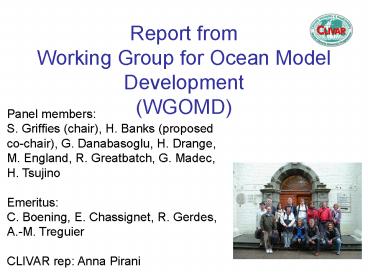
Report from Working Group for Ocean Model
Development (WGOMD)
Panel members S. Griffies (chair), H. Banks
(proposed co-chair), G. Danabasoglu, H. Drange,
M. England, R. Greatbatch, G. Madec, H. Tsujino
Emeritus C. Boening, E. Chassignet, R. Gerdes,
A.-M. Treguier CLIVAR rep Anna Pirani
2
WGOMD Terms of Reference (as of 2005)
- To stimulate the development of ocean models for
research in climate and related fields. - To encourage investigations of the effects of
model formulation on the results of ocean models,
making use of sensitivity studies and
intercomparisons. - To promote interaction amongst the ocean
modelling community and between this and other
communities through workshops and other
activities. - To stimulate the validation of ocean models when
used in stand alone mode and as part of a coupled
ocean-atmosphere model, using oceanographic data
and other methods, and to advise on the
observational requirements of such studies. - To publicise developments in ocean models amongst
the climate modelling community. - To collaborate with other activities in areas of
overlapping responsibility. - To advise on ocean modelling and related issues
and to report on its activities to the JSC/CLIVAR
WGCM and CLIVAR Scientific Steering Group.
3
7th Panel meeting Bergen 25th-27th August 2007
- Organised numerical methods workshop before panel
meeting, August 23-24 - 80 participants
- Discuss and debate novel methods for developing
the next generation of ocean models for global,
regional and coastal applications. - Bring together key practitioners and algorithm
developers for eight provocative and pedagogical
sessions.
4
7th Panel meeting Bergen 25th-26th August 2007
- Joint session with SOPHOCLES project
- Key discussions
- CORE (Coordinated Ocean Reference Experiments)
design and progress - Ocean metrics
5
Key Goals of CORE
- Provide a workable and agreeable experimental
design for global ocean-ice models to be run for
long-term climate studies. - Establish a framework where the experimental
design is flexible and subject to refinement as
the community gains experience and provides
feedback.
6
A Few Problems with Ocean-ice Modelling
- Diversity in Methods, lack of documentation
- Inconsistencies when decouple
- Decoupling ocean-ice from interactive
atmosphere-land exposes the simulations to
spurious instabilities and missed feedbacks,
largely related to ambiguities in how to specify
the hydrological cycle (e.g., mixed boundary
conditions and THC stability). - This problem leads to endless debates about SSS
restoring (e.g., strength of the restoring
normalization of hydrological cycle). - These inconsistencies often do not cause
large-scale problems until 100s of years, but
when look in detail they may prove more
problematic even for short-term. - Ambiguity in Forcing
- Ocean surface fluxes are poorly known.
- Developing a global dataset for running ocean-ice
models is very tough. - Off-the-shelf reanalysis products are not
balanced. - Contrast to the well known SST, making AMIP seem
trivial compared to OMIP.
7
CORE is Not OMIP
- We do not term this an OMIP
- We are unprepared to formally sanction the
present CORE protocol or forcing dataset until
the community has time to provide feedback. - CORE is a research project conducted by
interested scientists. - There is no oversight committee or repository of
simulation output. - An Ocean Model Intercomparison Project (OMIP) may
evolve from CORE, but WGOMD is not prepared yet
to make this recommendation, given the increased
overhead of an OMIP, and continued evolution of
the CORE experimental design.
8
Atmospheric Dataset
- Large and Yeager (2004) Provide a balanced
atmospheric state based on a hybrid of - NCEP reanalysis
- Satellite products
- Adjustments
- Normal year is based on statistical average of 50
year interannual data, plus sample synoptic
variability. - NCAR bulk formulae are used to compute fluxes
based on prescribed atmospheric state and
evolving SST and currents. - Differences in bulk formulae yield large
differences in fluxes, which then corrupt
comparisons. - Many caveats come with Large and Yeager (2004).
Nonetheless, - It continues to be refined based on new data and
input from the modelling community. - It is supported by two modelling centres (NCAR
and GFDL). - Hence, there is good reason for WGOMD to
recommend its use for CORE.
9
Three proposed COREs
- CORE-I 500 year spin-up with repeating Normal
Year Forcing (NYF) (Griffies et al in
preparation). - CORE-II 50 year retrospective with interannually
varying forcing (details of design under
investigation by WGOMD and collaborators). - CORE-III Fresh water melt perturbation
idealizing the melt of water around Greenland
(prototype documented by Gerdes, Hurlin, and
Griffies 2006, Ocean Modelling)
10
Progress with CORE-I
- Griffies et al. paper in preparation-21 authors
from 11 institutions - Project includes seven model groups with three
ocean model classes (geopotential, isopycnal,
hybrid). - Other outcomes
- improved surface flux products
- discussions on bulk formulae
11
Zonal Velocity at Equator Y491-500
12
CORE-I sea ice
13
CORE 1 Atlantic MOC at 45N
14
CORE-II
- Hindcast type experiment with forcing varying
from 1958-2004 (NCAR to update to 2006 by end of
year) - Experiments have already been performed by NCAR,
DRAKKAR consortium - Informal meeting will be arranged to coordinate
community efforts - Other outcomes
- Advice to GSOP on the best choice of surface
forcing for ocean reanalysis
15
Proposed collaboration with Pacific panel on
CORE-II (Magdalena Balmaseda)
- Known model deficiencies in representation of
Pacific in climate models - Upwelling off the South American Coast (winds,
resolution?) - Cold tongue penetrating too far west (winds?
momentum mixing?) - Too weak/too strong east-west slope of the
thermocline - Equatorial heat content (IT/meridional transport,
vertical .. - Pacific panel particularly interested in CORE-II
experiments with additional sensitivity
experiments to determine which are the dominant
source of error - Forcing fields?
- Model parameterizations/configuration?
- Model resolution?
- Parameterization of air-sea interaction?
16
Ocean metrics
- WGOMD has started to set up a Repository for
Evaluating Ocean Simulations (REOS)-digested
summary of metrics, datasets, etc, with comments
and recommendations. - Ocean metrics are being developed by Hadley
Centre, GSOP, GODAE, PCMDI - At panel meeting, presentations on ocean metrics
given by GSOP and Hadley Centre-how can we merge
community efforts to a common standard? - WGOMD intends to work to propose a suitable set
of ocean metrics for model evaluation acceptable
to the community, and in particular of use for
AR5 ocean-ice.
17
Key contributions of WGOMD
- Review paper Pedagogically documents
state-of-art in ocean climate models (Griffies et
al (2000)) - Workshops Topical workshops that facilitate
collaboration, communication, and education - Princeton/GFDL 2004 State-of-art in Ocean
Climate Modelling - Hobart/CSIRO 2005 Southern Ocean Modelling
- Bergen 2007 Numerical Methods for Ocean Models
- CORE Benchmark experiments for global ocean-ice
models. Peer-review paper illustrates CORE-I with
seven ocean-ice models each run for 500 years
(Griffies et al in prep).
18
Future plans
- We have plans for a CORE-II informal gathering
within next 12 months, for those directly
participating in the CORE-II experiments. - WGOMD 8th panel meeting April 2009 at Hadley
Centre - WGOMD workshop on mesoscale eddies April 2009 at
Hadley Centre
19
GSOP proposed Metrics (Detlef Stammer)
- Systematic model-data comparison RMS model data
differences rel. to prior data errors. - Comparison to reference data sets, e.g., surface
fluxes. - Comparison with time series stations.
- Computation of integral quantities.
- Budgets, e.g., heat content and its change.
- Model-Model differences (incl. first guess).
20
Hadley Centre Proposed ocean metrics
- Temperature (SST, X-secns, MLD)
- Salinity (SSS, X-secns)
- Currents (EUC, ACC, Arctic transports)
- Upwelling (Equatorial, Basin upwelling)
- Ocean transports (heat, freshwater)
- Water masses (T-S, formation)
- Budgets (conservation, surface fluxes)
- MOC (overflows, transports, etc)
- SSH (mean, anomaly)
- Mesoscale features (eddy ke, TIWs, Gulf Stream
separation, Agulhas)
21
CORE-III
- Protocol as for CORE-I plus freshwater flux
anomaly of 0.1Sv around Greenland
Recommended

