

Coronal IP Shocks Nat Gopalswamy NASA/GSFC PowerPoint PPT Presentation
Title: Coronal IP Shocks Nat Gopalswamy NASA/GSFC
1
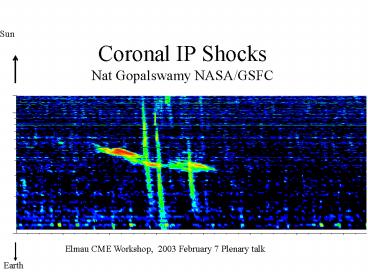
Coronal IP ShocksNat Gopalswamy NASA/GSFC
Sun
Elmau CME Workshop, 2003 February 7 Plenary talk
Earth
2
Plan of the talk
- Type II bursts CMEs
- Type II bursts, SEPs CMEs
- Metric IP type II bursts
- ? Wind/WAVES SOHO/LASCO Data
- ? IP 15 MHz 20 kHz (3Ro 1 AU) 15-1MHz DH
3
Type II Radio Bursts
- Discovered by Payne-Scott et al. (1947) at metric
wavelengths (lt150 MHz). - Malitson et al. (1973) in the IP medium using
spaceborne radio instruments - (see reviews by Cane, Reiner, Gopalswamy in AGU
monograph 119) - Plasma Emission Process is responsible
- - Fast CMEs drive MHD shocks
- - Shock accelerates electrons (10 keV)
- - Nonthermal electrons generate Langmuir waves at
local plasma frequency (fp) - - Langmuir waves scatter off of ions or combine
to produce radio emission at fp (fundamental) and
2fp (harmonic)
4
Radio Sky
coronal
Interplanetary (bounded by Red lines)
Nelson Labrum, 1985)
5
LASCO CME DH Type II
Type II
H
F
CME-driven metric DH type II
SA Event (Type III Bursts)
6
An IP Type II its CME
f 3MHz ? n 2.8x104 cm-3 (harmonic emission)
Type II
Type III
Type II bursts track the CME through the IP medium
7
DH Type II burst starts when the CME reaches 2
Ro
- The RAD2 spectral range (14-1 MHz) Wind/WAVES
correspond to 2-10 Ro ? Type II bursts can
identify shock-driving CMEs in the near-Sun IP
medium. - Too much delay due to accelerating CMEs
- CME delay Disk events
8
All, FW DH CMEs
- gt 5000 CMEs during 1996-2000
- 150 Fast Wide (FW) CMEs
- 150 DH Type II bursts
- 50 FW frontside western CMEs
- 50 Major SEP events
- 1-3 of all CMEs are important for SEPs
- Electron accelerators are also ion accelerators
9
Solar Cycle Variation of Energetic Events
- DH type IIs, fast and wide CMEs and major SEP
events similar solar-cycle variation. - Close correlation implies physical relationship
the same CME-driven shock accelerates electrons
that produce DH type II bursts, and SEPs. - The number of DH type II bursts is the largest
because eastern events are also included. - Minor differences due to other parameters like
Alfven speed.
10
Speeds of CMEs associated with Metric DH type
IIs
Lara et al. 2003, GRL, in press
Average CME speeds increase in this order .
General population (G) . Metric type II related
(M) . DH type II related (D) Similar tendency
for width and acceleration of CMEs
M
D
G
Since DH type II bursts are 100 associated with
CMEs, these properties suggest that metric type
IIs are also due to CMEs, but less energetic
11
Two Shocks from the same source?
Metric domain
- Alfven-speed hump expected based on B, n
profiles in the quiet corona (Hollweg, 1978
Krogulec et al, 1994 Mann et al. 1999) - Include active region 3 regions of interest
(Gopalswamy et al. 2001) - Easy to drive shocks on either side of the
Alfven-speed hump Gopalswamy et al. JGR
(2001). - Easier to shock the corona in the transverse
direction? (Gopalswamy, Kaiser Pick, 2000). - Type IIs occurring to the right of the hump are
likely to be strong and indicative of IP shocks.
fp
12
Example of the metric DH type II (02/12/22)
Hiraiso metric type II
WAVES type II
13
The CME propagates thru a tenuous medium where
Va is expected to be high
14
Summary
- Any short-lived driver with 350 km/s may drive
a shock close to the Sun, but not beyond. - Blast wave 1. Speed declines with time, 2.
Weakens further at the Alfven speed hump. (No
blast waves observed in situ driver-less
shocks are due to limb CMEs!) - CME-driven
- 1. CMEs accelerate low in the corona.
- 2. Depending on CME speed and initial height, CME
can drive shocks in the corona IP medium
(cause metric IP type II) - 3. CME can drive a shock in the metric corona,
lose it around Va peak and drive again in the IP
medium. If it does not drive again (CMEs of
moderate speed), situation similar to blast wave. - 4. Solar wind works against shock-driving
capacity of CMEs in the IP medium - 5. SEP release height (Kahler et al., 1994)
coincides with Va peak
Recommended

