

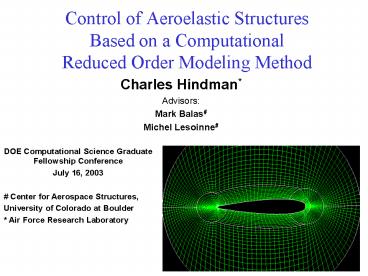
Control of Aeroelastic Structures Based on a Computational Reduced Order Modeling Method PowerPoint PPT Presentation
1 / 31
Title: Control of Aeroelastic Structures Based on a Computational Reduced Order Modeling Method
1
Control of Aeroelastic StructuresBased on a
ComputationalReduced Order Modeling Method
- Charles Hindman
- Advisors
- Mark Balas
- Michel Lesoinne
DOE Computational Science Graduate Fellowship
Conference July 16, 2003 Center for Aerospace
Structures, University of Colorado at Boulder
Air Force Research Laboratory
2
Aeroelastic Instability Flutter
- Flutter occurs when the fluid surrounding a
structure feeds back dynamic energy into the
structure instead of absorbing it. Typically a
structure will be stable up to a limiting
velocity (the flutter velocity) for given
conditions.
- The crash of a F117 Stealth Fighter in 1997 was
linked to flutter (and many others)
3
Flutter Suppression
- Passive Flutter Suppression Techniques
- Local or global stiffening
- Adds weight, cost, requires redesign
- Mass balancing
- Moves components around requires redesign, may
not be feasible - Avoidance
- Requires operation below the flutter velocity
reduces performance - Active Flutter Suppression
- An onboard automatic control system actuates a
control surface to suppress flutter - First tested in 1973 on a B-52 achieved flight
above the flutter speed. Problems with model
accuracy / robustness.
4
Motivation
- We wish to stabilize aeroelastic structures (for
example, to suppress flutter) by using automatic
actuation - Past attempts at flutter suppression have been
based on small empirical and theoretical models
that approximate the aerodynamics - These techniques have had some success, but
suffer from the underlying approximations used in
the aerodynamic models - Several highly accurate computational methods
have been created in recent years to simulate the
time response of aeroelastic systems. - These time integration methods do not easily
provide ways to develop rational control laws
(they are too large and complex). - A model is needed that matches all the relevant
dynamics of a full scale aeroelastic simulation
and yet is still small enough for standard
control design techniques to apply.
5
Computational Aeroelasticity
- The nonlinear computational aeroelastic
simulation used in this research is based on a
3-field approach - Separate fluid and structure codes are used,
coupled by a set of matched interface nodes - A staggered half time step integration is used to
advance the solution in time
6
Modern Control Design
- Most modern linear control theory is based on a
state space system representation - System Controller
- Where
- x system state
- u control input
- y system output
- By design of the gain matrix G we can alter the
response of our system it acts as if it is
more damped, for example
7
Controller Design
- For large systems, the design of the gain matrix
G becomes extremely difficult (plus the
controller becomes slower) - Also, access to the state matrix may be
impossible (no measurements), in which case a
separate model must be developed to estimate the
state from whatever measurements are available
(y).
System
Observer
Controller
8
Reduced Order Modeling
- Reduced Order Modeling is the generic name for a
class of methods that attempt to approximate a
high order (linear or nonlinear) dynamical system
by a very low order, typically linear,
approximation. - A plethora of techniques have been developed for
reduced order modeling - Eigenvalue (Modal) Truncation
- Balanced Model Reduction (Approximate)
- Karhunen-Loeve or P.O.D. (snapshots)
- System ID methods
- Hybrid techniques
- -and many, many more
9
Modal Truncation
- Modal truncation uses a diagonalizing projection
T applied to the (A,B,C) system - The error for the reduced transfer function is
given by - This error bound is problematic for fluid systems!
10
Balanced Reductions
- A Balancing transformation of a system is a
special coordinate transformation that makes the
system grammians equal and diagonal. - This approach takes into account the system
inputs and outputs, which is what we are
interested in. - An error bound on the reduced order model is
given by - For typical systems, si drops off very rapidly.
11
Model Reduction Approach
- Linearization a large scale nonlinear CFD code
is used to create a linearized model about some
steady-state operating point - Structure The structure is reduced to a small
number of modes by eigenmodal truncation - Fluid The linearized fluid is reduced to a small
number of states by an approximate balancing
method, using the coupling with the structure as
the input and output matrices - This results in a reduced order model that
retains the structural modes we wish to control
and the relevant aeroelastic dynamics
12
Linearization
- The nonlinear flux equation is linearized about
an operating point ( uo vo 0, wo w(steady
state) ) - This method only requires access to the numerical
flux function, F(w,y,u), and cell volumes A(u). - The Linearized equations are
- Where
(Farhat, Lesoinne)
13
Approximate Balancing
- There are many algorithms for computing the
balancing transformation matrix directly. - None of these methods are suitable for large,
sparse problems - They form and use the (generally dense) grammians
- Or they use the (generally dense) Cholesky
factors of the grammians - Instead, various approximate methods have been
developed - UASI
- The Laub Gudmundsson algorithm
- Alternating Direction Implicit
- LRCF-ADI
14
ADI
- The Alternating Direction Implicit (LRCF-ADI)
method is an approximate method for solving the
full-rank continuous time Lyapunov equation - The main idea in ADI is to use an iterative
technique that converges rapidly (Peaceman
Rachford, Wachpress) - Where p is a set of shift parameters selected
with some heuristic for rapid convergence.
15
LRCF-ADI
- The Low Rank Cholesky Factorization ADI method
replaces the Xj iterates in the ADI algorithm
with a low rank Cholesky factorization - Where Zj has jm columns, where m is the number
of columns in B or C - There are many advantages to this algorithm
- Never forms the full-scale grammians (preserves
sparsity). - Only requires solutions of (complex, shifted and
transposed) linear systems, which can be
developed from existing simulation codes. - Is easily parallelized
- Converges quickly, as long as the shift
parameters pi are chosen in some (sub) optimal
manner (they approximate the eigenspectrum of A).
16
2-D NACA0012 Airfoil
- This system consists of a rigid airfoil with an
integral flap, restrained by rotational and
vertical displacement springs, in 2-D Euler flow
with 3 - 50,000 DOFs (for different grid
discretizations).
17
NACA 0012 Linearization Results
- The Linearized model produced results almost
identical to the nonlinear model - 1 RMS error over 1 period
Plunge and pitch time response
Pressure around airfoil, linearized model
18
2-D Airfoil-ROM
- The LRCF-ADI method was applied to the linearized
2D NACA0012 airfoil with a trailing edge flap.
The performance of the algorithm on this problem
was excellent, with a convergence history shown
below
19
2-D Airfoil-ROM
- A ROM of size 10 was created from the output of
the LRCF-ADI algorithm. A comparison of this
model with the full scale system is shown for an
initial velocity and an initial flap deflection
RMS errors for 0.5 sec were 1.
20
Modal vs Balanced ROM
- Compare the response to a flap deflection on the
previous slide to the response an n40 state
modal based ROM gives a RMS error of 50 for
the first .5 seconds of a flap deflection (7 for
an initial velocity).
21
2-D Airfoil-Control
- An output feedback state estimator control law
was developed for the airfoil using the 10 state
balanced-based ROM. The following plots show the
uncontrolled model (top) and controlled system
(bottom).
22
2-D Airfoil/Flap-Control
- The same control law was applied to the full
scale linear and nonlinear models, with the
linearized on the left and the nonlinear on the
right.
No Control
Controlled
Animations
23
2-D Airfoil/Flap Robustness
- To test the range of applicability of the
controlled system, the nonlinear simulation with
the controller was used to test the following
conditions - Grid dependence The controller was applied to
800, 3000, and 12,000 node models (all
unstructured grids). - Flight speed tested at Mach 0.5, 0.75, 0.9, and
0.95. - Angle of Attack tested at 0, 5, 10, and 15
degrees (stall limit). - This was all done using the same controller,
built around a linearized model at Mach 0.5 and 0
angle of attack. - Creating multiple models at different
linearization points and using gain scheduling or
some other adaptive technique would produce
better results
24
2-D Airfoil/Flap Robustness
- Example results
- Left 15 degree angle of attack (near-stall)
- Right Operation at Mach 0.9 (Flutter conditions)
25
3-D AGARD Wing
- This systems consists of a flexible Agard wing in
3-D Euler flow with 110,000 DOFs.
26
AGARD Wing Continued
- The model is based on a parallel non-linear
aeroelastic simulation. The the first 8
structural modes were used as a basis for
developing a parallel linearized model.
27
AGARD Linearization Results
- The lift response to a forced oscillation (left)
and an initial velocity (right) is shown for both
the nonlinear and linearized AGARD models.
28
3-D Results
- The LRCF-ADI algorithm was implemented on the
AGARD wing model with a trailing edge flap (seen
below). This required developing a parallel
version on the algorithm, and modifying the
simulation code to allow complex and transposed
operations. - The relative convergence of the largest
eigenvalue of WcWo was rapid.
29
3-D Results
- The results from the LRCF-ADI algorithm were used
to construct a 2 state ROM, which is compared to
the full order model below for an initial modal
velocity input. The RMS error for the first 0.1
sec was 4.6. - A 13 state ROM of the wing with a flap gives a
1.6 RMS error for the response to a flap
deflection (shown on the left) - Operation count 218 linear solves, 70 mat-vec
multiplications
30
3-D Control
- An output feedback state estimator controller was
constructed based on the reduced order model to
stabilize the system. ROM (left) and FOM (right)
uncontrolled and controlled responses are shown
below.
31
Future Work
- Possible extensions to this work include
- Adaptive controllers based on one or several
ROMs - Use of the ROMs for flutter prediction
- Integration of a control law to the 3D nonlinear
parallel code - Improvements to the parallel LRCF-ADI algorithm
(error tracking)
Recommended

