

Advancing Computational Science Research for Accelerator Design and Optimization PowerPoint PPT Presentation
1 / 1
Title: Advancing Computational Science Research for Accelerator Design and Optimization
1
Advancing Computational Science Research for
Accelerator Design and Optimization
Accelerator Science and Technology - SLAC, LBNL,
LLNL, SNL, UT Austin, Columbia, RPI, Stanford, UC
Davis, U Wisconsin
The SciDAC Accelerator project at SLAC is
committed to advancing computational science
research which is absolutely essential to the
success of LARGE scale electromagnetic
simulations that are necessary for the design and
optimization of DOE accelerators such as the
International Linear Collider (ILC). In order to
be able to model an entire, realistic ILC
cryomodule, petaflops-scale computing resources
will be needed as well as advances in shape
determination, nonlinear eigensolvers and
adaptive refinement.
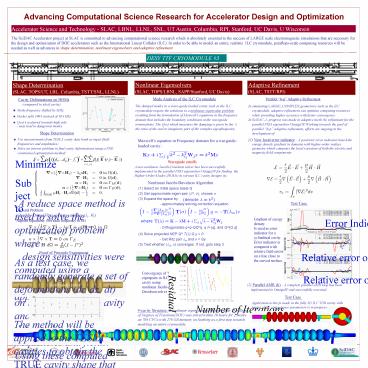
DESY TTF CRYOMODULE 3
Nonlinear Eigensolvers (SLAC,
TOPS/LBNL, SAPP/Stanford, UC Davis))
Adaptive Refinement (SLAC,
TSTT/RPI))
Shape Determination (SLAC, TOPS/UT, LBL,
Columbia, TSTT/SNL, LLNL)
- Mode Analysis of the ILC
Cryomodule - The damped modes in a wave-guide loaded cavity
such as the ILC cryomodule require the solutions
to a nonlinear eigenvalue problem resulting from
the formulation of Maxwells equations in the
frequency domain that includes the boundary
conditions at the waveguide terminations. The
Qext which measures the damping is given by the ½
the ratio of the real to imaginary part of the
complex eigenfrequency.
- Parallel h-p Adaptive
Refinement - In simulating LARGE, COMPLEX geometries such as
the ILC cryomodule, adaptive refinement can
optimize computing resources while providing
higher accuracy with faster convergence. - In SciDAC-1, progress was made in adaptive mesh
(h) refinement for the parallel FEM eigensolver
Omega3P. Working towards the goal of parallel
h-p adaptive refinement, efforts are ongoing in
the development of - (1) New local error indicator A posterior error
indicator based the energy density gradient in
domains with higher-order surface geometry which
computes the local variation of both the electric
and magnetic field components
- Cavity Deformations on HOMs
- (compared to ideal cavity)
- Mode frequency shifted by MHz
- Modes split 100s instead of 10s kHz
- Qexts scattered towards high side
- - may lead to dangerous modes
- Shape Determination
- Use measurements from TESLA cavity data bank as
input (field - frequencies and amplitudes)
- Solve an inverse problem to find cavity
deformations using a PDE - constrained optimization method
Maxwells equation in Frequency domain for a
wavguide-loaded cavity
Waveguide cutoffs
A new nonlinear Jacobi-Davidson solver has been
successfully implemented in the parallel FEM
eigensolver Omega3P for finding the
Higher-Order-Modes (HOMs) in various ILC cavity
designs ity.
Nonlinear Jacobi-Davidson Algorithm
- (1) Select an initial space basis Q
- (2) Get approximate eigen-pair (?m, v), choose ?
- (3) Expand the space by
- - approximately solving correction equation
- - Orthogonalize qq-QQHq, q / q, and QQ q
- (4) Solve projected NEP QH T(?) Q y 0
- - Get Ritz pair ?m and v Qy
- (5) Test whether (?m, v) converges. If not, goto
step 3
- A reduce space method is used to solve the
optimization problem where - design sensitivities were computed using a
continuous adjoint approach
Test Case
Gradient of energy density Is used as error
indicator for a cylindrical cavity. Error
indicator is compared with relative field errors
on a line close to the curved surface.
- Proof of Principle
Experiment - As a test case, we randomly generate a set of
deformations (dr, dz, dt) on the ideal TESLA
cavity and computed the deformed cavity
frequencies and fields. Using these computed
results, we apply our shape determination tool to
solve the inverse problem and fully recover the
set of deformations
(2) Parallel AMR (h) A complete parallel AMR
loop has been implemented in Omega3P and
successfully executed.
9-cell model cavity
Test Case
Application to the pi mode in the fully 3D ILC
TDR cavity with tuning of the convergence
parameters is in progress
4-cavity Structure A nonlinear eigensystem with
more than 15 million of Degrees of Freedoms(DOF)
was solved within 10 hours for 2 modes on 768
CPUs with 276 GB memory on Seaborg as a first
step towards modeling an entire cryomodule.
The method will be applied to the TESLA cavities
to obtain the TRUE cavity shape that corresponds
to the measured frequencies and Qexts.
Recommended

