

Control of methane hydrate formation at the molecular level PowerPoint PPT Presentation
1 / 1
Title: Control of methane hydrate formation at the molecular level
1
Control of methane hydrate formation at the
molecular level
Tadanori Koga, Department of Materials Science
and Engineering, Stony Brook University
Natural gas hydrates owe their existence to the
ability of water molecules to assemble via
hydrogen bonding and form polyhedral cavities in
which trapped methane molecules reside. Though
initial interest in understanding gas hydrate
formation focused on flow assurance to avoid gas
pipeline plugging, it is now being considered for
applications such as an alternative to
desalination technology, potentially a huge
natural gas reserve, and natural gas transport
alternative to liquefied natural gas (LNG) due to
high energy density. A recognizable problem in
utilizing the versatility of gas hydrate route is
the uncertainty in the hydrate formation process
that can take from few minutes to several days.
This proposal seeks to undertake a fundamental
study to help understand the hydrate nucleation
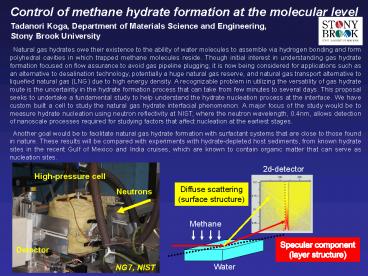
process at the interface. We have custom built a
cell to study the natural gas hydrate interfacial
phenomenon. A major focus of the study would be
to measure hydrate nucleation using neutron
reflectivity at NIST, where the neutron
wavelength, 0.4nm, allows detection of nanoscale
processes required for studying factors that
affect nucleation at the earliest stages.
Another goal would be to facilitate natural gas
hydrate formation with surfactant systems that
are close to those found in nature. These results
will be compared with experiments with
hydrate-depleted host sediments, from known
hydrate sites in the recent Gulf of Mexico and
India cruises, which are known to contain organic
matter that can serve as nucleation sites.
2d-detector
High-pressure cell
Diffuse scattering (surface structure)
Neutrons
Methane
Specular component (layer structure)
Detector
Water
NG7, NIST
Recommended

