

A Fast Algorithm for Generalized Van Vleck Perturbation Theory PowerPoint PPT Presentation
1 / 1
Title: A Fast Algorithm for Generalized Van Vleck Perturbation Theory
1
A Fast Algorithm for Generalized
Van Vleck Perturbation Theory
Wanyi Jiang, Yuriy G. Khait,
Alexander V. Gaenko, and Mark R. Hoffmann
Chemistry Department,
University of North Dakota, Grand Forks, ND
58203-9024
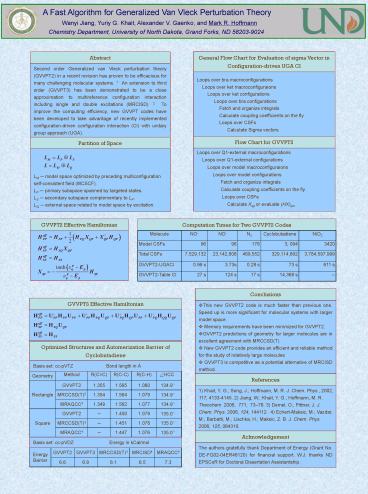
General Flow Chart for Evaluation of sigma Vector
in Configuration-driven UGA CI
Abstract
Second order Generalized van Vleck perturbation
theory (GVVPT2) in a recent revision has proven
to be efficacious for many challenging molecular
systems. 1 An extension to third order (GVVPT3)
has been demonstrated to be a close approximation
to multireference configuration interaction
including single and double excitations (MRCISD).
2 To improve the computing efficiency, new GVVPT
codes have been developed to take advantage of
recently implemented configuration-driven
configuration interaction (CI) with unitary group
approach (UGA).
Loops over bra macroconfigurations Loops
over ket macroconfiguraions Loops over
ket configurations Loops over bra
configurations
Fetch and organize integrals
Calculate coupling coefficients on the fly
Loops over CSFs
Calculate Sigma vectors
Flow Chart for GVVPT2
Partition of Space
Loops over Q1-external macroconfigurations
Loops over Q1-external configurations
Loops over model macroconfiguraions
Loops over model configurations
Fetch and organize integrals
Calculate coupling coefficients on the fly
Loops over CSFs
Calculate Xqp or evaluate (HX)qm
LM - model space optimized by preceding
multiconfiguration self-consistent field
(MCSCF). LP - primary subspace spanned by
targeted states. LS - secondary subspace
complementary to LP . LQ - external space
related to model space by excitation.
GVVPT2 Effective Hamiltonian
Computation Times for Two GVVPT2 Codes
Conclusions
GVVPT3 Effective Hamiltonian
- This new GVVPT2 code is much faster than previous
one. Speed up is more significant for molecular
systems with larger model space. - Memory requirements have been minimized for
GVVPT2. - GVVPT2 predictions of geometry for larger
molecules are in excellent agreement with
MRCCSD(T). - New GVVPT2 code provides an efficient and
reliable method for the study of relatively large
molecules - GVVPT3 is competitive as a potential alternative
of MRCISD method.
Optimized Structures and Automerization Barrier
of Cyclobutadiene
Basis set cc-pVTZ Bond
length in Å
References
1) Khait, Y. G. Song, J. Hoffmann, M. R. J.
Chem. Phys., 2002, 117, 4133-4145. 2) Jiang, W.
Khait, Y. G. Hoffmann, M. R. Theochem 2006,
771, 7378. 3) Demel, O. Pittner, J. J. Chem.
Phys. 2006, 124, 144112. 4) Echert-Maksic, M.
Vazdar, M. Barbatti, M. Lischka, H. Maksic, Z.
B. J. Chem. Phys. 2006, 125, 064310.
Acknowledgement
Basis set cc-pVDZ
Energy in kCal/mol
The authors gratefully thank Department of Energy
(Grant No. DE-FG02-04ER46120) for financial
support. W.J. thanks ND EPSCoR for Doctoral
Dissertation Assistantship.
Recommended

