

Validation of Detached Eddy Simulation in a Planetary General Circulation Model PowerPoint PPT Presentation
1 / 1
Title: Validation of Detached Eddy Simulation in a Planetary General Circulation Model
1
Validation of Detached Eddy Simulation in a
Planetary General Circulation Model V. K.
Parimi, R. P. LeBeau, University of Kentucky T.E.
Dowling, University of Louisville
Atmospheric turbulence is a critical in many
meteorological phenomena, from the planetary
boundary layer (PBL) on Earth to eddy viscosity
mixing parameterizations used in atmospheric
chemistry. For turbulence effects away from
planetary surfaces, a favored technique for
modeling turbulence in atmospheric models is
Large Eddy Simulation (LES). For the PBL, there
is a plethora of numerical models designed to
capture the dynamics often through highly
parameterized models that rely on data
measurements of the atmosphere. As PBL data is
only realistically available for Earth
(extensive) and Mars (limited), recalibrating
such models for new environments like Venus,
Titan, or Triton is a challenge. The objectives
of this project are to reduce the dependence of
the PBL model on in situ data so that it is more
readily cross-applicable to many planetary
systems and to create a unified model that
provides turbulence closure from the PBL to the
upper atmosphere. Our approach is to draw on
recent advances in engineering turbulence
research by employing the detached-eddy
simulation (DES) concept Spalart et al., 1997.
Our attraction to DES is threefold it is able to
reproduce benchmark and practical engineering
turbulent flows with a high degree of success, it
readily fits into eddy viscosity closure models,
and it transits smoothly from a Reynolds-Averaged
Navier-Stokes (RANS) model in the PBL to a LES
model aloft. Presented results focus on the
incorporation of the DES approach into the
multi-planet EPIC atmospheric model Dowling et
al., 2004 and efforts to validate the model,
including reconfiguring EPIC to simulate
benchmark engineering flows. This allows for a
more precise assessment of the model capabilities
than typically more qualitative comparisons
against geophysical data.
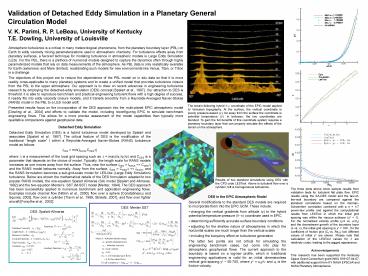
The terrain-following hybrid q-s coordinate of
the EPIC model applied to Venusian topography. At
the surface, the vertical coordinate is purely
pressure-based (s) far away from the surface the
coordinate is potential temperature (q). In
between, the two coordinates are blended. To gain
the full benefits of this coordinate system
requires a planetary boundary layer that can
properly simulate the effects of the terrain on
the atmosphere.
Detached Eddy Simulation Detached Eddy
Simulation (DES) is a hybrid turbulence model
developed by Spalart and associates Spalart et
al., 1997. The critical feature of DES is the
modification of the traditional length scale l
within a Reynolds-Averaged Navier-Stokes (RANS)
turbulence model as follows lDES
min(lRANS,CDESD) where D is a measurement of
the local grid spacing such as D max(dx,dy,dz)
and CDES is a parameter that depends on the
choice of model. Typically, the length scale for
RANS models increases as one moves away from the
surface. Thus, near the surface lDES lRANS ltlt
CDESD and the RANS model behaves normally. Away
from the surface, lDES CDESD ltlt lRANS, and the
RANS formulation becomes a sub-grid-scale model
for LES-like (Large Eddy Simulation) turbulence.
Below are shown the mathematical details of the
DES formulation adapted to two popular RANS
models, the one-equation Spalart Allmaras (SA)
model Spalart and Allmaras, 1992 and the
two-equation Menters SST (M-SST) model Menter,
1994. The DES approach has been successfully
applied to numerous benchmark and application
engineering flows. Examples include channel flow
Nitikin et al., 2000, flow over a sphere
Constatinescu and Squires, 2002, flow over a
cylinder Travin et al., 1999 Strelets, 2001,
and flow over fighter aircraft Forsythe et al.,
2002.
Results of two standard simulations using DES
with the CFD code LESTool. Above is turbulent
flow over a cylinder left is homogeneous
turbulence.
The three plots above show sample results from
validation tests for turbulent flat plate flow.
EPIC results using the SA-DES model and the
law-of-the-wall boundary are compared against the
standard correlations based on the
Karman-Schoenherr correlation combined with a n
1/7 power-law profile and against the
computational results from LESTool in which the
initial grid spacing was within the viscous
sublayer (y lt 1). For the normalized velocity
profile (y/d vs. u/Ue) and the downstream growth
of the boundary layer (d vs. x), the initial grid
spacing is y 100 for the coefficient of
friction plot (Cf vs. Req), two different values
of initial y are shown. Please note that
calculation of the LESTool values for d are
relatively crude, leading to the jagged
appearance.
- DES in the EPIC Atmospheric Model
- Several modifications to the standard DES models
are required to incorporate them into the EPIC
GCM. These include - changing the vertical gradients from altitude
(z) to the hybrid potential temperature-pressure
(q-s) coordinate used in EPIC - determining sufficiently accurate surface
boundary conditions - adjusting for the shallow nature of atmospheres
in which the horizontal scales are much longer
than the vertical scales - including the buoyancy effect on turbulence
generation - The latter two points are not critical for
simulating the engineering benchmark cases, but
come into play for atmospheric geophysical flows.
The current approach to the boundary is based on
a log-law profile, which in traditional
engineering applications is valid for an initial
dimensionless vertical grid spacing y 50-700,
where y uty/n and ut is the friction velocity.
DES Menter SST
Acknowledgements This research has been
supported the Kentucky Space Grant Consortium
grant WKU 516107-04-07, with additional support
from KY NASA EPSCoR and NASA Planetary
Atmospheres.
Recommended

