

Observing Subpolar Ocean Circulation with Seagliders: Winter 20032004 Charlie Eriksen, Peter Rhines PowerPoint PPT Presentation
1 / 1
Title: Observing Subpolar Ocean Circulation with Seagliders: Winter 20032004 Charlie Eriksen, Peter Rhines
1
Observing Subpolar Ocean Circulation with
Seagliders Winter 2003-2004 Charlie Eriksen,
Peter Rhines University of Washington
Global climate variability is affected by
events at the rim of the Arctic ocean water
masses are modified here, transports of
liquid freshwater, ice and heat are
strong, atmosphere-ocean interaction is strong,
and yet direct observations are sparse.
Following development supported by ONR, a new
NOAA program is aimed at observing the system
with unprecedented coverage.
Labrador
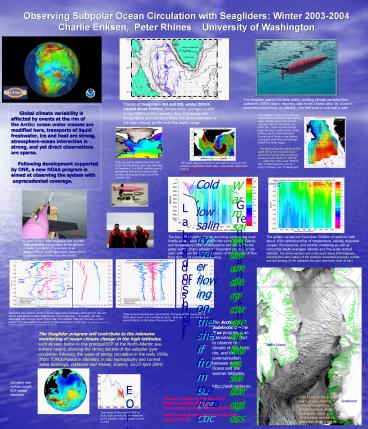
The two gliders wintered over, surviving some of
the most hostile winds, waves and cold in the
world ocean. Salinity and temperature (colored
perspective plot above) on the glider section
from Labrador to Greenland provides a cat-scan
with 3 km horizontal resolution of the arteries
of flow from Arctic and subtropical sources.
The gliders carried out more than 5000km of
sections with about 1550 vertical profiles of
temperature, salinity, dissolved oxygen,
fluorescence, and particle scattering as well as
horizontal depth-averaged velocity and fine-scale
vertical velocity. The above section runs
north-south along 55W longitude, showing the warm
waters of the Irminger Greenland boundary current
and the doming of the Labrador Sea gyre (see
track chart at top).
Seagliders also measure vertical velocity, as a
residual between observed sink rate and vehicle
glide characteristics here intense vertical
velocities, 6 cm/sec, are seen associated with
internal waves. This is near the Labrador shelf
and boundary current system. The temperature and
salinity profiles are shown on the right. (the
red/purple curves are w, the difference between
observed and predicted sink or rise rate).
These vertical velocities are characteristic of
intense winter convection to 300m depth (see T
and S profiles at right). Note the change in
character of vertical velocity at the base of the
mixed layer.
The Arctic SubArctic Ocean Flux program is an
international effort to observe the climate of
the Arctic rim, and the communication between
Arctic Ocean and the warmer latitudes.
http//asof.npolar.no
The Seaglider program will contribute to the
intensive monitoring of ocean climate change in
the high-latitudes, such as seen below in this
principal EOF of the North Atlantic sea-surface
height, showing the strong decline of the
subpolar gyre circulation following the years of
strong circulation in the early 1990s (from
TOPEX/Poseidon altimetry, in situ hydrography and
current meter moorings, Häkkinen and Rhines,
Science, 16/23 April 2004)
Baffin Island
Greenland
Baffin Island
altimetric sea-surface height EOF spatial
structure
EOF timeseries
Cold Arctic air flows over warm ocean, making
convective warming of the atmosphere while
cooling the ocean, driving deep convection and
water mass creation
Thanks to NOAA Arctic Research Office and ONR
Physical Oceanography for program
support www.ocean.washington.edu/research/gfd/gfd.
html
Greenland
Time series of the principal EOF (in blue), and
currents directly measured at the Labrador deep
boundary current (in red)
Recommended

