

Cooking Cooperatively at Shun Robert C Marshall, Anthropology Department, Western Washington Univers PowerPoint PPT Presentation
1 / 1
Title: Cooking Cooperatively at Shun Robert C Marshall, Anthropology Department, Western Washington Univers
1
Cooking Cooperatively at ShunRobert C
Marshall, Anthropology Department, Western
Washington University, Bellingham, WA 98225
V. Analysis A. If culture is symbolic, so is
how people cook B. Symbols pattern public
action based on local, interested
knowledge rather than communication encoded,
disinterested meanings C. Technical knowledge,
tropical associations and strategic
action all fuse in symbols D. Multi-vocality
of symbols allows concerted action
without 1. An explicit consensual
interpretation or gloss of the
meaning of the action, or 2. Belying
strategic plausible deniability E. Shuns
cooks cook with 1. a high degree of energy,
enthusiasm, skill and mutual confidence
in a setting in which 2. acts of aggressive
egoism are forestalled and 3. accusations of
aggressive egoism are avoided
III. What are some results of cooking this
way? A. No bosses B. No stars C. High
mutual confidence D. Consistent characteristic
taste
I. Who is Shun? A. 14 middle-aged,
middle-income housewives, all B. Members
of Seikatsu Club Consumer Co-operative, who
have started C. A worker owned and managed
lunch delivery restaurant (shidashi
bentoya) D. Dedicated to high quality,
wholesome, home cooking, and who work as
E. A self-managed, egalitarian, part-time
labor force.
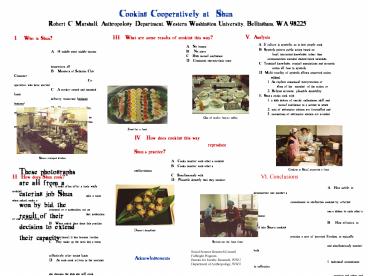
One of twelve festive tables
Food for a feast
IV. How does cooking this way reproduce
Shuns practice? A. Cooks monitor each others
cooking B. Cooks monitor each others
egalitarianism C. Simultaneously with D.
Plausible deniably that they monitor.
Shuns cramped kitchen These photographs are all
from a catering job Shun won by bid, the result
of their decision to extend their capacity.
Cooking at Shun preparing a feast
II. How does Shun cook? A. Cooks often offer a
taste while cooking, take a taste when asked,
make a comment or a suggestion, act
on that suggestion or ask a second cook. B.
When asked, they deny this practice any
importance it has become routine. C. They make
up the next days menu collectively after
eating lunch. D. As each cook arrives in the
morning, she chooses the dish she will
cook. E. Every combination of cooks, from 4 to
12, 1. Cooks any of 200 dishes 2. Without
written recipes 3. In batches of 50 to 300
servings 4. From menus they did not make
and 5. Ingredients they did not buy.
VI. Conclusions A. How subtle, to
demonstrate one anothers commitment to
egalitarian cooking by offering ones dishes
to each others judgment. B. How effective,
to build into Shuns cooking practice a sort
of inverted Fordism, to mutually and
simultaneously monitor both 1. individual
commitment to collective practice and
ethos, and 2. Quality control in a highly
variable labor force 3.
Tacitly C. These data were gathered in 1994,
Shuns fourth year in business. Shun
continues in 2004, prospering thru more than a
decade of stagnation in the wider economy.
Dessert dumplings
Setting out the feast food
Social Science Research CouncilFulbright
ProgramBureau for Faculty Research, WWU
Department of Anthropology, WWU
Acknowledgements
Recommended

